Last updated:
Disclosure: As an Amazon Associate we earn from qualifying purchases. This does not change what we recommend. See our affiliate disclaimer.
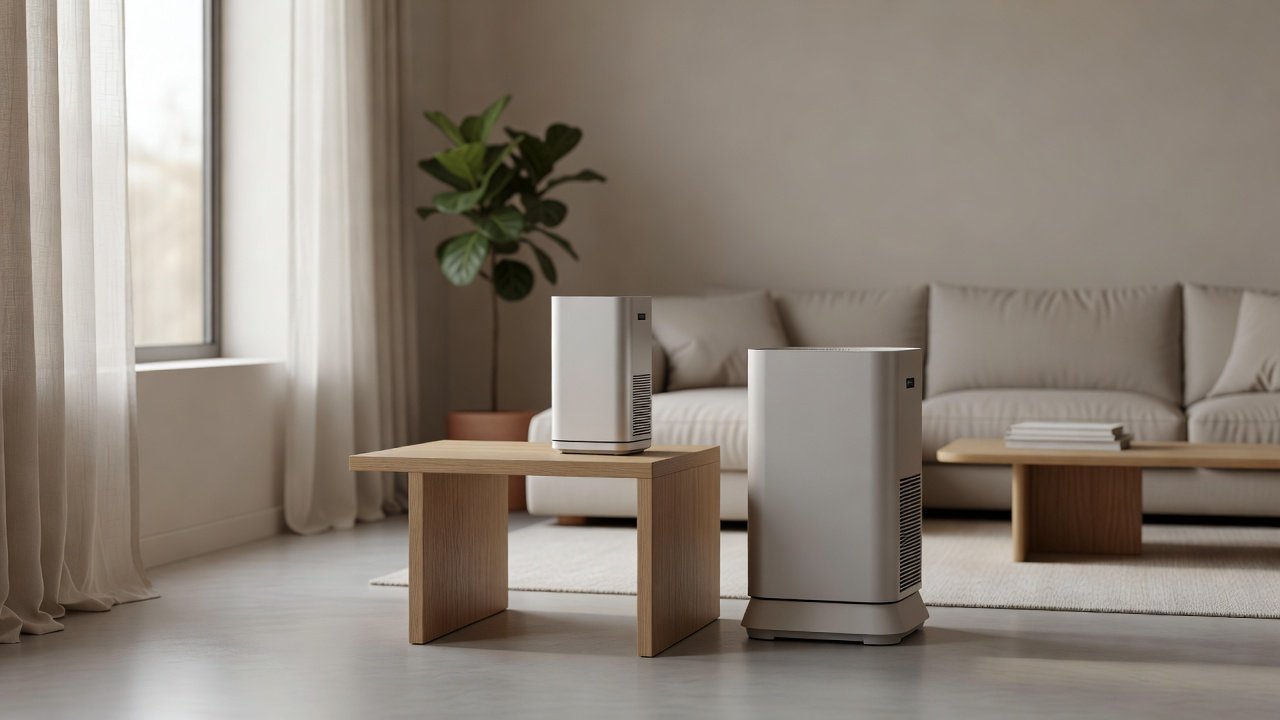
Compact air purifiers are small enough for a desk, nightstand or kitchen counter and are easy to move from room to room. Larger models have bigger filters and stronger fans, so they can clean a whole bedroom or living area quickly. The right size is less about taste than about arithmetic: how many cubic feet of air you need to filter and how fast.
This guide compares the two on capacity, noise, filters, portability, placement and cost of ownership. We have not tested these products ourselves, we do not list prices and specifications differ by model, so confirm details on each manufacturer’s product page.
Compact fits
- Desks, nightstands and small rooms
- Portability between spaces
- Tight budgets and limited floor space
Larger fits
- Bedrooms over about 200 sq ft and living areas
- Allergy, smoke or pet-dander concerns
- Quieter operation at low speeds
Key Takeaways
- Choose by smoke CADR and room size, not by how big or small the machine looks.
- The AHAM rule: smoke CADR of about two-thirds of floor area for an eight-foot ceiling.
- Compact units are right for desks, nightstands and small rooms; larger units suit bedrooms and living areas.
- An undersized unit runs on high and is louder, so going one size up often means quieter use.
- Check filter cost, clearance and noise at your working speed before buying.
Examples by Room Size
Take a 120 square foot home office. A smoke CADR near 80 meets the two-thirds rule, which many compact and mid-sized units can reach. A 180 square foot primary bedroom needs about 120, so a compact unit with CADR in the double digits will be undersized and a mid-sized model is a better match. A 350 square foot living room needs a smoke CADR around 230, which points to a large unit or two mid-sized ones.
Ceiling height changes the numbers. For every extra foot of ceiling above eight feet, add roughly 12 percent to the CADR you need. A room with vaulted ceilings or a basement with low ceilings should be calculated by volume, not floor area. A simple check: air changes per hour equals CADR times 60 divided by the room volume in cubic feet.
Portability and Everyday Use
A compact purifier can follow you from the kitchen to the office to the bedroom, but moving it means each room is only cleaned while it is there. Particle levels rebound quickly when the unit leaves. If you want steady results, assign a unit to each main room and leave it running.
Weight matters. Larger units can weigh well over 15 pounds and may have no carry handle. If you have mobility concerns or move furniture often, check the weight and handle design before ordering.
Final Checklist
Measure the room, compute the CADR you need, compare noise at the speed required, check filter cost and replacement interval, and confirm that the exact model is still sold. Specifications and availability change, so trust the manufacturer’s current page over any summary. This article gives general information and is not medical advice; if you have a respiratory condition, talk to your clinician about the best steps for your home.
Cost of Ownership Over Several Years
The sticker price is the smaller part of the story. Over three to five years you will replace filters several times, and the filter often costs a meaningful share of the unit itself. Smaller units usually have cheaper filters but need replacing more often because they are loaded harder relative to their size. Larger units tend to have bigger, pricier filters that last longer.
A fair comparison divides the annual filter cost by the area the unit can actually clean. We do not list prices, so look at current figures on the retailer page. Also consider power use, since a unit running at a low speed all year uses less electricity than a small unit stuck on high.
Mistakes to Avoid
Buying by appearance is the first mistake. A slim, attractive unit may have a small filter and a weak fan. Another mistake is relying on the room-size claim without checking how it was calculated: many labels use a low air-change rate that makes the room look larger than the unit can clean quickly. Compare claims on the same basis using CADR.
People also place compact units on the floor behind furniture, which blocks intake. Put the unit where air can reach it, at least a short distance from walls, and keep pets and children away from the vents. Lastly, do not forget replacement: a purifier with an overdue filter does little, whatever its size.
When to Choose Both
Some households benefit from one larger unit in the main room and a compact unit in a secondary space such as a home office or nursery. This avoids carrying equipment around and keeps both spaces covered. If budget is tight, begin with the room where you spend the most hours, usually the bedroom, and add a second unit later.
Air Purifiers to Compare
The table below lists purifiers from our affiliate partner. Compare smoke CADR and rated room sizes across compact and larger models, and check dimensions for your space.
Side-by-Side Comparison
The table summarizes typical differences. Individual models vary.
| Factor | Compact | Larger |
|---|---|---|
| Typical CADR | Lower | Higher |
| Room fit | Small rooms, personal zones | Bedrooms and living areas |
| Portability | Easy | Heavier |
| Filter size and life | Smaller, often shorter life | Larger, often longer life |
| Noise at needed airflow | Often louder | Often quieter |
| Footprint | Small | Larger |
Capacity Is the Deciding Factor
CADR measures how much filtered air a purifier delivers. A common rule from AHAM is that smoke CADR should be around two-thirds of the room’s floor area for an eight-foot ceiling, which gives about 4.8 air changes per hour. A 100 square foot room needs a smoke CADR near 67, a 200 square foot room near 133 and a 300 square foot room near 200.
Many compact models have CADR figures below 100, so they match small rooms or personal zones. Larger models often reach 200 or more, which is why they are the better fit for big rooms. Always compare the CADR, not the physical size, because a small unit with a strong fan can outperform a larger one that is poorly designed.
Noise and Fan Speed
A compact unit that is too small for the room has to run on high, which is louder. A larger purifier can deliver the same airflow at a lower speed, which tends to be quieter. Look for decibel ratings at low, medium and high speeds, and pay attention to the level at the speed you will actually use.
Where Compact Units Shine
Compact purifiers are useful where you want a personal bubble of cleaner air. A desk in a home office, a nightstand in a small bedroom, a baby changing area or a dorm room are typical uses. They are easy to carry, light on electricity and often cheaper to run and replace.
They are also helpful as a second unit in a home that already has a larger purifier in the main living space. Be realistic, though: a unit rated for a few dozen square feet will not clean a large room just because it is running.
Where Larger Models Shine
Larger purifiers handle open-plan areas, big bedrooms and basements. Bigger filters tend to last longer between replacements and hold more particles before airflow drops. The extra mass also means they are less likely to tip, and they usually have more speed settings.
Their drawbacks are space, weight and a higher up-front cost. If you rent or move often, a mid-sized unit that fits through doors and sits easily in different rooms may be a better balance.
Placement and Clearance
Whichever size you choose, leave a few inches to a foot of clearance around vents and avoid putting the unit in a corner behind furniture. Do not place it on soft surfaces that can block bottom intakes. Keep it a few feet from your bed or couch rather than blowing directly on you, and run it with doors closed for best results.
Filters, Carbon and Maintenance
Compact units use smaller HEPA and carbon filters, so they load faster, particularly in kitchens or homes with pets. Check how often the manufacturer recommends replacement and how much each filter costs. Carbon layers help with some odors but are not a replacement for ventilation. Vacuum or rinse washable pre-filters according to the manual.
A Note on Multiple Units
Two compact units in separate rooms can cover more of a home than one large unit in a single room, because purifiers do not clean through closed doors. If you spend the day in the living room and the night in the bedroom, consider one purifier for each rather than moving one around.
How to Choose
- Measure the room and compute the smoke CADR you need.
- Check noise at the speed that CADR requires.
- Compare filter cost and replacement interval.
- Check clearance requirements for the intake and outlet.
- Avoid ozone-generating modes; the EPA advises against ozone-emitting air cleaners.
Do
- Match the unit’s rated coverage to your room first
- Run it consistently, not only when the air feels bad
- Leave space around the unit for airflow
- Replace filters on the maker’s schedule
Don’t
- Do not buy on looks or price alone
- Do not block the intake or exhaust
- Do not skip filter changes
- Do not expect a purifier to fix every source of pollution
Honest Limits
- This guide uses manufacturer information and public guidance from the EPA and AHAM, not our own lab tests.
- Features and room ratings change between model years, so confirm on the listing before you buy.
- A purifier is not a medical device and does not replace medical advice or treatment.
Who Should Skip This
When to See a Professional
Frequently Asked Questions
How do I know if a compact purifier is big enough?
Compare its smoke CADR with about two-thirds of your room’s floor area for eight-foot ceilings. If the CADR is lower than that, it will clean the room more slowly.
Are larger purifiers quieter?
They can be, because they deliver the same airflow at a lower fan speed. Compare decibel ratings at the speed you will use.
Can I use a compact purifier in a bedroom?
Yes, if the CADR matches the bedroom size or you use it as a personal unit near the bed in a small room.
Do bigger purifiers use more electricity?
Often at maximum speed, yes, but at the same airflow they can use similar or less power. Check the wattage at your working speed.
Is one big unit better than two small ones?
It depends on the layout. Closed doors limit cleaning across rooms, so two units can be better for separate spaces.
Bottom Line
Pick the smallest unit that still delivers the CADR your room needs, not the smallest unit available.
If you are between sizes, go up, since a larger unit can run quietly at a lower speed.
Related reading: sens,fan,bed
Sources: EPA, Guide to Air Cleaners in the Home; AHAM Verifide.