Last updated:
Disclosure: As an Amazon Associate we earn from qualifying purchases. This does not change what we recommend. See our affiliate disclaimer.
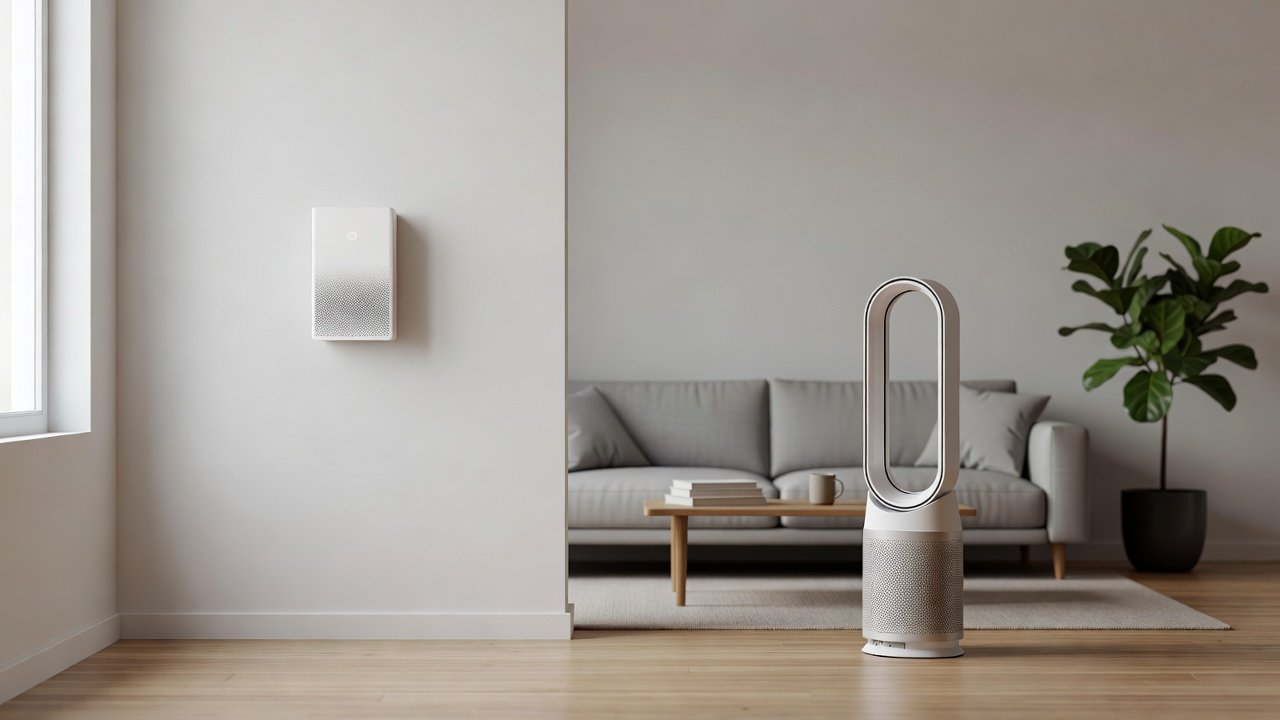
Wall-mounted air purifiers save floor space and keep the unit out of reach of children and pets. Floor-standing models are easier to set up, easier to move and come in a much wider range of sizes and capacities. Neither design is better in every home. The right choice depends on your room, your walls, your airflow needs and how much you want to do during installation.
This guide covers the practical differences: capacity, placement, installation, noise, filter access and cost of ownership. It does not list prices, because they change often, and we have not tested these products ourselves. Always confirm specifications and mounting requirements on the manufacturer’s product page before you buy.
Wall-mounted fits
- Small rooms with little free floor
- Homes with toddlers or pets that knock things over
- Buyers comfortable drilling into a wall
Floor-standing fits
- Renters or anyone who wants no installation
- Large rooms that need high CADR
- Moving the unit between rooms
Key Takeaways
- Floor-standing purifiers are simpler to set up and cover the widest range of room sizes.
- Wall-mounted purifiers save floor space and keep the unit away from children and pets, but they are usually aimed at smaller rooms.
- Match smoke CADR to roughly two-thirds of floor area for eight-foot ceilings, whichever design you choose.
- Check mounting requirements, cord routing and filter access before you buy a wall unit.
- Renters should confirm whether drilling is allowed; a floor unit avoids the problem.
Cost of Ownership Beyond the Sticker
The upfront price is only part of the cost. Add the filter replacement schedule, the electricity used over a year and, for wall units, the cost of mounting hardware or professional installation. A cheaper unit with expensive proprietary filters can end up costing more than a pricier one with affordable filters.
Because we do not list prices, compare current numbers on the retailer page and divide the annual filter cost by the room size you need to clean. That gives a more honest picture than comparing the headline figure alone.
Which Layout Suits Which Room
Small bedrooms and nurseries with limited floor space are the strongest case for a wall unit. Home offices and apartments with little floor clearance also benefit. Living rooms, open-plan spaces and basements usually need more capacity than most wall units offer, so a floor-standing model, or two units, is typically the better route.
If you rent, move often or are unsure where the unit will end up, buy a floor-standing model. If you own the home and want a clean, built-in look in a small room, a wall unit makes sense. In both cases, check that the exact model is still sold and compare the manual’s specifications to your room before ordering.
This article gives general information and is not medical advice. If you have a respiratory condition, discuss air quality steps with your clinician.
Common Mistakes to Avoid
The most common mistake is buying for looks and ignoring capacity. A slim wall unit can be attractive, but if its CADR is too low for your room, it will take a long time to clean the air and may run on its loudest setting. Another mistake is mounting the unit where furniture, curtains or a door will block the intake.
People also forget to plan for service. If you have to climb a chair to open the filter cover, you are less likely to change the filter on time. Choose a position you can reach comfortably, and keep the manual and filter model number somewhere easy to find.
Finally, do not assume a purifier replaces ventilation or source control. Cooking fumes, gas appliances, mold and strong chemical smells need to be dealt with at the source. In the case of carbon monoxide alarms, gas smells or heavy smoke, leave the area and get help instead of relying on a purifier.
A Quick Room-by-Room Guide
Bedroom under about 150 square feet: either layout works, and a wall unit is attractive if floor space is tight. Bedroom of 150 to 300 square feet: a floor unit gives more model choice at the CADR you need. Living room over 300 square feet: a floor-standing model with high CADR, or two units, is the more reliable plan. Office or nursery: choose by noise level and safety first, then by layout.
Whatever you pick, confirm the smoke CADR, filter type and replacement cost on the manufacturer’s page, and remember that products change, so specifications can differ from what you read elsewhere.
Air Purifiers to Compare
The table below lists purifiers from our affiliate partner. Check each model’s smoke CADR, room size rating, dimensions and whether it is designed for wall mounting, then confirm details on the manufacturer’s page.
Side-by-Side Comparison
The table summarizes the general trade-offs. Individual models differ, so check each product’s specifications.
| Factor | Wall-mounted | Floor-standing |
|---|---|---|
| Installation | Needs mounting hardware and a suitable wall | Plug in and place |
| Floor space | None | Takes up floor area |
| Capacity range | Often small to mid rooms | Small to very large rooms |
| Portability | Fixed once installed | Easy to move |
| Child and pet safety | Out of reach when mounted high | Can be bumped or tipped |
| Rental friendly | Often not without wall damage | Yes |
How Each Design Works
Both designs draw air through a filter stage and return it to the room. The difference is mostly where the unit sits and how air moves through the space. A wall-mounted unit usually draws air in from the front or bottom and releases it upward or outward from a position above the floor. A floor-standing unit sits at ground level and often pushes air upward or in a 360-degree pattern.
Because dust and many particles settle, air near the floor can carry more of them than air near the ceiling. Some people prefer a floor unit for that reason. Others place a wall unit at roughly bedside or desk height to clean the air they breathe. In practice, the more important question is whether the purifier’s CADR is large enough for the room and whether airflow is not blocked.
Capacity: The Biggest Practical Difference
Floor-standing purifiers cover the full range, from small bedroom units to large machines meant for open living areas. Wall-mounted models tend to be slimmer, so many are aimed at smaller or mid-sized rooms. A slim body generally means a smaller filter, which limits how much air it can clean per hour.
The AHAM rule of thumb is to look for a smoke CADR of about two-thirds of the room’s floor area for an eight-foot ceiling. For a 200 square foot bedroom, that is a smoke CADR of roughly 130. If a wall-mounted model’s smoke CADR is well below that number, it will clean more slowly than the label might suggest.
Installing a Wall-Mounted Purifier
A wall unit needs a suitable wall, the right fixings and a nearby outlet. Drywall alone may not hold a heavier unit unless it is fixed into studs or anchored with rated hardware, so follow the manufacturer’s mounting instructions and weight limits. If you are not comfortable drilling into a wall, a handyman can do it quickly.
Plan the cord. A visible cord running down a wall is a common complaint, and cord covers or a wall-hidden outlet solve it. Never run an extension cord through a wall. If you are unsure about the electrical side, ask a qualified electrician.
Placement Rules That Apply to Both
Leave clearance around the intake and outlet so airflow is not choked. Avoid placing any purifier behind a sofa, inside a cabinet or tight against curtains. Keep it a few feet away from heat sources and out of splash zones in bathrooms and kitchens.
In a bedroom, mount or place the unit where air can move across the sleeping area. In a living room, a central or open wall generally gives the best circulation. Run it continuously rather than in short bursts, with doors closed, for the best results.
Noise and Airflow Direction
Slim wall units can run louder at the same airflow because the fan has less room to move air quietly. Floor units with larger filters can often deliver the same CADR at a lower fan speed. Check noise ratings at the speed you will actually use and be wary of purifiers that only list a minimum figure.
Airflow direction matters for comfort. A unit that blows cold-feeling air across a bed or couch can be annoying, and an upward or diffused output tends to be easier to live with. Product pages and manuals usually describe where air leaves the unit.
Filters and Maintenance
Whichever layout you choose, filters are the recurring cost. Look for a model with a pre-filter you can vacuum or rinse, a true HEPA stage for fine particles and activated carbon if odors are a concern. Confirm how often each filter is replaced and how easy it is to reach. A wall unit mounted high can be awkward to open, and a unit that is hard to service tends to be neglected.
Keep a note of the replacement date or use the unit’s filter indicator. Skipping filter changes reduces airflow and cleaning performance.
Safety Around Kids and Pets
A wall-mounted unit placed well above reach avoids tipping, chewing and knocked-over water bowls. A floor unit is fine if it has a stable base and the cord is secured, but curious toddlers and large dogs can push it around. Whichever you choose, keep cords out of reach and check that grilles prevent fingers from touching moving parts.
How to Choose
- Measure your room and target a smoke CADR of about two-thirds of floor area.
- Check whether the model is actually rated for wall mounting and what hardware is included.
- Plan a power outlet and cord route before drilling.
- Look at filter access and how often replacement is needed.
- Avoid ozone-generating or ionizer modes; the EPA advises against ozone-emitting air cleaners.
Do
- Match the unit’s rated coverage to your room first
- Run it consistently, not only when the air feels bad
- Leave space around the unit for airflow
- Replace filters on the maker’s schedule
Don’t
- Do not buy on looks or price alone
- Do not block the intake or exhaust
- Do not skip filter changes
- Do not expect a purifier to fix every source of pollution
Honest Limits
- This guide uses manufacturer information and public guidance from the EPA and AHAM, not our own lab tests.
- Features and room ratings change between model years, so confirm on the listing before you buy.
- A purifier is not a medical device and does not replace medical advice or treatment.
Who Should Skip This
When to See a Professional
Frequently Asked Questions
Are wall-mounted air purifiers as effective as floor-standing ones?
They can be, if their CADR is matched to the room. Wall units often have smaller filters, so check smoke CADR and the rated room size rather than assuming equal performance.
Do I need to drill to use a wall-mounted purifier?
Most wall-mounted models require fixings. Some can sit on a shelf or hang from a bracket, so read the manufacturer’s installation instructions.
Which is better for a small bedroom?
Either can work. A wall unit saves floor space, while a floor unit gives you more models to choose from. Match CADR to room size first.
Where should I place a floor-standing purifier?
Leave clearance on all sides, avoid corners and blocked spots and keep it away from heat and moisture.
Do wall-mounted purifiers need less maintenance?
Not necessarily. Filters still need replacement, and a high wall position can make servicing less convenient.
Bottom Line
Floor-standing is the simpler and more flexible choice for most homes, and it covers large rooms.
Wall-mounted suits small spaces and households that need the unit off the floor, as long as the CADR matches the room.
Related reading: sens,fan,bed
Sources: EPA, Guide to Air Cleaners in the Home; AHAM Verifide.