Last updated:
Disclosure: As an Amazon Associate we earn from qualifying purchases. This does not change what we recommend. See our affiliate disclaimer.
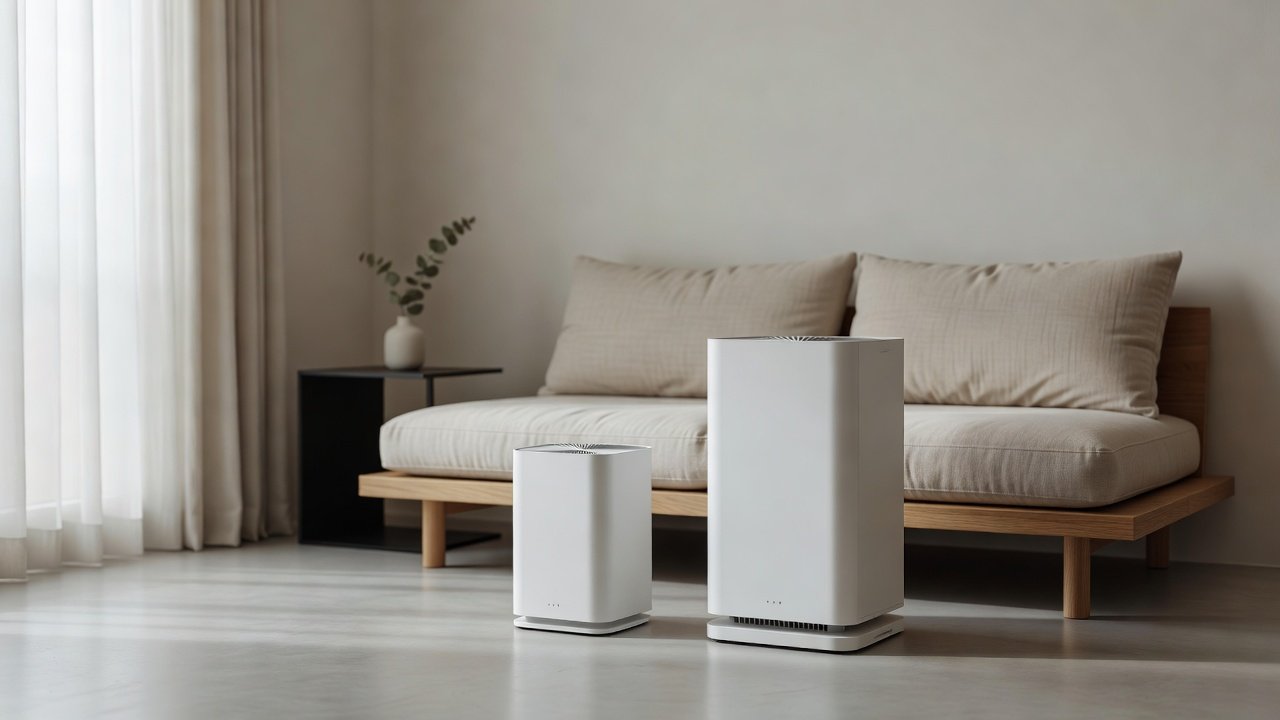
The Coway Airmega 150 is a compact, lightweight purifier aimed at small rooms such as bedrooms and offices. The Airmega 250 is a larger unit that has been described as covering a far bigger area, with a combined carbon and HEPA filter set and extra modes. Choosing between them is mostly a question of room size, noise tolerance and how much capacity you want in reserve.
Airmega 150 details below come from Coway’s own product page at the time of writing. Airmega 250 details come from a third-party review, because we could not confirm the full specification on Coway’s current pages; that model may have been updated or replaced, so check availability and current specs. We have not tested these products ourselves, and we do not list prices.
Airmega 150 fits
- Small bedrooms and offices
- Lightweight and easy to move
- Washable pre-filter and quiet low settings
Airmega 250 fits
- Larger bedrooms and living areas
- Buyers who want more headroom
- Extra modes and a timer, per reviews
Key Takeaways
- Per Coway, the Airmega 150 lists a smoke CADR of 153 and 214 sq ft at 4.8 air changes per hour.
- A reviewer reports the 250 at about 930 sq ft at 2 air changes per hour, so compare on the same basis.
- Confirm the 250’s current availability and specs; we relied on a third-party source for it.
- Size by smoke CADR for your own room and ceiling height.
Allergies, Pets and Everyday Dust With These Units
For everyday dust and pollen, the key is to run the unit continuously on a low or medium setting and keep the filters fresh. For pets, the 150’s washable pre-filter is a useful feature, because hair is the first thing to clog the intake. For odors, the deodorization or carbon layer helps, but its capacity is limited, so replace it at the listed interval or sooner if odors return.
If someone in the household has asthma or allergies, a doctor’s advice should guide the overall plan, and the purifier is one supportive measure. Pair it with regular cleaning, hot-wash bedding and humidity at 30 to 50 percent. Place the unit with open space around it and close windows during high pollen days.
Before You Buy
Confirm the exact model and version on Coway’s site, since colors, features and numbers can differ between versions. Check the replacement filter set and the price per year. Consider the warranty. Read the manual for how to switch off any optional indoor-air features, and check whether the unit can be wall-mounted or must stand on the floor.
Keep notes of the model number and purchase date and set a reminder for the first filter check. If you decide a different brand or model suits your room better, use the same method: smoke CADR, air changes, noise at the speed you will use and filter cost. That approach works for any purifier and keeps the decision grounded in numbers rather than marketing.
A Note on Model Names and Versions
Coway, like many makers, releases variants of the same model with different features, such as Wi-Fi versions, colors or regional versions. A listing for an Airmega 150 may differ in small ways from another, and older models such as the 250 may be sold by third parties after Coway has moved on. Check the model number printed on the box or the listing, and compare it with the manufacturer’s page.
If a listing offers a much lower figure or an unusual coverage claim, look for the same figure on the maker’s site. When figures differ, trust the manufacturer or an independent test, and ask the seller. This simple check protects you from mislabeled listings and helps you buy the unit you intended.
Air Purifiers to Compare
The table below lists purifiers from our affiliate partner. Compare smoke CADR, room size ratings and filter details across brands, and check Coway’s pages for current Airmega models.
Comparing Coverage Fairly
The 150’s 518 square feet at 2 air changes per hour is the like-for-like comparison with the 250’s roughly 930 square feet at 2 air changes per hour. That suggests the 250 moves about 1.8 times as much air. For everyday use, the AHAM guide of a smoke CADR of about two-thirds of floor area puts the 150 at a comfortable fit for a bedroom of about 200 square feet.
If your room is 300 to 400 square feet, the 150 would deliver fewer air changes per hour and run at higher speeds, which is louder, while the larger unit could run lower.
At a Glance
The table below summarizes what is published or reported. Confirm current figures.
| Factor | Airmega 150 | Airmega 250 (reviewer figures) |
|---|---|---|
| Coverage basis | 214 sq ft at 4.8 ACH | About 930 sq ft at 2 ACH |
| Filters | Washable pre-filter, deodorization, HEPA | Pre-filter, carbon + HEPA set |
| Weight | About 12 lbs | About 20 lbs |
| Timer | Check current page | 1, 4, 8 hours reported |
| Best for | Small rooms | Larger rooms |
What Coway Lists for the Airmega 150
Coway’s page lists a smoke CADR of 153, dust 161 and pollen 220 for the Airmega 150. Its stated coverage is 214 square feet at 4.8 air changes per hour, 518 square feet at 2 air changes per hour and 1,035 square feet at 1 air change per hour. It uses a washable pre-filter, a deodorization filter with a listed life of about six months and a HEPA filter listed at about one year.
Noise is listed from about 20 to 48 dB(A), the unit weighs about 12 pounds, draws up to 35 watts and has Auto and three manual speeds with filter-change indicators. The page we reviewed did not mention an ionizer.
What a Third-Party Review Reports for the Airmega 250
A Gearbrain comparison describes the Airmega 250 as covering roughly 930 square feet, cleaning that area twice an hour, with a pre-filter and a Max2 filter that bonds activated carbon with HEPA and is replaced about once a year. It reports auto mode, 1, 4 and 8 hour timers, Rapid, Sleep and Eco modes and a larger air quality light band, with a weight of about 20 pounds.
These are reviewer figures, and the coverage uses a 2 air change per hour basis, so it is not directly comparable with the 150’s 214 square feet at 4.8. Confirm the current specifications with Coway before relying on them.
Matching Each Unit to a Room
For a 150 square foot bedroom, the AHAM guide suggests a smoke CADR of about 100, so the 150, at a listed 153, has headroom and can run on a low setting. For a 250 square foot room, the target is about 165, which the 150 meets only at a high setting, so the larger unit would be a better fit. For a 400 square foot living area, the target is about 270, and the 150 would be strained.
This is why the same-basis comparison matters. A unit may be rated to cover a large area at 1 or 2 air changes per hour, but if you want the faster cleaning that 4.8 air changes provides, you need to buy for the smaller area. Decide how fast you want the air cleaned, then choose.
Filters, Upkeep and Costs
Coway lists the 150 with a washable pre-filter and cartridge-style filters, with the deodorization filter replaced about every six months and the HEPA filter about every year. According to the reviewer, the 250 uses a combined carbon and HEPA filter replaced about once a year. A combined filter is simpler; separate filters let you refresh the odor layer more often.
Whatever you choose, look up the replacement filter cost and availability before buying, particularly for an older model such as the 250, whose parts may become harder to find. Compare the annual filter cost, not just the purchase price.
Noise and Controls
Coway lists the 150 at roughly 20 dB(A) on its lowest setting up to about 48 on its highest, which is a useful range for a bedroom at low speed. The reviewer describes the 250 as very quiet on low but louder on high. The practical point is the same for both: a unit sized comfortably for the room can run on a low, quiet setting most of the time.
The 150 has Auto and three manual speeds with a touch display and an air quality indicator light that can be turned off. The 250 is reported to have extra modes and a timer. Think about whether you will use these extras.
Size, Weight and Placement
The 150 is light at about 12 pounds and compact, easy to move from room to room. The 250 is heavier at about 20 pounds. Both need clear space on all sides, and neither should be pushed against a wall or hidden behind furniture. Check dimensions against where you plan to put the unit.
If you plan to move the unit often, the 150 has the edge. If it will live in one place in a larger space, the 250’s size is less of a concern.
Making the Choice
If your room is under about 200 square feet and you value compactness, the 150 is a natural fit. If your room is bigger, or you want more reserve capacity and extras, a larger unit such as the 250, or a current larger Airmega model, is worth considering. Check the current Coway lineup, since newer models may fit better.
Verify availability, warranty and specifications with Coway before purchasing, and plan your filter routine on day one.
How to Choose
- Convert coverage claims to the same air-change basis.
- Size by smoke CADR for your room.
- Check the filter type, life and replacement cost.
- Check noise at the speed you will use.
- Avoid ozone generating or ionizer modes; the EPA advises against ozone-emitting air cleaners.
Do
- Match the unit’s rated coverage to your room first
- Run it consistently, not only when the air feels bad
- Leave space around the unit for airflow
- Replace filters on the maker’s schedule
Don’t
- Do not buy on looks or price alone
- Do not block the intake or exhaust
- Do not skip filter changes
- Do not expect a purifier to fix every source of pollution
Honest Limits
- This guide uses manufacturer information and public guidance from the EPA and AHAM, not our own lab tests.
- Features and room ratings change between model years, so confirm on the listing before you buy.
- A purifier is not a medical device and does not replace medical advice or treatment.
Who Should Skip This
When to See a Professional
Choose the smallest unit that meets your CADR target at a quiet setting, and compare coverage on the same air-change basis.
Frequently Asked Questions
Which is better for a bedroom?
For a bedroom of around 200 square feet or less, the Airmega 150 is a compact fit.
Why do the coverage numbers look so different?
They use different air-change assumptions. Convert to the same basis before comparing.
What filters does the 150 use?
A washable pre-filter, a deodorization filter and a HEPA filter, per Coway.
Does the 250 use a combined filter?
A reviewer reports a Max2 carbon and HEPA filter set, replaced about once a year.
Is the 250 still sold?
Check Coway and retailers. Models are updated or replaced.
How loud is the 150?
Coway lists about 20 to 48 dB(A) depending on speed.
Does the 150 have an ionizer?
The page we reviewed does not mention one.
Can I wash the pre-filter?
The 150 has a washable pre-filter. Follow the manual.
Do I need the larger model?
Only if your room or air-change goals require it.
Where do I confirm specs?
On Coway’s current product pages.
Bottom Line
The Airmega 150 is a compact small-room unit; the 250 is a larger step up, though its current availability and specs should be confirmed.
Size by smoke CADR and air changes, and verify everything on Coway’s current pages.
Related reading: sens,fan,bed
Sources: EPA, Guide to Air Cleaners in the Home; AHAM Verifide.