Last updated:
Disclosure: As an Amazon Associate we earn from qualifying purchases. This does not change what we recommend. See our affiliate disclaimer.
Kitchens are some of the hardest places for an air purifier. Cooking releases fine particles, grease aerosols, steam and odors, and a unit placed near the stove collects a sticky film on the casing, grille and pre-filter far faster than one in a bedroom. That film can clog filters, attract dust and, in worst cases, create a fire concern if the unit sits too close to heat.
This guide explains where to place a purifier in or near a kitchen, how to clean grease buildup safely, how often to check filters and what to avoid. It is general information. We have not tested these products ourselves, and procedures differ by model, so follow your manual and keep the unit well away from heat sources.
Do
- Place the unit away from direct heat and splashes
- Wipe grease with a barely damp cloth, unplugged
- Check the pre-filter often
Avoid
- Placing the unit on or beside a hot stove
- Spraying degreaser into vents
- Using the purifier instead of a range hood
Key Takeaways
- Keep a kitchen purifier several feet from the stove and away from heat and splashes.
- Wipe grease with a barely damp, mild-soap cloth while the unit is unplugged, and never spray degreaser into vents.
- Check the pre-filter weekly and replace HEPA and carbon sooner than the standard interval.
- A purifier does not remove gas appliance by-products; use a hood, ventilation and a carbon monoxide alarm.
- Ventilation and source control matter as much as the purifier.
Sizing for an Open-Plan Kitchen and Living Area
If the kitchen opens to a living room, treat the combined space as one volume. A 400 square foot open area needs a smoke CADR near 267 under the AHAM rule, and more if ceilings are high. One unit placed centrally and run on a higher speed during cooking can handle light cooking. Heavy frying may need extra capacity or a second unit. Position it so air passes between the kitchen and seating area, and not right beside the stove.
Remember that ventilation at the source is much more effective than trying to clean the whole room afterward. Capture fumes with the hood, and use the purifier to catch what escapes.
Cleaning Supplies and Safe Practices
Keep a soft brush, microfiber cloths, mild dish soap, a bowl of warm water, a vacuum with a brush attachment and spare filters together. Wear gloves if you prefer. Unplug the unit. Avoid abrasive scrubbers and strong chemicals. Do not wet vents or electronics. Let parts dry fully before reassembly. Wash your hands afterward.
If a greasy filter smells rancid or burnt, replace it rather than trying to clean it. If the unit smells burnt, stop using it and contact the manufacturer.
Final Checklist
Place the unit away from heat. Use the hood. Wipe the casing weekly. Check the pre-filter weekly and replace or wash as allowed. Replace HEPA and carbon sooner. Keep a carbon monoxide alarm if you have gas appliances. Log dates. Verify details for your model on the manufacturer’s page. This article provides general information and is not medical advice. If you have a respiratory condition, ask your clinician what steps are right for you.
Which Filters Handle Cooking Best
A purifier for a kitchen-adjacent room benefits from a combination of a washable pre-filter for grease droplets, a true HEPA layer for fine particles and a substantial carbon layer for odors. Look for carbon quantity on the spec sheet, since a thin coating saturates in weeks of regular frying. Consider models with separate carbon cartridges so you can replace carbon more often without replacing the HEPA layer each time.
If you often cook strongly scented foods, plan a replacement calendar for carbon and keep spares. If your cooking is light, a standard schedule may be enough. Observe how fast the pre-filter gets sticky and how long the odor control lasts, and adjust.
After a Cooking Accident or Fire
If you have a kitchen fire or heavy smoke event, ventilate and make sure the area is safe before using the purifier. Replace pre-filters and likely the main filters afterward, since they will be coated in soot and grease. Wipe the casing and housing. Do not run a heavily soiled filter, which can smell and shed. If you have any doubt about electrical safety after smoke or water exposure, have the unit checked or replace it. Leave the area and call emergency services for any active fire.
This article provides general information, not a substitute for your manual or professional advice.
Air Purifiers to Compare
The table below lists purifiers from our affiliate partner. For kitchen-adjacent spaces, compare smoke CADR, carbon layers, washable pre-filters and filter cost.
Placement in or Near the Kitchen
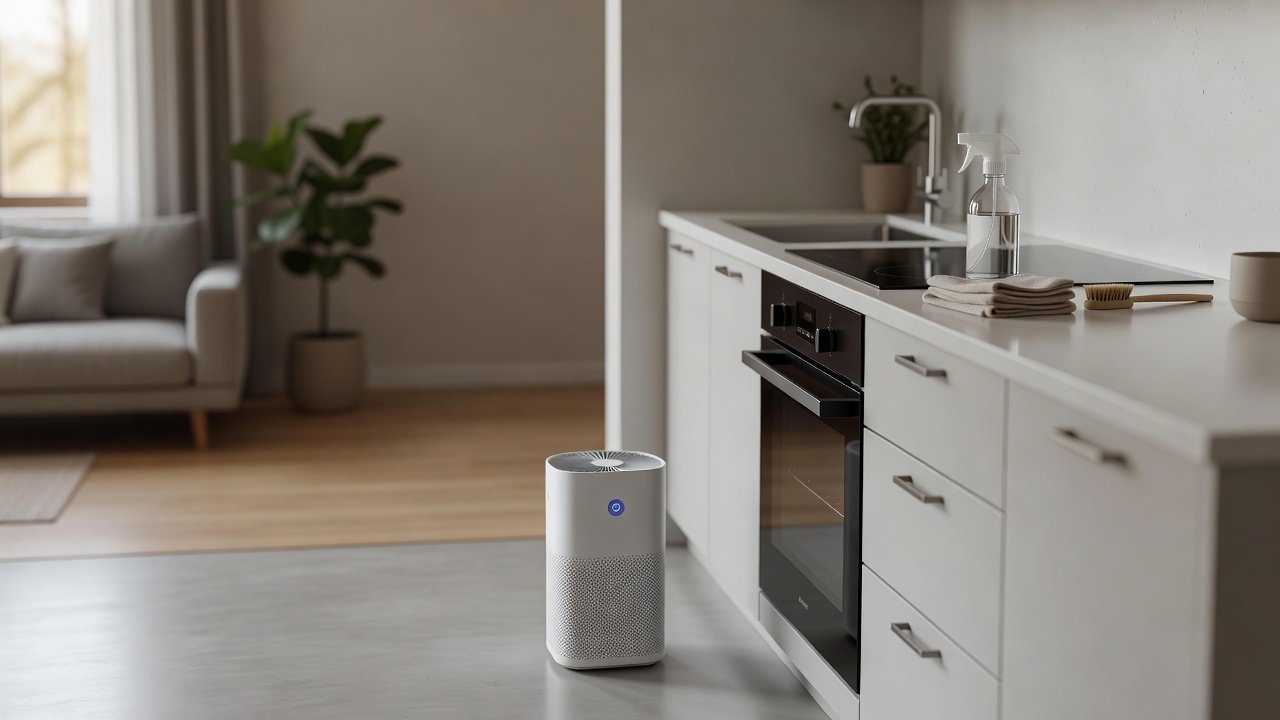
Keep the purifier several feet from the stove, oven and any hot surfaces, away from splashes and not directly under a range hood. Do not place it on the stove or beside a toaster or kettle. Put it where air can flow around it, such as on a nearby counter at a safe distance or on a stable table in an open-plan room. Keep cords away from heat and wet areas.
A purifier does not replace a range hood. Use the hood while cooking, vent it outdoors where possible and keep it clean. Run the purifier on a higher speed while cooking and for a while afterward, if the room can handle the noise.
Cleaning Grease Buildup
Unplug the unit. Wipe the casing with a soft cloth dampened with warm water and a small amount of mild dish soap, wrung out well, then wipe again with a clean damp cloth and dry. Do not spray degreaser on the unit or into vents. Use a soft brush or vacuum brush on the grille to remove loose dust before wiping. Avoid abrasive pads that scratch plastic.
Open the unit and check the pre-filter. A greasy pre-filter is sticky and holds dust. If the manual allows washing, rinse with warm water and a little mild soap, rinse thoroughly and dry completely. If it is not washable or stays sticky, replace it. Greasy HEPA and carbon filters cannot be cleaned and should be replaced.
| Part | Kitchen issue | What to do |
|---|---|---|
| Casing | Sticky film | Mild soap on a wrung-out cloth, dry |
| Grille and vents | Greasy dust | Soft brush, wipe, keep liquids out |
| Pre-filter | Clogged, sticky | Wash if allowed or replace |
| HEPA and carbon | Greasy, saturated | Replace sooner |
| Sensor | Sticky or dirty | Dry swab per manual |
How Cooking Loads a Purifier
Frying, searing and broiling produce fine particles and grease aerosols that can be among the highest indoor sources of particles. Gas stoves also release combustion by-products, which a particle filter does not remove. Boiling and steaming add moisture. All of this reaches the purifier if it is nearby. The pre-filter catches larger particles and grease droplets, the HEPA layer captures fine particles and carbon can adsorb some cooking odors.
The result is faster loading, a sticky pre-filter, saturated carbon and a casing that needs frequent wiping. Plan for shorter intervals than the manual’s typical-use schedule.
Gas Stoves and Safety
A particle filter does not remove gases such as carbon monoxide or nitrogen dioxide from gas appliances. Use the range hood, vent outdoors and keep a working carbon monoxide alarm. If an alarm sounds or you smell gas, leave the area and get help. Have gas appliances serviced regularly. Soot on cookware or walls can be a sign of poor combustion and should be checked by a qualified technician.
A Cleaning Routine for Kitchen Units
Weekly: wipe the casing and grille with a barely damp cloth and check the pre-filter. Every two weeks: wash or replace the pre-filter as the manual allows. Monthly: inspect the main filters, vacuum the compartment and clean the sensor window. Every few months: replace the carbon filter or the combined cartridge if odors return. After heavy frying or smoke: check immediately. Keep a spare set of filters for quick swaps.
Use mild soap and warm water on the casing, never degreasers sprayed on the unit. Let everything dry before plugging it back in.
Odors and Carbon
Cooking odors rely on the carbon layer. A thin layer saturates fast in a kitchen. If you cook often, consider a model with a substantial carbon filter or separate carbon cartridges that you can replace on their own. Ventilation helps most: open a window if outdoor air is good, use the hood and fan, and wipe surfaces where grease settles. A purifier supports these steps and does not replace them.
Common Mistakes
Putting the unit too close to the stove, spraying degreaser into the vents, ignoring a sticky pre-filter, running the unit with a greasy filter, forgetting to ventilate and relying on a purifier instead of a range hood are the most frequent errors. Another is leaving the unit on a high setting all day when a short burst during and after cooking is enough. Use the unit sensibly and maintain it on schedule.
How to Choose
- Choose a model with a substantial carbon layer for cooking odors.
- Look for a washable pre-filter and easy access.
- Check smoke CADR for an open-plan area.
- Compare filter cost, since kitchens use filters faster.
- Avoid ozone-generating modes; the EPA advises against ozone-emitting air cleaners.
Do
- Match the unit’s rated coverage to your room first
- Run it consistently, not only when the air feels bad
- Leave space around the unit for airflow
- Replace filters on the maker’s schedule
Don’t
- Do not buy on looks or price alone
- Do not block the intake or exhaust
- Do not skip filter changes
- Do not expect a purifier to fix every source of pollution
Honest Limits
- This guide uses manufacturer information and public guidance from the EPA and AHAM, not our own lab tests.
- Features and room ratings change between model years, so confirm on the listing before you buy.
- A purifier is not a medical device and does not replace medical advice or treatment.
Who Should Skip This
When to See a Professional
Frequently Asked Questions
Can I put an air purifier next to my stove?
Keep it several feet away from heat and splashes, with clear airflow. Never place it on or beside hot appliances.
How do I remove grease from the casing?
Unplug the unit and wipe with a wrung-out cloth with mild soap and warm water, then dry. Avoid sprays near vents.
How often should I replace filters in a kitchen?
Sooner than the standard interval, particularly the pre-filter and carbon layers. Check often.
Does a purifier remove gas stove fumes?
No. Particle filters do not remove gases like carbon monoxide. Use ventilation and an alarm.
Is a purifier a substitute for a range hood?
No. Use the hood and ventilate in addition to a purifier.
Bottom Line
Keep the purifier away from heat, wipe grease with a barely damp cloth and check the pre-filter often.
Expect to replace filters sooner in kitchens, and use a range hood too.
Related reading: sens,fan,bed
Sources: EPA, Guide to Air Cleaners in the Home; AHAM Verifide.