Last updated:
As an Amazon Associate we earn from qualifying purchases. This does not change what we recommend. See our affiliate disclaimer.
Dust is the complaint that brings most people to an air purifier in the first place. The shelves look clean on Saturday and gray by Wednesday, the TV screen grows a film, and anyone with allergies notices it in the morning. So the question is fair: does an air purifier clean dust, or does it just hum in the corner while the dust keeps landing?
The short version is that a filter-based air purifier does remove dust, but only the dust that is still floating. A true HEPA filter is rated to capture 99.97 percent of particles at 0.3 microns under test conditions, and larger dust fragments, fibers and pet dander are easier for it to catch than that test size. What a purifier cannot do is lift dust that has already settled on a shelf or floor. Settled dust has to be wiped or vacuumed. A well-sized unit that runs most of the day will visibly slow how fast surfaces dust over, usually within a week or two, but it will not make dusting unnecessary.
In short: a purifier is a dust interceptor, not a dust remover. It pulls particles out of the air before they land, which is why it works best in rooms where dust is constantly being stirred up, such as bedrooms with bedding and carpet, and far less in a tidy room nobody uses.
The EPA’s guide to air cleaners in the home makes the same point in plain words: portable air cleaners can help reduce airborne particles, but source control and ventilation remain the first steps, and no device replaces cleaning. We lean on that guidance and on AHAM’s CADR sizing method throughout this article.
Everything below is research-based, drawn from maker specifications, EPA and AHAM guidance and the way dust actually behaves indoors. We have not lab-tested the models in the comparison table, and we do not repeat prices or ratings; we compare published features only.
A purifier helps with dust if
- Someone in the home wakes up congested or sneezes in the morning
- You see dust floating in a sunbeam most days
- The room has carpet, upholstered furniture or pets
- You can run the unit at least 12 hours a day
Be careful about expecting too much if
- Dust is coming from an open window or a leaking duct
- The room is much larger than the unit is rated for
- You plan to run it on the lowest speed only
- You are hoping to stop dusting entirely
Key Takeaways
- A filter-based purifier captures airborne dust; it cannot pick up dust that has already settled.
- True HEPA filters are rated for 99.97 percent of 0.3 micron particles under test conditions, and most dust is larger and easier to catch.
- Match the CADR to the room: about two-thirds of the floor area in square feet for 8 foot ceilings is the AHAM rule of thumb.
- Run time matters more than top speed; a unit on medium for 12 hours removes far more dust than ten minutes on turbo.
- Placement near the dust source, with clear space around the intake, improves results.
- Fix the sources too: leaky ducts, open windows on windy days, old carpet and unwashed bedding keep refilling the room.
- Expect to notice fewer dust motes within days and slower surface build-up within a couple of weeks.
Dust-Focused Air Purifiers to Compare
These widely reviewed filter-based units cover small bedrooms through open living areas. Compare the maker-listed room coverage and filter type against your dustiest room, and skip anything that relies on an ionizer alone.






How We Approached This Guide
We did not run particle counters in a test house. Instead we worked from three kinds of evidence: the mechanics of how dust moves and settles indoors, the filter and airflow specifications makers publish, and the sizing guidance from the EPA and AHAM. Where a number appears next to a model name, it is the maker’s figure, not ours.
Dust is a mixture rather than a single thing. In a typical home it includes skin flakes, fabric fibers, soil tracked in on shoes, pet dander, pollen that came through a door, insect fragments and tiny bits of paper and cardboard. Particle sizes run from well under a micron up to visible fluff. That range matters because a purifier handles the small, light fraction best and the heavy fraction barely at all.
How Dust Behaves in a Room
Dust does not hang in the air forever. Gravity pulls it down, and how long a particle floats depends almost entirely on its size. A 10 micron fragment of fiber settles out of still air in a few minutes. A 1 micron particle of dander or soot can stay aloft for hours, drifting on the slightest current from a vent or a person walking by. Below about 0.5 microns, particles behave more like gas and settle so slowly that air movement, not gravity, decides where they go.
This is why a purifier changes the look of a room. The fine, long-floating fraction is exactly what the fan can pull into the filter before it lands. The coarse fraction, the visible fluff and grit, lands fast and close to where it was created, usually within a few feet of a bed, a sofa or a doormat. A purifier catches some of that only if it happens to be running right next to the source.
| Particle size | Typical example | Time to settle 6 feet in still air | Purifier capture |
|---|---|---|---|
| Over 10 microns | Visible fluff, sand, large fibers | Minutes | Low; it lands before reaching the intake |
| 2.5 to 10 microns | Pollen, dust mite fragments, most dander | Minutes to an hour | Good when the unit runs continuously |
| 0.3 to 2.5 microns | Smoke, fine dander, soot | Hours to days | Very good; this is the HEPA test range |
| Under 0.3 microns | Combustion by-products, some fumes | Days | Very good by diffusion, though gases need carbon |
Air movement is the other half of the story. Forced-air heating and cooling systems stir up and redistribute dust several times an hour. Walking across a carpet launches a cloud at ankle height. Opening a closet door sends a puff of fiber off the clothes. A purifier is competing with all of these sources at once, which is why the next section on capacity matters so much.
What a HEPA Filter Actually Catches
A true HEPA filter is a dense mat of fine glass or synthetic fibers. Particles are captured in three ways. Large ones are simply too big to pass between fibers and are sieved out. Medium ones are carried by the air stream into a fiber and stick on impact. The smallest ones wobble in random paths, bump into fibers and stick by diffusion. The hardest size to catch is around 0.3 microns, which is why the HEPA standard is defined there: 99.97 percent at 0.3 microns under test conditions.
Most household dust sits above that size, so a true HEPA filter catches it efficiently on the first pass. The catch is the phrase on the first pass. The filter only cleans the air that goes through it, and in a real room only a fraction of the air passes the filter each hour. That is why effectiveness depends on airflow and run time, not just the filter grade.
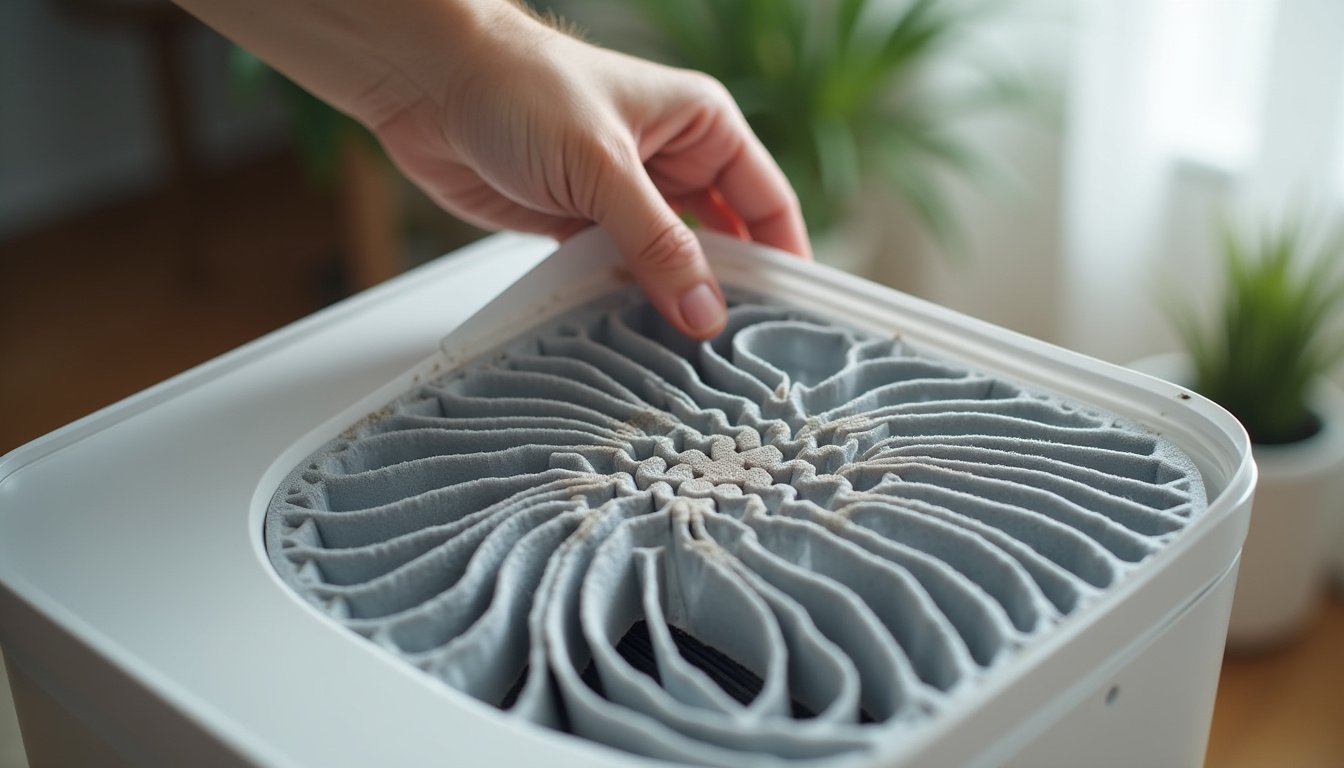
Pre-filters are worth a mention. Most units place a coarse mesh or foam layer in front of the HEPA stage. In a dusty home this layer does a lot of work, catching hair, lint and large fibers that would otherwise clog the main filter early. A pre-filter you can vacuum or rinse extends HEPA life considerably. The HEPA stage itself is not washable; it is replaced on the maker’s schedule or when the indicator calls for it.
Sizing a Purifier for a Dusty Room
Capacity is where most dust complaints come from. A compact unit rated for a 150 square foot room will struggle in a 350 square foot living room, no matter how good its filter is. The AHAM rule of thumb is to look for a dust CADR of at least two-thirds of the floor area in square feet, assuming 8 foot ceilings. That delivers roughly 4.8 air changes per hour, enough to make a noticeable difference for allergy sufferers.
Worked example: a bedroom measures 12 by 15 feet, so the floor area is 180 square feet. Two-thirds of 180 is 120, so you want a dust CADR of about 120 or higher. If the ceiling is 10 feet rather than 8, scale up by a quarter, to about 150. If the room has carpet and a dog sleeps on the bed, treat it as a dustier-than-average room and step up another size class so the unit can run on medium instead of high.
If you are choosing between a unit that is just big enough and one that is comfortably oversized, the larger one usually wins for dust. It can run on a quieter speed and still move the required air, which means you will actually leave it on. A loud unit that gets switched off at bedtime removes no dust at all.
Placement and Airflow
Where the unit sits changes how much dust it sees. Dust concentrations are highest near their sources: beside the bed, at the foot of a sofa, by the entry door, and under a supply vent that blows across a carpet. A purifier placed within a few feet of the main source intercepts dust before it spreads. Tucked behind a chair in the far corner, it cleans the air that happens to drift past.
Give the intake and outlet room to breathe. Most makers ask for at least a foot of clearance around the unit, and more behind a rear intake. Avoid setting it on thick carpet if the intake is at the base; the fan will pull fiber straight off the pile and the pre-filter will clog fast. A hard floor or a low, stable stand is better.
Doors matter too. A purifier rated for one room cannot keep up with a hallway, a stairwell and two open bedrooms. Close the door when you want fast results in one room, especially overnight in a bedroom. If you need coverage across an open floor plan, see the section below on running more than one unit.
Why Run Time Beats Top Speed
People often run a purifier on high for twenty minutes, hear it roar, and switch it off. Dust does not work that way. New dust enters the air continuously as people move, pets shed and the HVAC cycles. The useful measure is total air volume filtered over the day, and a unit on medium for 14 hours moves far more air than one on turbo for a short burst.
Auto mode helps if the unit has a decent particle sensor. It idles on low when the air is calm and ramps up when you make the bed or vacuum. Sensors drift and can be fooled by humidity, so treat the reading as a trend rather than a measurement. If the fan never leaves low in a room you know is dusty, override it to medium.
| Schedule | Approximate air filtered per day in a 180 sq ft bedroom | What you will notice |
|---|---|---|
| High for 30 minutes, then off | One room volume or less | Almost nothing changes |
| Low, 24 hours | Around 20 room volumes | Fewer floating motes, slow improvement on shelves |
| Medium, 14 hours while home and asleep | Around 40 to 50 room volumes | Clear reduction in morning congestion and surface dust |
| Auto with a working sensor | Varies, often 30 to 60 room volumes | Good results with lower average noise |
Filter life is the natural worry with long run times. Most makers rate a HEPA stage at 6 to 12 months of normal use, and heavy dust can shorten that. The trade-off is real but favorable: the filter is doing exactly what you bought it for, and vacuuming the pre-filter every two to four weeks protects the main stage from the coarse load.
Finding and Fixing the Dust Sources
A purifier removes dust from the air. It does not stop dust from being made. If the room refills faster than the filter can empty it, the surfaces will still gray over. Spend an hour finding where the dust comes from and you will get more improvement than any upgrade in filter grade.
- Bedding and upholstery shed fibers and skin flakes constantly; wash sheets weekly in hot water and vacuum mattresses and sofas monthly.
- Carpet stores dust and releases it with every step; vacuum with a sealed, HEPA-bagged vacuum twice a week or consider hard flooring in bedrooms.
- Leaky return ducts in an attic or crawlspace pull insulation fibers and soil into the system; have an HVAC technician check and seal them.
- Open windows on dry, windy days bring in pollen, soil and road dust; use screens and close windows during high-wind afternoons.
- Clutter, open shelving and stacks of paper collect and release dust; closed storage and fewer horizontal surfaces help.
- Entry mats inside and outside the door catch tracked-in grit before it reaches the carpet.
The HVAC filter deserves its own line. The EPA suggests a MERV 13 or higher filter where the system supports it. Upgrading from a basic fiberglass pad to a pleated MERV 11 to 13 filter captures far more fine dust every time the furnace or air handler runs. Check with the system’s manual or an HVAC professional before going higher, since very dense filters can restrict airflow in some older systems.
Measuring Whether It Is Working
Dust is a slow problem, so give the purifier time before judging it. Floating motes in a sunbeam thin out within a day or two. Surface dust changes more slowly because settled dust is still there until you wipe it, and new coarse dust keeps landing from nearby sources. Wipe the usual shelves clean on day one and compare the build-up after one week and again after three.
If the unit has a particle sensor, note the baseline reading in the evening before you start running it full time, then compare the same hour a week later. Standalone air quality monitors that report PM2.5 and PM10 are more consistent than built-in sensors and make the before and after comparison much clearer.
| Sign | Likely meaning | What to adjust |
|---|---|---|
| Fewer motes in light, shelves still dusty | Fine dust is handled; coarse dust is landing locally | Find and fix nearby sources, vacuum more often |
| Little change anywhere after two weeks | Unit undersized or running too little | Move it closer, raise the speed, close the door, or upgrade |
| Sensor stays low but you still sneeze | Allergen may be settled dust or mites, not airborne | Wash bedding, encase mattress, vacuum with HEPA |
| Pre-filter clogs within a week | Heavy coarse load | Vacuum pre-filter weekly, address carpet and pets |
One Unit or Several?
A single portable purifier cleans the room it is in. It will not meaningfully clean a room down the hall, and a whole house is out of reach for any portable unit. For most homes the practical answer is one correctly sized unit in the bedroom, where you spend eight hours breathing a few feet above a dust-shedding mattress, and a second in the main living area if dust or allergies are a daily issue.
If budget allows only one, start in the bedroom. Night-time exposure matters most for morning symptoms, and a closed bedroom door lets a modest unit achieve many air changes per hour. Add a living room unit later and choose a larger CADR for the open space.
In-duct or whole-house filtration through the HVAC system is a different tool with a different strength. It filters air only while the system runs, but it covers every room with a supply vent. Pairing a better HVAC filter with one or two portable HEPA units in the dustiest rooms usually beats trying to buy one giant purifier.
Dust Versus Dust Mites
Dust mite allergy is often what people mean when they say dust bothers them. Mites live in bedding, mattresses, carpet and soft toys, feeding on skin flakes, and their waste particles are the allergen. Those particles are relatively heavy and settle quickly, so they are airborne mainly while you make the bed, fluff a pillow or roll over at night.
A purifier catches some of this during those moments, but it does nothing for the mites in the mattress. The measures that help most are the ones allergists recommend first: wash bedding weekly in hot water, use zippered allergen-proof encasements on the mattress and pillows, keep indoor humidity between 30 and 50 percent as the EPA suggests, and remove carpet from the bedroom if symptoms are severe. A purifier is a useful supporting player here, not the lead.
How to Choose a Purifier for Dust in 7 Steps
- Measure the room and multiply length by width to get the floor area in square feet.
- Take two-thirds of that number as the minimum dust CADR; raise it for high ceilings, carpet or pets.
- Insist on a true HEPA main filter and a washable or vacuumable pre-filter; skip ionizer-only units.
- Check the maker’s noise rating on the medium speed, since that is the speed you will live with.
- Look for a filter-change indicator so the HEPA stage is not run past its useful life.
- Decide where it will sit, close to the dust source with a foot of clearance, and confirm the unit’s size fits.
- Price the replacement filters over a year, not just the unit, and confirm they are easy to buy.
Do and Do Not
Do
- Run it most of the day, on medium or auto, with the bedroom door closed at night.
- Vacuum the pre-filter every two to four weeks in a dusty home.
- Place it near the bed, sofa or entry where dust is generated.
- Pair it with a pleated MERV 11 to 13 HVAC filter if your system allows.
- Wipe surfaces on day one so you can see the change.
Do not
- Do not expect it to lift dust that has already settled.
- Do not set it on deep carpet if the intake is at the base.
- Do not buy on filter grade alone; CADR and run time matter more for dust.
- Do not wash a HEPA filter; replace it on schedule.
- Do not rely on ozone generators or ionizers to handle dust.
Who Should Skip This
If your dust is clearly coming from a construction project, an unsealed crawlspace or a failing duct system, spend the money on fixing the source first. A purifier in a room fed by a leaking return duct is bailing a boat with the drain open. Once the source is sealed, a purifier becomes a sensible finishing step.
Renters in a small, hard-floored studio with no pets and no allergy symptoms may find that a weekly vacuum and damp dusting handles dust fine. A purifier still helps with smoke and pollen, but dust alone may not justify one in that setting.
Honest Limits
- It cannot remove dust that has already settled on surfaces; only cleaning does that.
- It cleans one room at a time, and only while running.
- Coarse, heavy dust lands before it can reach the intake unless the unit is very close to the source.
- It does not kill or remove dust mites living in mattresses and carpet.
- HEPA filters do not remove gases or odors; that needs activated carbon, source control and ventilation.
- Filters load faster in dusty homes and must be replaced on the maker’s schedule.
When to See a Professional
See a doctor or allergist if dust seems to trigger persistent congestion, wheezing, asthma symptoms or skin reactions. Allergy testing can confirm whether dust mites, pet dander or something else is responsible, and treatment plans differ for each. A purifier can support that plan but is not a substitute for medical advice.
Call an HVAC professional if dust appears suddenly, smells like insulation, or coats supply vents, since that points to duct leaks or a failing filter rack. If dust comes with visible mold or a musty smell, a mold professional should assess any area larger than about 10 square feet, following EPA guidance. Nothing on this page is medical advice.
Frequently Asked Questions
Does an air purifier really reduce dust in a room?
Yes, for the airborne fraction. A true HEPA purifier sized to the room and run most of the day pulls fine dust out of the air before it lands. You will notice fewer floating particles within days and slower build-up on surfaces over a couple of weeks, but settled dust still needs cleaning.
Why are my shelves still dusty with a purifier running?
Coarse dust lands within minutes and close to its source, before it can drift to the intake. Shelves near a bed, sofa or carpet keep collecting it. Move the unit closer, raise the speed, close the door and address the sources, such as bedding and carpet, to slow the build-up further.
What CADR do I need for dust?
Use the AHAM rule of thumb: a dust CADR of at least two-thirds of the floor area in square feet with 8 foot ceilings. A 12 by 15 foot bedroom is 180 square feet, so aim for about 120 or higher, and step up for high ceilings, carpet or pets.
Is a HEPA filter necessary for dust?
A true HEPA filter is the safe choice because it captures fine dust efficiently on each pass. Many dust particles are larger than the 0.3 micron test size, so even lesser filters catch some, but HEPA-type and HEPA-like media let more fine particles through and are not held to the same standard.
Should I run the purifier all day for dust?
Yes, or at least whenever the room is in use and overnight. Dust is generated continuously, so total air filtered over the day matters more than brief bursts on high. Medium speed for 12 to 14 hours or auto mode with a working sensor gives the best results.
Where should I put a purifier to reduce dust?
Place it near the main dust source, such as beside the bed or the sofa, on a hard floor or stand, with at least a foot of clearance around the intake and outlet. Avoid far corners and deep carpet, and close the door when you want quick results in one room.
Will a purifier help with dust mite allergy?
It helps a little by catching mite allergen that becomes airborne when you make the bed or move at night. The main measures are washing bedding weekly in hot water, allergen-proof mattress and pillow encasements, humidity between 30 and 50 percent and removing bedroom carpet where possible.
How often will I replace the filter in a dusty home?
Makers typically rate HEPA filters for 6 to 12 months, and heavy dust shortens that. Vacuuming the pre-filter every two to four weeks protects the main stage and extends its life. Replace the HEPA stage when the indicator calls for it or when airflow drops noticeably.
Can one purifier clean dust in the whole house?
No. A portable unit cleans the room it is in and only while running. For whole-home coverage, pair a better pleated HVAC filter, MERV 11 to 13 where the system allows, with one or two portable HEPA units in the bedroom and the main living area.
Do ionizers or ozone air cleaners remove dust better?
No. Ionizers charge particles so they stick to nearby surfaces, which can make walls and furniture dirtier, and the EPA advises against ozone-generating air cleaners, which some electronic units produce as a by-product. A filter-based HEPA purifier removes dust without those drawbacks.
Bottom Line
An air purifier does clean dust, with an important asterisk: it cleans the dust that is still in the air. Size it to the room using the two-thirds CADR rule, put it near where dust is made, and let it run on medium or auto most of the day. Within a couple of weeks you should see fewer floating motes, slower build-up on shelves and, for many people, easier mornings.
Treat it as one part of a dust strategy rather than the whole answer. Weekly hot washes for bedding, a sealed HEPA vacuum, a better HVAC filter and attention to leaks and open windows do the heavy lifting on the coarse dust that no purifier can reach. Together they turn a dusty room into one that stays clean between cleanings.
Related reading: What do air purifiers clean, How many air purifiers do I need, Best Levoit air purifier.