Last updated:
As an Amazon Associate we earn from qualifying purchases. This does not change what we recommend. See our affiliate disclaimer.
Air purifier boxes make big promises and small print. The box says it cleans the air; the manual, if you read it, says it reduces certain airborne particles under certain conditions. The gap between those two statements is where most disappointment lives, so it helps to know exactly what a purifier cleans, what it partly cleans and what it leaves untouched.
The direct answer is that a filter-based purifier does two separate jobs with two separate parts. The HEPA stage captures airborne particles: dust, pollen, pet dander, mold spores, smoke particles and other solid or liquid specks small enough to stay aloft. The activated carbon stage, when the unit has a meaningful amount of it, adsorbs some gases and odors such as cooking smells, pet odor and a share of volatile organic compounds. Neither stage removes carbon monoxide, radon, carbon dioxide or moisture, and neither cleans anything that has already settled on a surface.
In short: purifiers are good at particles, fair to good at odors depending on the carbon, and useless against several of the most dangerous indoor gases. Knowing which problem you have tells you whether a purifier is the right tool at all.
The EPA’s guide to air cleaners in the home is clear that source control and ventilation come first and that portable air cleaners are a supplement. The American Lung Association echoes that, and AHAM’s CADR ratings cover only three particle types: dust, pollen and smoke. Nothing in those ratings tells you about gases.
The picks and comparisons below are research-based. We compare maker-listed filter stages, carbon amounts and room ratings, and we lean on EPA and AHAM guidance. We have not lab-tested these units and we do not list prices or ratings.
A purifier is the right tool for
- Dust, pollen and pet dander that make you sneeze
- Smoke particles from wildfires or a neighbor’s grill
- Mold spores drifting from a damp area while you fix the source
- Lingering cooking or pet odors, if the unit has real carbon
Look elsewhere for
- Carbon monoxide, radon or natural gas; you need alarms and testing
- Humidity and condensation; use a dehumidifier or ventilation
- Dust already settled on floors and shelves
- Strong, continuous chemical sources such as fresh paint without ventilation
Key Takeaways
- HEPA filters capture airborne particles, rated at 99.97 percent of 0.3 micron particles under test conditions; most household particles are larger and easier to catch.
- Activated carbon adsorbs some gases and odors, but thin carbon-coated pads saturate quickly; look for a substantial carbon bed for odor problems.
- No consumer purifier removes carbon monoxide, radon, carbon dioxide or moisture.
- Purifiers do not clean settled dust, surface mold or anything not in the air.
- AHAM CADR numbers describe dust, pollen and smoke removal only.
- The EPA advises against ozone-generating air cleaners; filter-based units do the particle job without the by-product.
- Match the stage to the problem: particles need HEPA, odors need carbon, gases like CO and radon need detectors and professionals.
Filter-Based Purifiers That Cover Particles and Odors
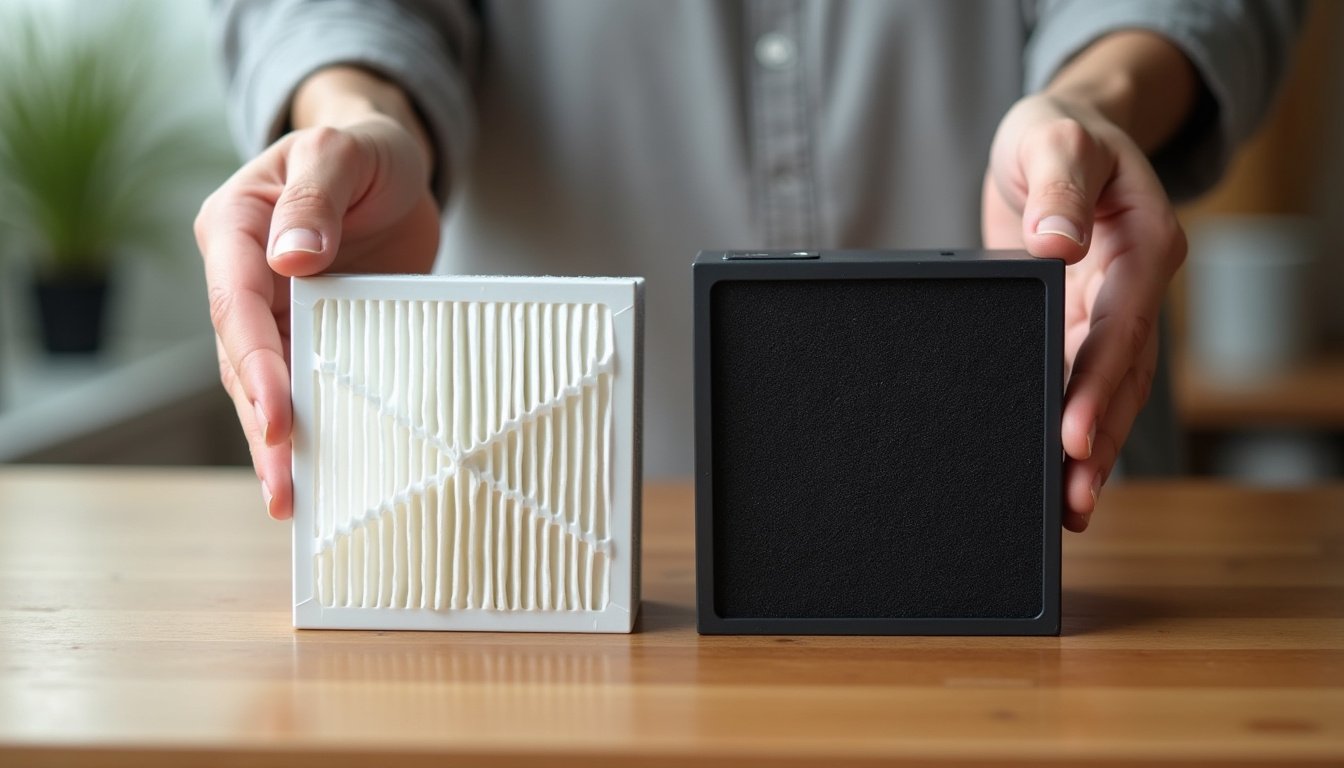
These widely reviewed units combine a true HEPA stage with activated carbon and cover small bedrooms through large living spaces. Compare the maker-listed filter stages and room size against the specific pollutant you are trying to tackle.






How This Guide Works
We sorted indoor pollutants into three groups, particles, gases and biological material, then checked how each filter technology handles them according to the physics involved, maker documentation and EPA and AHAM guidance. For the products in the table, every specification is the maker’s own figure.
One framing idea runs through the article: a purifier only touches what passes through it. Pollutants that are heavy, stuck to surfaces, or being produced faster than the fan can pull them in are mostly out of reach. That single idea explains most of the limits listed below.
Particles: What the HEPA Stage Removes
Particles are tiny solids or liquid droplets suspended in air. In a home they come from skin and fabric, outdoor soil and pollen, pets, cooking, candles, fireplaces, wildfire smoke, printers and ordinary wear of carpet and furniture. Health agencies pay most attention to PM2.5, particles 2.5 microns and smaller, because they can travel deep into the lungs.
A true HEPA filter handles this whole range. It sieves large particles, catches medium ones by impaction and traps the smallest by diffusion. The 0.3 micron rating point is the hardest size to catch, so performance above and below it is usually better. What varies between units is not so much the filter grade as the airflow pushing air through it, which is what CADR measures.
| Particle | Typical size in microns | Main sources | HEPA capture |
|---|---|---|---|
| Household dust | 0.5 to 100 | Fabric, skin, soil, paper | Good for the fine, floating fraction |
| Pollen | 10 to 100 | Trees, grass, weeds through doors and windows | Very good when airborne |
| Pet dander | 0.5 to 10 | Skin flakes carried on hair | Very good |
| Mold spores | 2 to 20 | Damp materials, soil, outdoor air | Very good, but the source must be fixed |
| Smoke particles | 0.1 to 1 | Wildfire, tobacco, cooking, candles | Very good; carbon handles the odor |
| Dust mite allergen | 10 to 40 | Bedding, carpet, upholstery | Fair; it settles fast |
The practical message is that if your problem is something you can see in a sunbeam or sneeze at, a correctly sized HEPA purifier run most of the day will reduce it. The reductions are measured in airborne concentration, not in cleaner shelves, which still need a cloth.
Gases and Odors: What Carbon Can and Cannot Do
Gases pass straight through a HEPA filter. To do anything about them a purifier needs a sorbent, almost always activated carbon, sometimes blended with other media. Activated carbon is riddled with microscopic pores that trap gas molecules on their surface, a process called adsorption. It is effective for many odor molecules, for a portion of volatile organic compounds and for some smoke gases.
The amount matters enormously. A thin fabric pad dusted with carbon, common in compact units, saturates within weeks in a smelly room and then does nothing. Units built for odor carry a pound or more of granular carbon in a thick bed, which lasts months and removes far more. The maker’s spec sheet or manual usually says how much carbon is included or at least whether the carbon is pelletized.
Formaldehyde deserves a special note. It is a common VOC from new furniture, flooring and cabinetry, and plain carbon holds it poorly. Some filters add treated media designed for formaldehyde, and the EPA notes that effectiveness varies by product. Ventilation and choosing low-emission materials remain the primary fixes.
Mold, Bacteria and Other Living Material
Mold spores, bacteria and pollen are particles, so the HEPA stage captures the ones that are airborne. That is useful during and after a leak or in a home with a damp basement, because spores that reach the filter do not reach you. It is not a solution to the mold itself, which keeps producing spores from the damp material until the moisture problem is fixed and the growth is removed.
Many units advertise UV lamps or antimicrobial coatings. The EPA notes that UV in a fast-moving airstream has very little time to act, and that results depend on intensity and exposure. We treat these as minor extras and do not weigh them in comparisons. Filter-based capture is the part doing the work.
We avoid making claims about illness. A purifier may help reduce airborne particles, including biological ones, and that is as far as the evidence takes a general-purpose article. If anyone in the home has a condition affected by air quality, their doctor is the right source for advice on what will help.
What Air Purifiers Miss Entirely
Several of the most important indoor problems never touch a purifier. Listing them plainly saves people from buying the wrong device.
- Settled dust and dirt on floors, shelves and fabrics; cleaning is the only remover.
- Surface mold on walls, grout or wood; it must be removed and the moisture fixed. The EPA suggests a professional for areas over about 10 square feet.
- Humidity and condensation, which drive mold and dust mites; use ventilation or a dehumidifier to hold 30 to 50 percent relative humidity.
- Carbon monoxide, radon and carbon dioxide; use alarms, testing and ventilation.
- Pollutants being produced faster than the unit can remove them, such as an active smoker in the room or paint drying with the windows shut.
- Air in other rooms; a portable unit cleans the room it is in.
Reading the Filter Specifications
Spec sheets use a few phrases worth decoding. True HEPA or H13 means the main filter meets the 99.97 percent at 0.3 micron standard. HEPA-type, HEPA-like or 99 percent efficient are looser and let more fine particles through. A pre-filter is a coarse mesh that catches hair and lint; the best ones are washable. Carbon filter can mean anything from a dusting on a fabric pad to a heavy granular bed, so look for weight or thickness.
| Spec sheet phrase | What it means | What to check |
|---|---|---|
| True HEPA, H13 | Meets the 99.97 percent at 0.3 micron standard | Replacement schedule and cost |
| HEPA-type, HEPA-like | Looser media, lower capture of fine particles | Avoid if fine dust or smoke is the problem |
| Activated carbon layer | Some odor removal, often thin | Carbon weight or pellet type |
| CADR dust, pollen, smoke | AHAM-tested particle removal rates | Dust CADR about two-thirds of floor area |
| Ionizer, plasma | Charges particles; some produce ozone | Prefer off or absent; EPA cautions on ozone |
| UV-C lamp | Short exposure in airflow | Treat as a minor extra |
CADR is the single most useful number for particles. AHAM Verifide tests dust, pollen and smoke separately, and the rule of thumb is a dust CADR of at least two-thirds of the room’s floor area in square feet for 8 foot ceilings. Nothing in a CADR rating addresses gases, so a high CADR unit with a thin carbon pad is still a weak odor remover.
Room by Room: What Needs Cleaning
Different rooms produce different pollutants, so the right configuration changes from room to room. A worked example shows how the pieces fit. Suppose a family has a 14 by 16 foot living room with a gas range in the open kitchen beyond it, a 12 by 12 bedroom with a cat, and a damp basement.
The living room is 224 square feet, so a dust CADR around 150 or more is the target, and because cooking adds both particles and odors, a unit with a real carbon bed earns its place there, along with running the range hood on every burner. The bedroom is 144 square feet, calling for a dust CADR near 100, with dander as the main particle; a HEPA unit by the bed and a weekly hot wash of bedding does the work. The basement needs a dehumidifier first and a purifier only after the moisture is under control.
| Room | Main pollutants | Primary fix | Purifier role |
|---|---|---|---|
| Kitchen and open living | Cooking particles, odors, grease aerosols | Vented range hood, windows | HEPA plus thick carbon, large CADR |
| Bedroom | Dander, dust mite allergen, dust | Hot wash bedding, encasements | HEPA sized to room, run overnight |
| Basement | Mold spores, damp, radon risk | Dehumidify, fix leaks, radon test | HEPA after moisture is controlled |
| Home office | Printer particles, dust | Ventilation | Small HEPA, low noise |
| Nursery | Dust, dander, VOCs from new furniture | Air out new items, low-VOC choices | HEPA plus carbon, quiet mode |
Why Source Control Comes First
Every public health guide on indoor air starts with the same sequence: remove or reduce the source, ventilate, then filter. A purifier working against a strong source is like a bucket under a running tap. Pull the plug on the source and the same purifier suddenly looks far more effective.
Source control looks different for each pollutant. For particles it means door mats, a sealed HEPA vacuum, washing bedding and keeping pets off beds. For odors and VOCs it means a vented range hood, airing out new furniture in a garage, choosing low-emission products and storing solvents outside living space. For mold it means fixing leaks and holding humidity between 30 and 50 percent. For combustion gases it means maintained appliances and never running engines or grills indoors.
Knowing Whether It Is Working
Particles can be measured with an inexpensive PM2.5 monitor, and the before and after difference in a closed room with the purifier running is usually obvious within an hour. Odors are judged by nose; if a smell returns within minutes of switching the unit off, the source is still active, and if the carbon no longer helps at all, it is saturated and due for replacement.
Gases such as CO and radon are measured only by dedicated detectors and test kits. A purifier’s air quality light does not and cannot report them, and a green light on the display should never be read as a safety signal for those gases.
How to Choose the Right Purifier in 6 Steps
- Name the problem precisely: particles, odors or gases, and which ones. This decides the filter stages you need.
- If the problem is CO, radon, gas or humidity, stop and buy detectors, testing or a dehumidifier instead.
- Measure the room and pick a dust CADR of at least two-thirds of the floor area in square feet.
- Insist on a true HEPA main stage; for odors, insist on a thick or pelletized carbon bed.
- Skip ionizer-only or ozone-generating units, following EPA guidance.
- Confirm replacement filters are available and budget for them; a saturated carbon filter cleans nothing.
Do and Do Not
Do
- Fix sources and ventilate first, then filter.
- Size by CADR, not by the biggest room number on the box.
- Run the unit continuously in the room that matters most.
- Replace carbon on schedule, sooner if odors return.
- Keep CO alarms and a radon test separate from any purifier decision.
Do not
- Do not expect any purifier to remove CO, radon or carbon dioxide.
- Do not rely on a thin carbon pad for strong odors.
- Do not treat a green air quality light as a safety signal.
- Do not use ozone generators indoors.
- Do not expect it to clean surfaces or other rooms.
Who Should Skip This
If your main concern is a damp basement, condensation on windows or a musty smell, a purifier is the wrong first purchase. Moisture control through a dehumidifier, ventilation and leak repair removes the cause; a purifier added later handles the spores that remain airborne.
If you are worried about combustion gases, a purifier offers false comfort. Carbon monoxide alarms on every level, annual appliance service and a radon test are the right spending, and any gas smell means leaving the home and calling the utility.
Honest Limits
- A purifier cleans only the air that passes through it, in the room where it sits.
- HEPA removes particles, not gases; carbon removes some gases, not particles.
- Thin carbon filters saturate quickly and then remove nothing.
- No consumer purifier handles carbon monoxide, radon, carbon dioxide or humidity.
- Settled dust, surface mold and odors absorbed into fabrics are out of reach.
- A strong, continuous source will outpace any portable unit.
When to See a Professional
See a doctor or allergist if indoor air seems to trigger ongoing symptoms such as congestion, cough, wheezing or headaches. Testing can identify the trigger and treatment is specific to it. A purifier may support that plan but is not medical care, and nothing on this page is medical advice.
Call an HVAC professional for duct leaks, persistent dust from vents or combustion appliance concerns, and a mold professional for growth larger than about 10 square feet or hidden behind walls, as the EPA suggests. For radon, use a certified tester or mitigation contractor. For a gas smell, leave and call the utility.
Frequently Asked Questions
What do air purifiers actually remove from the air?
Filter-based purifiers remove airborne particles such as dust, pollen, pet dander, mold spores and smoke through the HEPA stage, and some gases and odors through activated carbon. They do not remove carbon monoxide, radon, carbon dioxide or humidity, and they do not clean settled dust or surfaces.
Do air purifiers remove odors?
Only if they have a meaningful amount of activated carbon. Carbon adsorbs odor molecules from cooking, pets and smoke, but thin carbon-coated pads saturate within weeks. For persistent odors, choose a unit with a thick or pelletized carbon bed and replace it on schedule while fixing the source.
Can an air purifier remove carbon monoxide?
No. Consumer purifiers do not capture carbon monoxide in any useful amount. Install CO alarms on every level of the home, have fuel-burning appliances serviced regularly, and never run engines or grills indoors. A purifier’s air quality indicator does not detect CO.
Do air purifiers help with mold?
They capture airborne mold spores, which helps while you fix the problem, but they do not remove mold growing on surfaces or stop it from producing spores. Fix the moisture, remove the growth, and keep humidity at 30 to 50 percent. The EPA suggests a professional for areas over about 10 square feet.
Will a purifier remove VOCs from new furniture?
Partly. Activated carbon adsorbs a share of volatile organic compounds, and some filters add treated media for formaldehyde, which plain carbon holds poorly. Ventilation and airing out new items are the primary fixes; a carbon purifier helps lower what remains in a closed room.
What does CADR tell me?
CADR, tested by AHAM, gives the rate at which a unit removes dust, pollen and smoke particles from a room. The rule of thumb is a dust CADR of at least two-thirds of the floor area in square feet for 8 foot ceilings. It says nothing about gases or odors.
Does a HEPA filter remove viruses or bacteria?
HEPA filters capture particles in the size range of many biological particles when they are airborne, but this article makes no claims about preventing illness. Follow public health guidance from the CDC and your doctor, and treat a purifier as one possible supporting measure.
Are ionizers or ozone purifiers better at cleaning air?
No. Ionizers make particles stick to nearby surfaces rather than removing them, and the EPA advises against ozone-generating air cleaners because ozone is a lung irritant. Some electronic cleaners produce ozone as a by-product. A filter-based HEPA unit avoids these problems.
Can one purifier clean the whole house?
No. A portable unit cleans the room it is in and only while running. For broader coverage, upgrade the HVAC filter to a pleated MERV 11 to 13 where the system allows and place portable HEPA units in the rooms where you spend the most time.
How do I know what my air problem is?
Match symptoms to sources. Sneezing and visible dust point to particles; lingering smells point to odors and VOCs; condensation and musty smells point to moisture; headaches or appliance concerns call for CO alarms and professional checks. A PM2.5 monitor and a radon test kit answer two of the big questions cheaply.
Bottom Line
Air purifiers clean particles well, odors moderately when they carry real carbon, and several important gases not at all. That is not a knock on the technology; it is a map. Dust, pollen, dander, spores and smoke are exactly what a correctly sized HEPA unit was built for, and run continuously it will lower them in the room where it sits.
Use the map before you buy. Fix sources, ventilate, control moisture and install the alarms and tests that purifiers cannot replace. Then choose a filter-based unit by CADR and carbon amount for the problem you actually have, and it will do its job without surprises.
Related reading: Does an air purifier clean dust, Air purifier causing a chemical smell, Best Winix air purifier.