Last updated:
As an Amazon Associate we earn from qualifying purchases. This does not change what we recommend. See our affiliate disclaimer.
You switch on a new air purifier expecting cleaner air and instead the room smells like plastic, glue or something hot. It is an unsettling result from a device meant to make a home smell better, and it is worth taking seriously for a few minutes before deciding whether it is harmless or a reason to unplug the unit.
Most chemical or plastic smells from a purifier come from one of a few ordinary causes: new materials giving off a faint odor for the first hours or days, plastic wrapping left on a filter, a damp or dirty filter, or a filter that has been in use for too long. A sharp, clean, electric smell can point to ozone, and a burning, melting or fishy electrical smell is a different matter: stop using the unit, unplug it and contact the maker. Work through the checks below from the cheapest fix to the most serious.
In short: new-unit smells that fade within a day or two are usually normal, a smell that gets stronger or never fades is not, and any burning or electrical odor means unplug first and troubleshoot later.
The EPA notes that some air cleaners, including ionizers, electrostatic devices and units with some types of UV lamps, can emit ozone, which it describes as a lung irritant, and it also says people differ widely in how well they can smell ozone, so the lack of a smell does not mean levels are safe.
This guide is general information built from manufacturer practice and published guidance, not a diagnosis of your specific unit. If the manual says something different, follow the manual, and if you are unsure, contact the maker.
Usually harmless if
- The unit is brand new and the smell fades over a day or two
- The smell is faint and plastic-like, not sharp
- Opening a window and running it on low helps
- The filter wrapping has been removed
Stop and get help if
- There is a burning, melting or fishy electrical smell
- You see smoke, sparks or a hot or discolored plug
- The smell gets stronger over time or makes you cough
- The cord, plug or housing is damaged
Key Takeaways
- A mild plastic smell from a new unit is common and usually fades, but it should not get stronger over days.
- Always remove every layer of plastic wrapping from the filters before running the unit. Leftover wrap is a frequent cause of chemical smells.
- A sharp, clean smell that is hard to place can indicate ozone, and the EPA advises avoiding air cleaners that intentionally produce it.
- A burning, melting or fishy smell means unplug the unit and contact the manufacturer. Do not keep using it.
- A musty smell usually points to a damp or dirty filter or to moisture in the room, and a worn-out filter can make odors worse rather than better.
- Filters wear out. Replace them on the manufacturer schedule, and sooner after smoke, renovation or heavy pet shedding.
- A purifier cannot fix a smell that comes from a source in the room, such as paint, cleaning products or new furniture.
Top Picks: Filter-Based Purifiers Without Ozone
If your current unit has failed the checks below, these filter-based models are a place to start. None is described as an ozone generator, and each button opens the Amazon listing so you can confirm the exact variant.






How This Troubleshooting Guide Works
The steps below run from the cheapest and safest checks to the most serious. We drew on the way manufacturers typically describe filter and odor problems, EPA guidance on ozone and air cleaners, and consumer safety practice. We did not test any specific unit, and your manual always has the final say.
Quick Diagnosis: Match the Smell to the Cause
Different smells point to different problems. Use the table to narrow it down, then read the section for the cause that fits.
| What you smell | Likely cause | What to do | Stop using it? |
|---|---|---|---|
| Faint plastic, new-product smell | New materials giving off odor | Ventilate, run on low, wait a day or two | No, if it fades |
| Strong chemical or plastic smell with a new filter | Filter wrapping left on | Unplug, remove all wrapping | Not after wrapping is removed |
| Sharp, clean, electric smell | Possible ozone from the device | Check the manual and specs, consider replacing | Yes, if you suspect ozone |
| Musty or sour smell | Damp or dirty filter, moisture | Dry the room, replace or clean the filter | No, once fixed |
| Burning, melting or fishy smell | Overheating or electrical fault | Unplug immediately and contact the maker | Yes |
| Smell that gets worse as the filter ages | Worn-out or saturated filter | Replace the filter | No, once replaced |
The New-Unit Smell
Many new products give off a faint odor from the plastics, adhesives and coatings used to make them, especially when they warm up for the first time. In a purifier the odor is often most noticeable when the fan runs on high in a closed room. In most cases it fades over several hours to a few days of use.
To speed things along, run the unit on a low or medium setting in a room with a window cracked open or a door to a ventilated hall, and keep it away from beds and nurseries during the first day. If the smell is strong, grows stronger over time or comes with headaches, coughing or irritated eyes, stop using the unit and contact the seller or maker.
Plastic Wrapping Left on the Filter
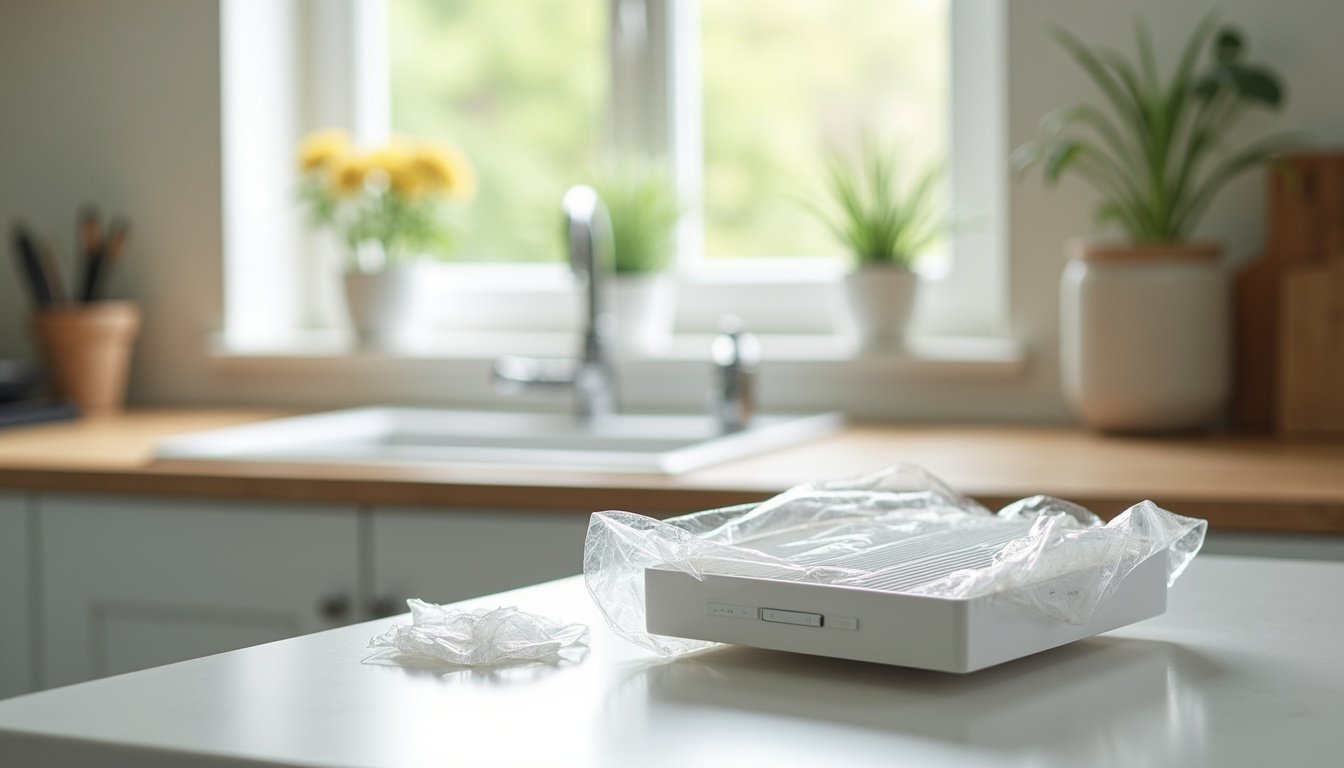
Filters often ship in sealed plastic bags to keep them clean and stop them absorbing moisture and odors in storage. If the bag is left on, air cannot pass through the filter, the fan has to work harder, and the plastic and the warm motor can produce a chemical or melting smell. It is also a frequent cause of weak airflow.
Unplug the unit, open the filter compartment according to the manual, and take out every filter. Remove all wrapping, including any thin inner film around a carbon layer, and put the filters back in the correct order and direction. Most manuals show which side faces the airflow.
A Sharp, Clean Smell: Could It Be Ozone?
Ozone has a sharp, clean smell that some people compare to the air after a thunderstorm or near an electrical appliance. Some types of air cleaners, including ionizers, electrostatic precipitators and some UV models, can produce ozone, and the EPA says that ozone can damage the lungs and may worsen asthma.
Here is the catch: people vary widely in their ability to smell ozone, and the EPA notes that the ability to detect it fades during exposure, so a smell is a warning sign but no smell is not proof of safety. If your unit lists ionization, plasma or UV features and you notice a sharp smell, check the manual and the maker specifications for ozone output. If you are unsure, stop using it and consider switching to a filter-based unit.
| Technology | Can it emit ozone? | What to check |
|---|---|---|
| Mechanical filter (HEPA plus carbon) | Not by design | Confirm there is no ionizer or plasma mode |
| Ionizer or electrostatic precipitator | May, as a by-product | Look for third-party emission testing or certification |
| UV light inside the unit | Some lamp types may | Check the manual and specifications |
| Ozone generator | Yes, on purpose | Avoid in occupied rooms |
Our comparison of HEPA versus ionic purifiers explains the differences in detail.
Worn-Out Carbon and Overloaded Filters
Activated carbon traps odor molecules on its surface, and it has a finite capacity. When a carbon layer is used up, it stops capturing smells, and in a smoky or heavily scented home that can happen faster than the manual interval suggests. A purifier with a spent carbon filter can leave a room smelling just as bad as before and may seem to give off an odor of its own.
The fix is simple: replace the filter on schedule. The EPA says all filters need regular replacement and gives typical recommendations of about every 60 to 90 days for some filters, but the right interval depends on your air. After smoke, renovation or heavy pet shedding, change filters sooner, and check the manual for any washable pre-filter you can clean in between.
| Situation | Filter attention needed |
|---|---|
| Normal home use | Follow the manual interval |
| After wildfire smoke or heavy cooking | Check and replace sooner |
| After painting or renovation | Replace sooner, ventilate well |
| Many pets or shedding | Clean pre-filter often, replace sooner |
| Filter looks gray, matted or smells | Replace now |
Musty or Sour Smells: Damp Filters and Moisture
A musty smell usually means moisture. A filter that has gotten damp, a purifier placed near a humidifier or in a damp basement, or a unit that was stored in a humid space can all develop a stale smell. Do not rinse a filter unless the maker says it is washable, and let any washable part dry completely before putting it back.
If the room itself is damp, a purifier will not solve the problem. Address the moisture, check for leaks, and see a mold professional if you find visible mold or the musty smell is strong. The EPA says source control and ventilation are the most effective strategies.
Burning, Melting or Fishy Electrical Smells
A burning, melting or fishy smell can signal an overheating motor, a failing circuit board, a damaged cord or a poor connection at the plug. These are safety problems, not odor problems. Unplug the unit if it is safe to do so, move it away from fabrics and walls, and do not run it again.
Check whether the model has been recalled on the CPSC recalls page, and keep the receipt and model number for the manufacturer or seller.
When the Smell Is Not the Purifier
Sometimes the purifier is only the messenger. Paint, new carpet, cleaning products, scented candles, cooking and new furniture all release odors, and a purifier running nearby can seem to be producing them. The easiest test is to turn the unit off and unplug it for a few hours in a ventilated room. If the smell stays, the source is elsewhere.
Particle filters do not remove gases well, and a small carbon layer has limited capacity for strong chemical fumes. For a room that smells of fresh paint or solvents, ventilation and waiting are more effective than any purifier.
If You Decide to Replace the Unit
If the unit keeps smelling after you have removed wrapping, replaced filters and ventilated the room, or if you suspect ozone, replacing it is reasonable. Choose a filter-based purifier with a true HEPA filter and a carbon layer sized for your room, and check its listing for ozone information. If you are buying for a smoky or odor-heavy space, our guide on true HEPA versus HEPA-type filters explains what the label means.
Keep the receipt, check the return window, and follow the manual for the first-use routine so the new unit starts out clean.
Fix It in 7 Steps, Cheapest First
- Unplug the unit and sniff the vents. If the smell is burning, melting or fishy, stop here and contact the maker.
- Open a window or door and let the room air out.
- Take out every filter and remove all plastic wrapping and film.
- Reinstall the filters in the right order and direction, and make sure the cover is seated.
- Run the unit on low in a ventilated room for a day and see whether the smell fades.
- Replace any filter that is past its schedule or visibly dirty, and let any washable part dry fully.
- If the smell persists, contact the maker or retailer, and consider swapping to a filter-based model with no ozone features.
Do and Do Not
Do
- Remove all filter wrapping before first use
- Ventilate the room during the first day
- Unplug immediately for burning smells
- Check the manual for the filter schedule
Do not
- Do not keep running a unit that smells like burning
- Do not rinse a filter that is not labeled washable
- Do not mask odors with scented sprays near the unit
- Do not use an ozone generator in an occupied room
Who Should Skip This
Skip this guide if the smell is not from the purifier but from gas appliances. If you smell natural gas or suspect a gas leak, leave the building and call your gas utility or emergency number.
Skip it too if the smell is a musty odor from a damp room and you have not checked for leaks. Fixing the moisture problem comes first and a purifier will not fix it.
Honest Limits
- We cannot identify the exact cause of a smell from a description, and an unusual smell may have more than one cause.
- A purifier is not the right tool for strong gas or solvent odors.
- Filter life depends on your air, so the manual schedule is a starting point, not a guarantee.
- An air purifier is not a substitute for ventilation, source control or fixing a safety fault.
When to See a Professional
If you are coughing, wheezing or have eye or throat irritation that seems linked to the smell, stop using the unit, get fresh air and talk to a doctor if symptoms continue. This page is general information, not medical advice.
For burning smells, damaged wiring or hot outlets, call a qualified electrician, and contact the manufacturer for a repair or replacement under warranty.
Frequently Asked Questions
Is it normal for a new air purifier to smell like plastic?
A faint plastic smell from a new unit is common and usually fades in a day or two as materials settle. Run it on low in a ventilated room. If the smell is strong, gets worse or causes irritation, stop using it and contact the maker.
Why does my air purifier smell like chemicals after I changed the filter?
The most common cause is plastic wrapping left on the new filter. Unplug the unit, remove every layer of film and bag, and reinstall the filter in the correct direction. Some new carbon filters may also have a faint smell at first.
Can an air purifier produce ozone?
Some can. The EPA says ionizers, electrostatic precipitators and some UV units may emit ozone as a by-product, and ozone generators make it on purpose. Check the manual, look for certification, and choose filter-based units if you want to avoid it.
What does ozone smell like?
Many people describe a sharp, clean smell like the air after a thunderstorm. But the EPA notes that people differ widely in their ability to smell it, and the ability fades with exposure, so a lack of smell does not mean it is safe.
My air purifier smells like burning. What should I do?
Unplug it if it is safe to do so, move it away from fabrics, ventilate the room and do not use it again. Contact the manufacturer and check for recalls. If you see smoke or flames, leave and call emergency services.
Why does my purifier smell musty?
Usually moisture. A damp filter, a humid room or a unit placed near a humidifier can cause a stale smell. Dry the room, replace a damp filter and let washable parts dry fully. If you see mold or the smell is strong, call a mold professional.
Can a dirty filter make a purifier smell worse?
Yes. A filter loaded with dust, smoke or odors can stop working well and may give off the smells it has collected. Replace filters on the maker schedule, and sooner after smoke, renovation or heavy pet shedding.
How long should I run a new air purifier before the smell goes away?
Often a few hours to a couple of days on low in a ventilated room. If the smell is still there after several days or is getting stronger, stop using it and contact the seller, because a persistent smell can mean a defect.
Will opening a window help?
Yes. Ventilation dilutes odors and is one of the most effective ways to improve indoor air, according to the EPA. Opening a window during the first hours of use lets the new-unit smell clear faster, but avoid it on days with heavy outdoor smoke.
Should I replace a purifier that keeps smelling?
If wrapping is removed, filters are fresh and the room is ventilated, but the smell persists, replacing it is reasonable, especially if you suspect ozone or an electrical fault. Choose a filter-based unit and use the return window if it is still open.
Bottom Line
Most chemical-type smells from an air purifier have an ordinary cause: new materials, forgotten wrapping, a damp or worn-out filter, or a source in the room that the purifier is only picking up. Those are quick to fix. A burning, melting or fishy electrical smell, or a persistent sharp smell you suspect is ozone, belongs in a different category, and the right response is to unplug the unit and contact the maker.
Work through the steps in order, give a new unit a ventilated start, and replace filters on schedule. If you decide to replace the unit, pick a filter-based model sized for the room and avoid ozone-producing devices.
Related reading: HEPA versus ionic purifiers, true HEPA versus HEPA-type filters, UV light in air purifiers.