Last updated:
Disclosure: As an Amazon Associate we earn from qualifying purchases. This does not change what we recommend. See our affiliate disclaimer.
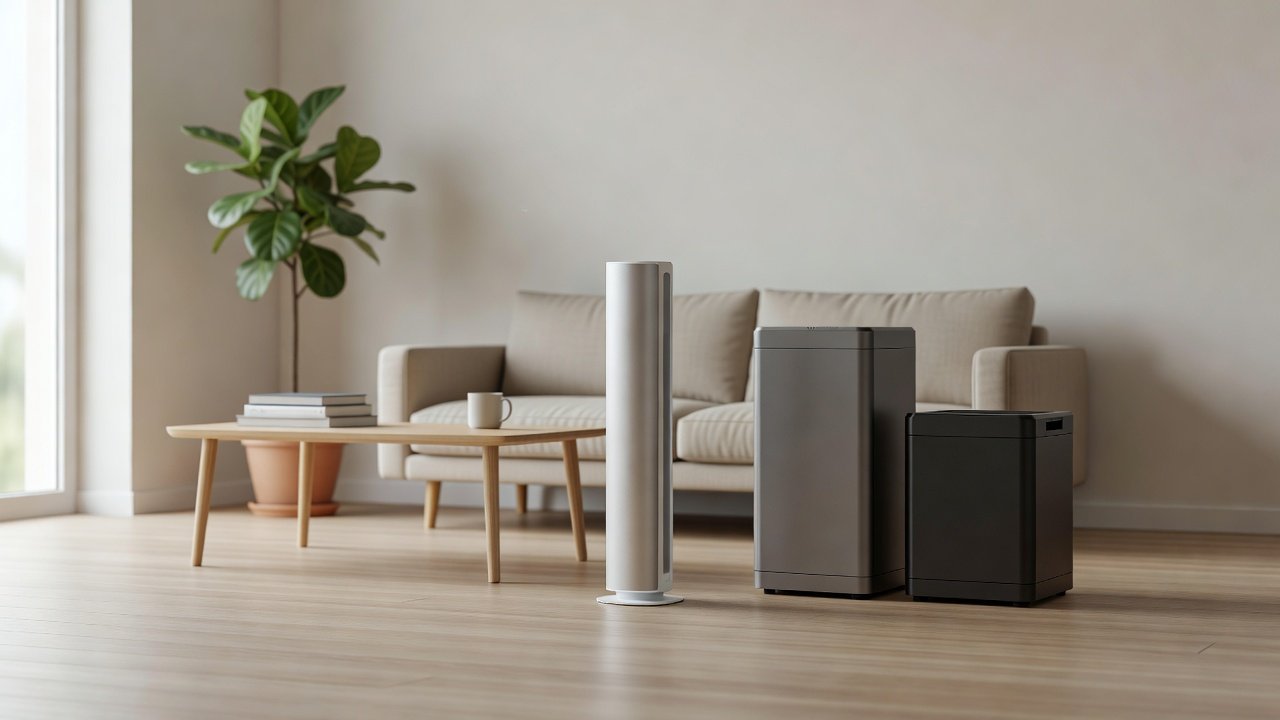
Weight is an easy spec to overlook when you shop for an air purifier, but it tells you something about the unit. A light, compact purifier is easy to move between rooms, fits on a desk or shelf and is a natural choice for small spaces. A heavy purifier usually has a larger filter, a stronger fan and sturdier build, which tend to go with higher airflow for bigger rooms. Neither is better in the abstract; the right one depends on how you will use it.
This guide compares lightweight and heavy purifiers, explains what weight implies about performance and helps you decide. We have not tested these products ourselves, and models change, so confirm specifications on the product page.
Lightweight suits
- Small rooms and desks
- Moving between rooms
- Renters and dorms
Heavier units suit
- Large rooms and open plans
- Higher airflow needs
- A fixed spot in the home
Key Takeaways
- Weight hints at filter size and fan strength, but CADR is the number to compare.
- Lightweight units suit small rooms, desks and moving between rooms.
- Heavier units suit large rooms where airflow and quiet operation at low speed matter.
- A purifier only cleans the room it is in, so portability helps only if you actually move it.
Real-World Scenarios
A student in a 120 square foot dorm room needs a smoke CADR of about 80. A compact, lightweight unit with a carry handle that fits on a desk or the floor is ideal, and can go home at the end of term. A remote worker with a 200 square foot home office who wants to move the unit to the bedroom at night can pick a mid-weight unit with a smoke CADR of about 135 and a quiet sleep mode.
A family with a 400 square foot living room and a dog needs a smoke CADR near 270, which usually means a larger and heavier unit with wheels or handles, placed where the family spends time. For a home with several small rooms, a mix works: compact units in bedrooms and a larger one in the main room. Matching each unit to its room is more effective than moving one unit around.
What to Check Before You Buy
Check the weight and dimensions on the product page and compare them with where the unit will sit. Look at the smoke CADR and the recommended room size, and compare with your floor area. Read the noise ratings on low and high. Check for handles, wheels and a filter access panel. Look up replacement filter cost and availability.
Finally, think about how the unit will be used in practice. A portable purifier that is never moved is just a small purifier, and a heavy one in a spare room is wasted. Choose for the room and the routine you actually have, and confirm specifications before you buy.
Travel, Storage and Everyday Handling
If you plan to move a purifier often, think about the practicalities. Does the unit have a built-in handle or a grip that makes it comfortable to carry? Is the cord long enough and does it wind up neatly? Can the unit be stored in a closet without damage to the filter or the housing? Keep any plastic wrap or covers off the filter while it is running, and store the unit upright, with the filter in place, in a dry spot.
When you move a purifier, switch it off and unplug it first. Place it on a stable, level surface in the new room, with open space around it, and allow a few minutes of running before judging the result. If you move the unit between a smoky kitchen and a bedroom, check the filter more often, since cooking particles load it quickly. Small habits like these keep a portable unit working well and prevent damage from being knocked or dropped.
Air Purifiers to Compare
The table below lists purifiers from our affiliate partner. Compare smoke CADR, room size ratings and dimensions, and check the product page for weight and handles.
When a Heavy Unit Is Better
For a large living area, an open-plan space or a room with heavy dust, pets or smoke, a heavier unit with higher airflow is generally the better choice. It can run at a lower speed to deliver the same air, which is quieter. Because it will stay in one place, weight is less of a drawback.
Make sure you can handle the weight when you need to change filters or move the unit for cleaning. Look for handles or wheels on larger models.
Lightweight vs Heavy at a Glance
The table below summarizes the comparison.
| Factor | Lightweight | Heavy |
|---|---|---|
| Typical room | Small | Medium to large |
| Airflow | Lower | Higher |
| Portability | Easy | Harder |
| Filter size | Smaller | Larger |
| Best for | Desks, bedrooms, renters | Living rooms, open plans |
What Weight Tells You
A heavier purifier usually contains a larger filter, a bigger fan and more robust housing. Those add up to higher airflow, which is what a large room needs. A lighter unit often has a smaller filter and a smaller fan, which suits a small room but can struggle in a larger one.
Weight is not a guarantee of performance. A heavy unit can be poorly designed, and a light one can be efficient. Always check the smoke CADR and the recommended room size, and compare them with your space.
When Portability Matters
If you want to move the purifier between the bedroom during the night and the living room during the day, a lightweight unit with a handle is far more practical. Renters, students and people who work from home in different rooms often value this. Lighter units can also be placed on a table or shelf, which is useful where floor space is limited, though a floor position often draws air better.
Remember that a purifier cleans the room it is in. Moving it is only helpful if you do so consistently. If you need clean air in two rooms at the same time, two small units usually beat one portable one.
Small Footprint, Small Room: The Lightweight Case
A lightweight purifier is often compact, which makes it a natural fit for a bedroom, dorm, home office or nursery. In these spaces a smaller unit can deliver enough air changes per hour without taking over the room. Many compact models have a smoke CADR in a range suitable for rooms up to about 150 square feet, which matches the AHAM guide of two-thirds of the floor area.
The advantages go beyond size. A small unit tends to draw less power, is easy to tuck onto a shelf or a table and can be moved when you rearrange the room. If you rent, you can take it with you without fuss. The disadvantages are limited airflow and smaller filters that may need changing more often, especially if the room has a lot of dust or a pet.
Airflow and Noise: The Physics of Size
Moving a lot of air quietly takes a big fan turning slowly, and a big fan needs room. That is why heavier, larger units often manage to be quieter at a given airflow than small ones, which must spin a small fan faster. If noise matters and your room is large, a heavier unit may serve you better.
At the same time, a small unit in a small room can be perfectly quiet on a low setting. Judge by the sound rating at the setting you plan to use. Do not confuse the lowest-setting rating with how loud the unit will be at the speed you need to keep up with your room.
Handling Filters and Maintenance
Weight and size affect upkeep. A light unit is easy to lift and tilt when you need to remove the filter or clean the intake. A heavy one can be awkward, especially if you have to turn it over. Look for designs with a front or rear access panel and a handle, and check the manual to see how filters are removed.
Filter size also differs. Larger units often have larger filters that last longer, while small units need replacements more often. Compare the replacement cost and interval before you buy.
Stability, Safety and Placement
Lightweight units can be tipped by pets or children, so place them on a stable surface, keep cords out of reach and follow the manual about placement. Heavy units are more stable on the floor but can be hazardous to move, so use proper lifting technique. In either case, leave a foot or more of clear space around the unit, and keep it away from curtains and wall corners.
If you place a unit on a table, make sure the table is sturdy and that the unit cannot be pulled off. In a nursery, keep the unit and cord out of reach.
Choosing for Your Situation
If you want one unit for a small bedroom or office and may move it, choose lightweight with a good CADR for the room. If you want a unit for a big living area, choose a heavier one with higher CADR and look for wheels or handles. If you want clean air in several rooms, consider a light unit in each small room and a heavier one for the main living area.
Whichever you choose, check the specifications on the product page, keep the filter schedule and place the unit with open space around it.
How to Choose
- Choose by smoke CADR for your room first.
- Consider weight if you will move the unit often.
- Check for a carry handle on portable units.
- Make sure you can change the filter easily.
- Avoid ozone generating or ionizer modes; the EPA advises against ozone-emitting air cleaners.
Do
- Match the unit’s rated coverage to your room first
- Run it consistently, not only when the air feels bad
- Leave space around the unit for airflow
- Replace filters on the maker’s schedule
Don’t
- Do not buy on looks or price alone
- Do not block the intake or exhaust
- Do not skip filter changes
- Do not expect a purifier to fix every source of pollution
Honest Limits
- This guide uses manufacturer information and public guidance from the EPA and AHAM, not our own lab tests.
- Features and room ratings change between model years, so confirm on the listing before you buy.
- A purifier is not a medical device and does not replace medical advice or treatment.
Who Should Skip This
When to See a Professional
Pick the lightest unit that still has enough CADR for the room.
Frequently Asked Questions
Is a heavier purifier better?
Not always. It often means bigger filters and a stronger fan, but check the CADR.
Is a lightweight purifier good enough?
For small rooms, yes. In large rooms it may struggle.
Can I carry a purifier between rooms?
Yes, with a lightweight model, but it cleans only the room it is in.
Are heavy units quieter?
Often at the same airflow, because larger fans can turn more slowly.
Do heavy units use more power?
Higher airflow models can, so check the power draw.
Where should I put a lightweight unit?
On a stable surface or the floor with space around it.
Is weight listed on the product page?
Usually; check the specifications.
How do I change the filter on a heavy unit?
Follow the manual, and use handles or an access panel.
Do lightweight units need more frequent filter changes?
Often, because the filters are smaller.
Can I use two light units instead of one heavy one?
Yes, in different rooms or at different points of a large space.
Bottom Line
Weight is a clue about size and airflow: lightweight for small and portable use, heavier for big rooms.
Match the unit to the room by CADR, and confirm weight and specifications on the product page.
Related reading: sens,fan,bed
Sources: EPA, Guide to Air Cleaners in the Home; AHAM Verifide.