Last updated:
Disclosure: As an Amazon Associate we earn from qualifying purchases. This does not change what we recommend. See our affiliate disclaimer.
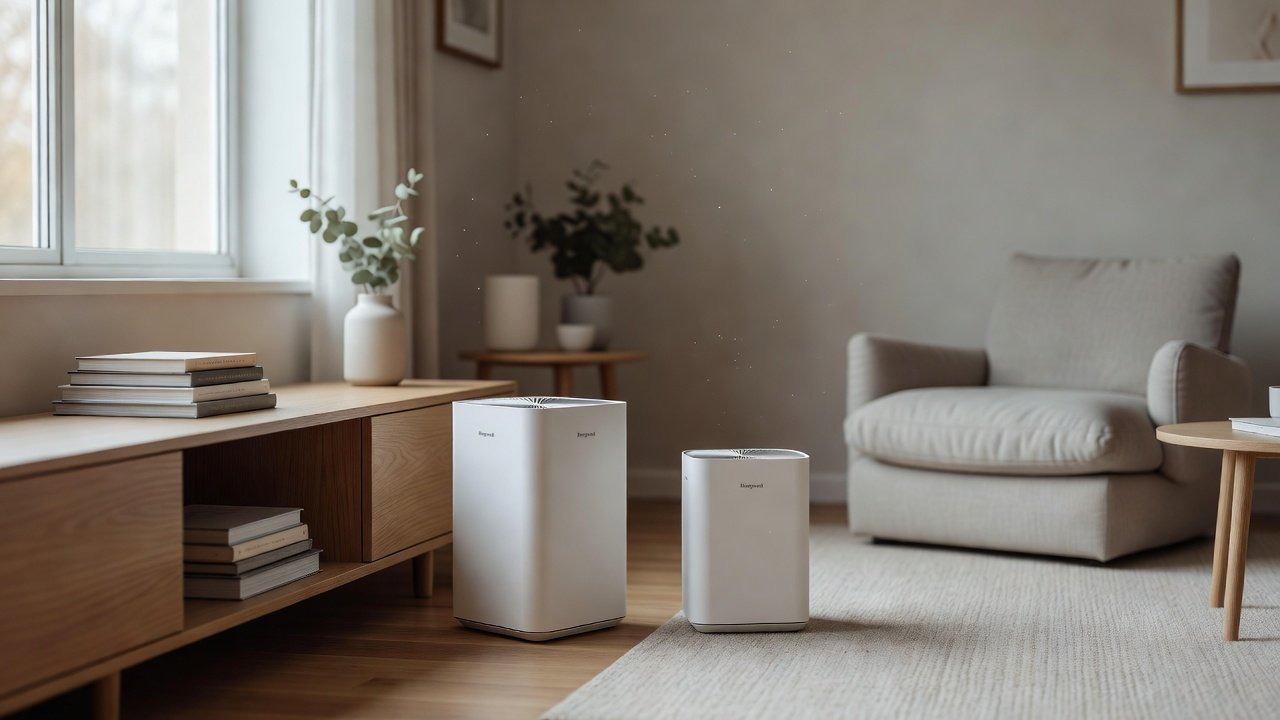
The Honeywell HPA200 and HPA300 are two models from the same True HEPA family, and the choice between them is largely a question of room size. In general terms, the HPA200 is the smaller of the two, aimed at medium rooms, while the HPA300 is the larger, aimed at big bedrooms, living rooms and open areas. They share a similar approach: a pre-filter, a True HEPA filter, a set of speed settings and a straightforward set of controls.
Because they look similar, many shoppers wonder whether the larger one is worth the extra money. This guide explains the differences in general terms and offers a way to decide for your own room. We have not tested these products ourselves, and specifications and filter details can change between versions, so confirm the current CADR, room size rating, filter type and noise figures on the product pages before buying.
The HPA200 may suit you if
- Your room is medium sized
- You want a smaller footprint
- You do not need maximum capacity
The HPA300 may suit you if
- Your room is large or open
- You want to run on a low, quiet speed
- You want spare capacity for smoke or pets
Key Takeaways
- The HPA300 is the larger model; the HPA200 suits medium rooms.
- Match smoke CADR to your room and add margin.
- A larger unit can run on a lower, quieter speed.
- Check filter part numbers, intervals and prices before buying.
- Leave clearance around the unit and keep it away from walls and curtains.
- Confirm current specs on the product page since models change.
- Avoid ozone or ionizer modes; the EPA advises against ozone-emitting air cleaners.
What to Check When the Unit Arrives
When your purifier arrives, unbox it carefully and check that nothing is missing. Remove all packaging from the filters, including any plastic wrap or protective film, since leaving it on blocks airflow and defeats the purpose. Seat the filter according to the manual, close the cover firmly and plug the unit in. Run it on each speed and listen for rattles, whistling or an unusual smell. A faint new-plastic smell can occur at first and usually fades; a burning smell does not, and if you notice it, unplug the unit and contact the maker.
Place it in your chosen spot and live with it for a few days. Note the noise at night, the airflow, the brightness of the indicator and the way the room feels. If something bothers you, use the return window while it is open. Register the product if registration is offered and keep your receipt in a safe place.
Mistakes Buyers Make With This Pair
A common mistake is choosing the smaller model for a room that is bigger than its rating, then running it on high and finding it loud. Another is ignoring filter costs. A third is failing to check that replacement filters are available in your region. A fourth is blocking the intake with furniture. A fifth is forgetting to reset the filter indicator. All of these are easy to avoid with a little planning. Measure, compare, check, place and maintain, and either model will do what it is designed to do.
Air Purifiers for Larger Rooms to Compare
The table below lists purifiers for larger rooms from our affiliate partner. Compare CADR, room size ratings and filter details, and confirm the current specifications on each product page.
Filters and Running Costs
Both models use True HEPA filters and a pre-filter, and the replacement filters differ in size and price. Check the part numbers, the recommended replacement intervals and the cost of each. The larger unit may use a larger and more expensive filter. Over several years, filter costs will be a large part of the total, so estimate the annual cost for each.
Electricity use is the other running cost. The larger unit draws more power at the top speed, but on a low speed, the difference is small. Include both in your comparison to see the true cost of ownership.
Quick Comparison
The table below summarizes the general differences. Confirm figures on the product pages.
| Factor | HPA200 | HPA300 |
|---|---|---|
| Room coverage | Medium rooms | Larger rooms |
| Capacity (CADR) | Lower | Higher |
| Footprint | Smaller | Larger |
| Noise at same cleaning | Often louder on high | Often quieter on low |
| Best for | Medium bedrooms and offices | Large bedrooms, living rooms |
The Core Difference: Capacity
The main difference between the two models is how much air they can clean. The HPA300 has a higher CADR and a larger stated room size rating than the HPA200. In practice, this means it will clean the same room faster, or clean a larger room at a comparable pace. For a room near the upper limit of the HPA200’s rating, the HPA300 would offer more comfortable margin.
Check the current figures for both, and compare them with your room using the two-thirds rule: the smoke CADR should be about two-thirds of the floor area in square feet for rooms with 8 foot ceilings. If the HPA200 only just meets your requirement, you would have to run it near its top speed to keep up, which is louder. The HPA300 could meet the same requirement on a lower setting.
Size, Noise and Placement
A larger unit takes more space. Check the dimensions and weight of both and measure the spot where you plan to put it. Leave clearance as the manual advises. Because the HPA300 moves more air, it can sound louder at its top speed than the HPA200 at its top speed, but at the same amount of cleaning it may be quieter, because it runs more slowly. Compare the published noise figures at the speeds you will actually use.
For a bedroom, think about whether you prefer a smaller unit that you hardly notice or a larger unit that can run on its quietest setting. For a living room or open area, the larger unit is the more natural fit.
Matching Each Model to Real Rooms
Consider a 200 square foot bedroom with 8 foot ceilings. Two-thirds of 200 is about 133, so you need a smoke CADR near 133. A model rated well above that can run on a low speed. Consider a 350 square foot living room: you need a smoke CADR near 233, and the smaller model may be at or beyond its limit, while the larger model has margin. Consider a 500 square foot open plan space: the requirement is around 333, and the larger model may only just reach it, so a second unit or a different approach might be needed.
Use your own numbers. Measure the floor area and ceiling height, calculate the target, check the published CADR for each model and see which has margin. The comparison is easier than it sounds and removes most of the guesswork.
Controls, Filters and Daily Use
Both models keep controls simple, with a few speeds and an indicator for filter changes. That simplicity is a strength for people who want to plug in and forget. Check the manual for how to reset the filter indicator after changing filters. Keep spare filters, write the install date on the frame and check the pre-filter regularly. A washable pre-filter, where fitted, extends the life of the main filter.
Placement Advice
Place the unit in an open spot with clearance on all sides. Avoid corners and tight spaces, and keep it away from curtains and furniture that could block the intake. In a bedroom, a few feet from the bed works well. In a living room, place it near the main seating area. Keep doors closed when you want the best results. If you use the unit on the floor, vacuum around it to prevent dust from being drawn into the intake.
Total Cost of Ownership
Add up the purchase price, five years of filters and an estimate of electricity. A larger unit costs more to buy and its filters may cost more, but if it lets you run on a low speed in a larger room, it may give better value. A smaller unit that is too small for your room is a false saving: you will run it harder and replace filters more often. Calculate the total for both and compare.
Which Should You Pick?
If your room is medium sized and you want a compact, simple unit, the HPA200 may be enough. If your room is large, open or has high ceilings, or if you want to run quietly with spare capacity, the HPA300 is likely the better choice. If you are close to the line, go larger. Buy from a seller with a fair return policy and test the unit at home.
How to Choose
- Measure your room and match smoke CADR to it.
- Choose the larger unit if the smaller is near its limit.
- Compare noise at the speeds you will use.
- Check replacement filter prices and intervals.
- Avoid ozone generating or ionizer modes; the EPA advises against ozone-emitting air cleaners.
Do
- Match the unit’s rated coverage to your room first
- Run it consistently, not only when the air feels bad
- Leave space around the unit for airflow
- Replace filters on the maker’s schedule
Don’t
- Do not buy on looks or price alone
- Do not block the intake or exhaust
- Do not skip filter changes
- Do not expect a purifier to fix every source of pollution
Honest Limits
- This guide uses manufacturer information and public guidance from the EPA and AHAM, not our own lab tests.
- Features and room ratings change between model years, so confirm on the listing before you buy.
- A purifier is not a medical device and does not replace medical advice or treatment.
Who Should Skip This
Skip a unit that is clearly too small for your room.
Skip ozone generators and ionizers that emit ozone; the EPA advises against them.
When to See a Professional
If you have asthma or allergies, a purifier supports but does not replace the plan your doctor gives you.
If a unit smells of burning or sparks, stop using it and contact the maker.
Frequently Asked Questions
What is the main difference between the HPA200 and HPA300?
The HPA300 is the larger model with more capacity and coverage.
Which is quieter?
At the same cleaning level the larger unit can run slower and quieter, but compare published noise at your speeds.
Which should I buy for a bedroom?
Match smoke CADR to your room; a medium bedroom may suit the HPA200, a large one the HPA300.
Do they use the same filter?
Filters differ by model, so check the part numbers.
How often do filters need replacing?
Follow the maker, often every 6 to 12 months, sooner in smoky or dusty homes.
Can I wash the filter?
Only if the manufacturer says it is washable.
How do I size the unit?
Match smoke CADR to roughly two-thirds of the floor area for 8 foot ceilings and add margin.
Is the larger model worth the extra cost?
If your room is near the smaller model’s limit, yes.
Where should I place the purifier?
Leave clearance around it and keep it away from walls and curtains.
Are ionizer modes safe?
Some produce ozone, which the EPA advises against.
Bottom Line
The HPA200 suits medium rooms, while the HPA300 offers more capacity for large rooms and quieter running on a lower speed.
Match the model to your room, then compare filter costs before you decide.
Related reading: sens,fan,bed
Sources: EPA, Guide to Air Cleaners in the Home; AHAM Verifide.