Last updated:
As an Amazon Associate we earn from qualifying purchases. This does not change what we recommend. See our affiliate disclaimer.
A used air purifier filter is an awkward object. It is full of the dust, pollen, dander, smoke and spores you bought the machine to remove, it is bulky, and its plastic frame suggests it ought to go somewhere better than the bin. Most people hover over the trash with it, unsure.
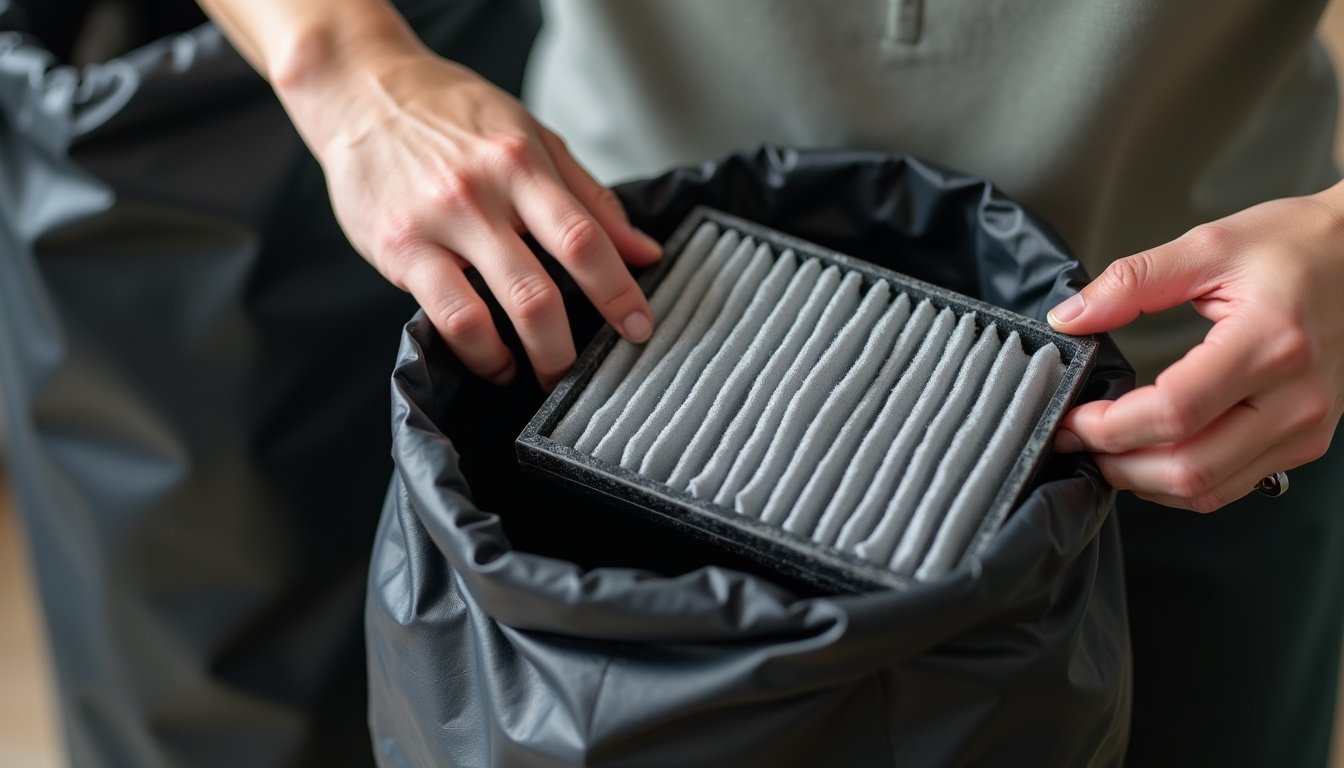
Nearly every air purifier filter goes in the household trash, sealed in a bag. HEPA media is a dense mat of glass or synthetic fibers bonded to a cardboard or plastic frame with a mesh and gasket; the mixed materials and the load of trapped particles make it unrecyclable through any curbside program. Activated carbon filters are the same story: granules or carbon cloth bonded to a frame, saturated with whatever they adsorbed, with no recovery route for household quantities. The sensible routine is to bag the filter at the purifier, before carrying it through the house, tie the bag and put it out with the regular trash. Pre-filters and washable permanent filters are the exception, since they are cleaned and reused for years, and a few makers run take-back schemes for their own cartridges. Filters that captured anything hazardous, which is rare in a home, follow the rules for that hazard. None of this is complicated, but a few details, from bagging without shaking dust loose to what to do with a plastic frame, keep the job clean.
In short: bag it at the machine, tie it and put it in the trash. Do not try to recycle HEPA or carbon filters, do not shake or vacuum them out, and check whether your maker takes old cartridges back.
The EPA’s guidance on air cleaners describes HEPA and carbon filters as replaceable consumables and, for ordinary household use, treats spent filters as regular solid waste. Maker manuals from major brands direct users to dispose of used filters in household waste in a sealed bag, and a handful offer mail-back recycling for their own products.
This guide is research-based, drawn from EPA guidance, maker manuals and municipal waste guidance. We have not tested the units in the comparison table and quote no prices or ratings. Nothing here is medical advice.
Household trash, bagged
- HEPA filters of every brand and grade
- Activated carbon filters and cartridges
- Combination HEPA and carbon filters
- Disposable pre-filter sheets and foam
Different route
- Washable pre-filters and permanent filters: rinse and reuse
- Maker take-back cartridges: mail or drop off per the scheme
- Plastic-framed filters where the frame separates cleanly: frame to recycling, media to trash
- Filters from asbestos, lead or chemical cleanups: follow hazardous waste rules
Key Takeaways
- HEPA and carbon filters are mixed materials loaded with captured particles; they are not recyclable and go in household trash.
- Bag the filter at the purifier before carrying it through the house, so the dust stays in the bag rather than back in the air.
- Never shake, vacuum or blow out a used HEPA filter; it releases what it caught and does not restore the filter.
- Washable pre-filters and permanent filters are rinsed, dried and reused, not thrown away.
- A few makers take back their own cartridges; check the manual or website before binning a branded filter.
- Plastic frames that separate cleanly can go in recycling; glued cardboard frames go with the media.
- Filters from hazardous cleanups follow the hazard’s disposal rules, not household trash.
Purifiers With Simple Filter Changes and Clear Disposal Guidance
These widely reviewed units use a single HEPA and carbon cartridge that lifts out without tools, so a filter change is a one-minute job that ends with the old cartridge going straight into a bag. Check each maker’s site for take-back schemes.






How This Guide Approaches the Question
We looked at what filters are made of, why that rules out recycling, how makers and the EPA describe disposal, and how to handle a loaded filter without releasing what it has captured. Product details in the table come from maker specifications.
The one rule that matters most is simple: a used filter is a bag of dust, and the goal of disposal is to keep it that way until it reaches the landfill.
What Filters Are Made Of, and Why That Decides Disposal
A HEPA filter is a pleated mat of very fine fibers, borosilicate glass in most, synthetic polymer in some, pleated and often separated by glue beads, sealed into a frame of cardboard, plastic or occasionally metal, with a foam or rubber gasket and sometimes a metal or plastic mesh. After months of use the media holds grams of dust, pollen, dander, soot, spores and whatever else passed through. No curbside program accepts it: the fibers are not a recyclable plastic, the materials cannot be separated economically, and the load of particles contaminates any stream.
Activated carbon filters hold granules or a carbon-coated cloth in a frame. Spent carbon is saturated with adsorbed odors and gases and is not reusable in household quantities; industrial carbon is sometimes reactivated, but no consumer route exists. Combination filters bond HEPA and carbon together and inherit both problems.
| Filter type | Materials | Recyclable at home? | Disposal |
|---|---|---|---|
| True HEPA | Glass or synthetic fibers, glue, cardboard or plastic frame, gasket | No | Bagged household trash |
| HEPA-type or ‘HEPA-like’ | Synthetic media, plastic frame | No | Bagged household trash |
| Activated carbon | Carbon granules or cloth, plastic or cardboard frame | No | Bagged household trash |
| Combination HEPA and carbon | All of the above bonded | No | Bagged household trash |
| Disposable pre-filter sheet | Nonwoven synthetic | No | Household trash |
| Washable pre-filter | Nylon mesh or foam | Not disposed | Rinse, dry, reuse |
| Permanent filter | Metal or plastic mesh, electrostatic plates | Not disposed | Wash per manual, reuse for years |
| Metal frame or housing | Steel or aluminum | Sometimes | Scrap metal if separable |
Bag It at the Machine
The mistake most people make is carrying a loaded filter across the house to the bin, trailing dust the whole way. Bring the bag to the purifier instead. A kitchen trash bag or the bag the new filter came in works; some makers ship replacement filters in a plastic sleeve sized for exactly this purpose. Open the bag, hold it over or beside the filter compartment, lift the old filter out and slide it in without tilting or tapping it, then tie the bag. The dust side of a HEPA filter is the side facing the intake; keep that side away from your face.
- Switch the purifier off and unplug it.
- Open a trash bag and bring it to the unit.
- Open the filter compartment and lift the filter straight out, dust side away from you.
- Slide the filter into the bag without shaking or tapping it; tie the bag.
- Wipe the empty compartment with a damp cloth and let it dry.
- Fit the new filter, reset the filter indicator and plug the unit back in.
- Put the bag out with household trash.
What Not to Do With a Used Filter
Do not shake a HEPA filter out, bang it against the bin, vacuum it or blow it clean with compressed air. None of these restore the filter, because particles are lodged deep in the fiber mat, and all of them release a cloud of what the filter spent months capturing, right into the room the purifier was cleaning. Compressed air also tears the fine media. Do not wash a HEPA filter either; water collapses and mats the fibers and the filter loses its rating, and a wet filter grows mold.
Do not burn filters, indoors or out. Synthetic media and plastic frames release fumes, and the trapped particles are released. Do not compost them; the media is not organic and the dust is not compost. Do not put them in recycling hoping for the best, since they contaminate the load and are pulled at the sorting facility.
| Action | Result |
|---|---|
| Shaking or tapping out | Releases captured dust; filter no better |
| Vacuuming the media | Releases dust; vacuum exhaust spreads the finest fraction |
| Compressed air | Tears media; releases dust |
| Washing HEPA | Collapses fibers; loses rating; mold risk |
| Burning | Fumes from plastic and media; releases particles |
| Recycling bin | Contaminates the stream; pulled at sorting |
| Bagging at the machine and binning | Dust stays contained; correct |
Washable Pre-Filters and Permanent Filters
Many purifiers have a mesh or foam pre-filter that catches hair, lint and large dust before the HEPA stage. These are not disposed of; they are rinsed under a tap, left to dry completely, and refitted, every two to four weeks or when visibly loaded. Permanent electrostatic or metal mesh filters in some units are washed the same way on the maker’s schedule and last the life of the appliance. Dry them fully before refitting; a damp pre-filter in front of HEPA media invites mold.
When a washable pre-filter finally tears or its frame breaks, after years, it goes in household trash. A plastic mesh pre-filter on its own is technically recyclable plastic in some programs, but the type is rarely marked and the piece is small; the trash is the realistic route.
Maker Take-Back and Recycling Schemes
A handful of makers run programs that accept their own spent filters by mail or at drop-off points, separating frames and media for processing that is not available to households. These schemes are brand-specific and change over time; check the manual, the filter packaging and the maker’s website before assuming either way. Where a scheme exists, the filter is usually bagged and shipped in the replacement’s box, which keeps the dust contained in transit. Where none exists, the household trash is correct, and no third-party recycler accepts loose HEPA or carbon filters.
Filters After Smoke, Mold and Hazardous Cleanups
Ordinary household use loads a filter with dust, pollen, dander, cooking and traffic particles; bagged trash is correct. Some situations change that. A filter run during a wildfire smoke event is heavily loaded with soot but is still household waste, bagged. A filter run during an indoor mold cleanup carries spores; bag it tightly and replace it, since a spore-laden filter can smell musty and shed if disturbed, and remember that mold over about ten square feet is a job for a professional. A filter run during work involving asbestos, lead paint or chemical spills has captured that hazard and follows the disposal rules for it, typically through a licensed hazardous waste route; a consumer purifier should not have been the control in those jobs in the first place.
| Situation | Filter disposal |
|---|---|
| Normal household use | Bagged household trash |
| Wildfire smoke season | Bagged household trash; replace early if airflow drops |
| After a small indoor mold cleanup | Double bag; household trash; replace promptly |
| Lead paint, asbestos or chemical work | Follow hazardous waste rules for that material; contact local authority |
| Flood or sewage exposure | Double bag; household trash; replace immediately |
| Heavy pet dander or allergy households | Bagged household trash; a mask for the sensitive |
How Often Filters Become Waste
HEPA filters typically last six to eighteen months depending on the unit and the household; carbon filters three to six months since they saturate faster. Running the purifier on auto in a clean home stretches that, while smoke, pets and renovation shorten it. The filter indicator on most units is a timer, not a sensor, so judge by airflow, odor and the maker’s interval as well. Changing on time keeps the purifier effective and keeps the number of filters in the trash to two or three a year, which is a modest footprint for the job they do.
Worked example: a two-bedroom home with a dog runs one HEPA purifier year round. The pre-filter is rinsed monthly, the carbon changed every four months and the HEPA yearly, each bagged at the machine. That is four bags of filter a year in the trash, three new-filter boxes in the recycling, and no dust on the hallway floor.
How to Dispose of a Filter in 6 Steps
- Unplug the purifier and bring an open trash bag to it rather than carrying the filter to the bin.
- Lift the old filter straight out, dust side away from your face, and slide it into the bag without shaking or tapping.
- Tie the bag and put it with household trash; HEPA and carbon filters are not recyclable.
- Rinse washable pre-filters and permanent filters instead of discarding them, and dry them fully before refitting.
- Check the maker’s manual or website for a take-back scheme before binning a branded cartridge.
- Recycle the new filter’s cardboard packaging and, if it separates cleanly and your program accepts it, a rigid plastic frame.
Do and Do Not
Do
- Bag the filter at the machine.
- Put HEPA and carbon filters in household trash.
- Rinse and reuse washable pre-filters.
- Check for maker take-back schemes.
- Recycle the clean packaging.
Do not
- Do not shake, vacuum or blow out a used HEPA filter.
- Do not wash HEPA media.
- Do not put filters in the recycling bin.
- Do not burn or compost filters.
- Do not treat a filter from a hazardous cleanup as household trash.
Who Should Skip This
If the filter in your hand is a washable pre-filter or a permanent filter, you are not disposing of anything; rinse it, dry it and put it back. Only HEPA and carbon media are consumables.
If the maker runs a take-back scheme for your model, skip the trash and follow the scheme; the filter is still bagged, usually in the new filter’s box, and the dust stays contained in transit.
Honest Limits
- Municipal waste rules vary; where yours differ from this general guidance, follow them.
- Maker take-back schemes change; check current terms rather than relying on the packaging.
- Plastic frame recyclability depends on the resin and your local program.
- Filter lifespans are typical ranges; actual intervals depend on the home.
- Hazardous cleanup disposal is governed by local regulation and is beyond household guidance.
- Nothing here is medical advice; people with dust or allergy sensitivities should take their own precautions.
When to See a Professional
Call your local waste authority if a filter was used during lead, asbestos or chemical work, for the correct hazardous waste route; and a mold remediation professional for mold over about ten square feet, who will handle contaminated filters as part of the job.
Contact the maker if the filter compartment or housing is damaged during a change, or if a filter will not seat properly; a poor seal lets air bypass the filter.
Frequently Asked Questions
How do I dispose of a HEPA air purifier filter?
Bring a trash bag to the purifier, lift the filter straight out with the dusty side away from you, slide it into the bag without shaking, tie it and put it out with household trash.
Can air purifier filters be recycled?
Not through household programs. HEPA and carbon filters combine fibers, glue, frames and gaskets that cannot be separated economically, and the captured dust contaminates any recycling stream. A few makers run take-back schemes for their own cartridges; the cardboard packaging from a new filter and some rigid plastic frames are the only recyclable parts.
Should I vacuum or shake out my HEPA filter before throwing it away?
No. Particles are lodged deep in the fiber mat, so shaking, tapping, vacuuming or blowing with compressed air releases months of captured dust into the room without restoring the filter, and compressed air tears the media. Bag the filter whole at the machine and let it go to the landfill intact.
How do I dispose of activated carbon filters?
The same way as HEPA: bagged, in household trash. Spent carbon is saturated with adsorbed odors and gases and cannot be reactivated at household scale, and the granules or cloth are bonded to a frame. Carbon is not hazardous in itself, so no special route is needed for ordinary home use.
Can I wash a HEPA filter instead of throwing it out?
No. Water collapses and mats the fine fibers, the filter loses its rating permanently, and a damp filter grows mold. Only pre-filters and permanent filters marked washable are rinsed and reused. If a HEPA filter looks grey and loaded, that is the end of its life; bag it and fit a new one.
Are used air purifier filters hazardous waste?
Not from ordinary household use; they hold dust, pollen, dander and soot and go in household trash. They become hazardous only if used during lead paint, asbestos or chemical work, in which case they follow the disposal rules for that material through your local authority.
What do I do with the plastic frame on the filter?
If the frame separates cleanly from the media and carries a resin code your program accepts, it can go in plastics recycling. Most frames are glued to the media or unmarked, in which case the whole filter goes in the trash. The cardboard box and paper inserts from the new filter are ordinary recycling.
Do any makers take back old filters?
A few do, by mail or at drop-off points, separating frames and media for processing unavailable to households. Schemes are brand-specific and change over time, so check the manual, the filter packaging and the maker’s website. Where none exists, bagged household trash is correct; no third-party recycler accepts loose filters.
How often will I be throwing filters away?
Typically a carbon filter every three to six months and a HEPA filter every six to eighteen months, so two to four bagged filters a year per purifier. Washable pre-filters are rinsed monthly and last years.
Is it safe to change a filter if I have allergies?
Yes, with care. The filter holds months of the pollen, dander and dust you react to, so bag it at the machine without shaking, keep the dusty side away from your face, and consider a mask and an open window or doing the change outdoors. Wipe the empty compartment with a damp cloth.
Bottom Line
Air purifier filters go in the household trash, bagged. HEPA and carbon media are mixed materials loaded with captured particles, unrecyclable through any home program, and the only job disposal has to do is keep that dust contained from the machine to the landfill. Bring the bag to the purifier, lift the filter out without shaking, tie it and bin it.
Rinse and reuse washable pre-filters, check whether your maker takes back its own cartridges, recycle the clean packaging and any frame that separates, and treat filters from hazardous cleanups by the rules for the hazard. Everything else is a one-minute job that ends with a tied bag.
Related reading: How often to change air purifier filter, Can you wash a HEPA filter, Air purifier filter replacement interval.