Last updated:
As an Amazon Associate we earn from qualifying purchases. This does not change what we recommend. See our affiliate disclaimer.
Hold a hand over the outlet of a purifier that used to push a steady column of air and feel almost nothing, and the natural conclusion is that the machine is wearing out. The fan sounds the same, the lights are on. Airflow is the one thing a purifier exists to produce, so when it fades the appliance seems to have failed.
Weak or uneven airflow from an air purifier is nearly always a restriction rather than a failing fan, and the restriction is nearly always the filter. A HEPA filter loads with dust over months, its resistance rises and the same fan pushes less air through it; a pre-filter matted with pet hair does the same thing faster, and a filter still wrapped in shipping plastic does it instantly. Then the surroundings: an intake pressed against a wall or curtain, a unit wedged under a desk, an outlet grille furred with dust. Then come controls: an auto mode holding the fan on low because a dirty sensor reads clean, a sleep mode left engaged, an eco setting. Only then does the fan come under suspicion, and even then the likely cause is an impeller caked with dust or a failing capacitor rather than a dead motor. The order matters because the first fixes cost nothing and take minutes. The one exception is the unit that has lost airflow and also smells hot or buzzes; that is unplugged first and diagnosed later.
In short: replace or clean the filter, pull the unit away from walls, clean the grilles, take it off auto and clean the sensor. If airflow is still weak, look at the impeller and capacitor; if it smells hot, unplug it.
Maker manuals attribute reduced airflow mainly to loaded filters and blocked intakes and list clearance distances from walls and furniture. The EPA notes that clean air delivery falls as filters load and that CADR assumes unobstructed airflow in the rated room size.
This guide is research-based, drawn from maker manuals, EPA guidance on portable air cleaners and AHAM clean air delivery rate standards. We have not tested the units in the table and quote no prices or ratings. Nothing here is medical advice.
Airflow is weak because of
- A loaded HEPA or matted pre-filter, or shipping plastic left on a new filter
- An intake against a wall, curtain, sofa or cabinet
- Dust on the outlet grille or inside the housing
- Auto, sleep or eco mode holding the fan on low
Suspect the fan only when
- Filters are new and seated, the unit has clearance and runs on manual high
- The impeller is caked with dust or spins stiffly by hand
- The fan hums, starts slowly or runs at one speed regardless of setting
- It smells hot or buzzes: unplug it first
Key Takeaways
- A loaded filter is the first cause of weak airflow; resistance rises as it fills and the fan pushes less air.
- New filters shipped in plastic must be unwrapped; a wrapped filter stops airflow completely.
- Intakes need clearance: a unit against a wall, behind a curtain or under furniture starves itself.
- Auto, sleep and eco modes hold the fan low; test on manual high before suspecting anything.
- A dirty particle sensor reads clean and keeps auto mode idling; clean it with a dry swab, never compressed air.
- Dust on grilles and the impeller cuts flow and unbalances the fan; vacuum with a brush, do not blow.
- Weak airflow plus a hot smell or buzzing is an electrical fault: unplug and contact the maker.
Purifiers With Strong, Serviceable Airflow
These widely reviewed units have open intakes that tolerate real-world placement, filters that lift out without tools and a manual speed mode for testing. Compare the maker-listed CADR against your room and give the unit the clearance its manual specifies.






How This Guide Approaches the Question
We looked at the physics of fan airflow against filter resistance, at the placement and control causes of weak output, at how to test each in order, and at the fan faults that remain when restrictions are ruled out. Product details in the table come from maker specifications.
A fan does not get weaker over time by itself; something has made it harder for the air to get in or out. Find the restriction and the airflow comes back.
How Airflow Works in a Purifier
A purifier is a fan pulling air through a stack of filters. Fans deliver less air as the resistance they push against rises, and filters are the resistance. A fresh HEPA filter has a certain pressure drop; as dust fills the fibers the drop climbs, and the fan, running at the same speed, moves less air. The fan may even sound slightly higher pitched because it is working against more resistance, which people misread as it running harder. The clean air delivery rate quoted by the maker is measured with fresh filters, clear intakes and a room of the rated size; every departure from that reduces real delivery.
| Change | Effect on airflow | Why |
|---|---|---|
| HEPA half-loaded | Noticeably less | Pressure drop rises as fibers fill |
| Pre-filter matted with hair | Much less, quickly | Surface blockage before the HEPA |
| Shipping plastic on a new filter | Near zero | Air cannot pass at all |
| Intake against a wall | Less, uneven | Fan starved on one side |
| Outlet grille dusty | Less, noisier | Exit restricted; turbulence |
| Impeller caked with dust | Less, vibration | Blade shape and balance altered |
| Auto mode with dirty sensor | Low speed only | Controller thinks the air is clean |
| Unit in a room twice the rated size | Feels weak | Delivery fine; room too large |
The Filter First
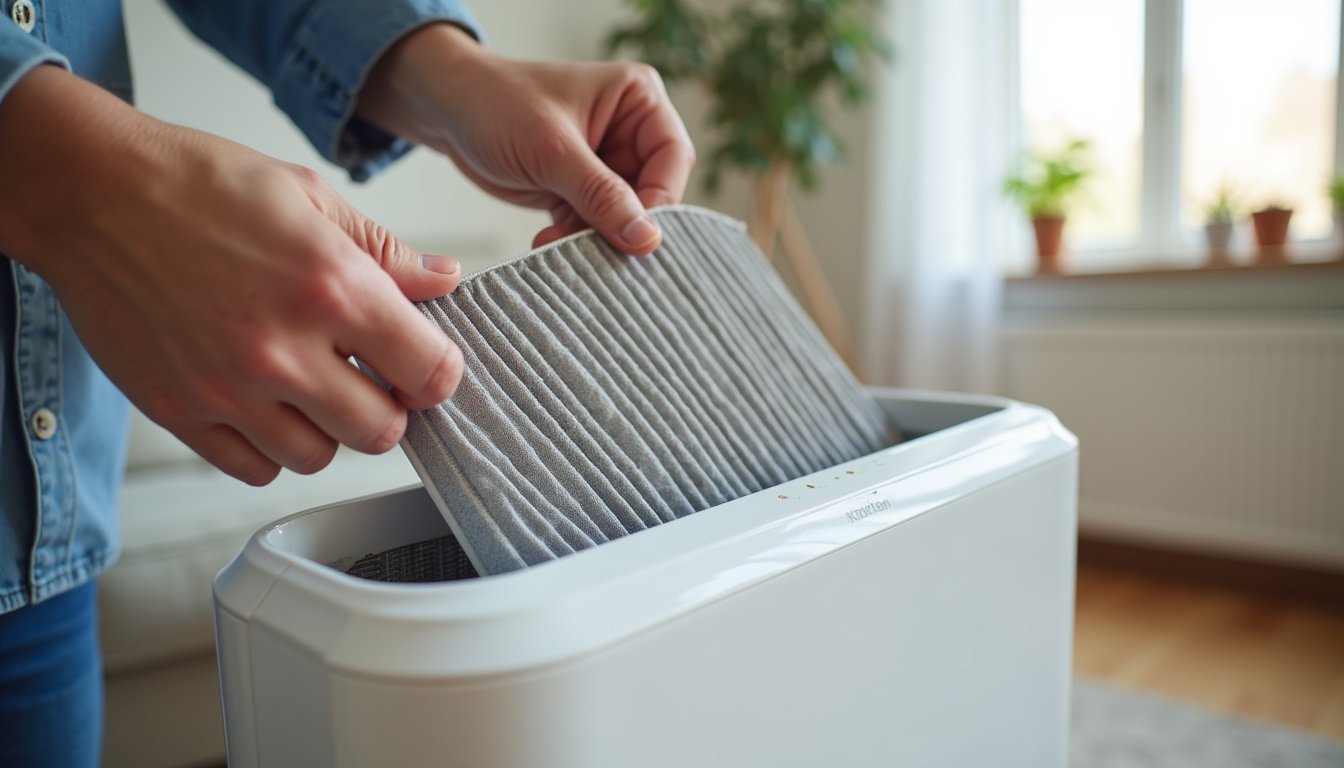
Pull the filters and look. A HEPA that is grey, brown or yellow across its face, or that has been in place longer than the maker’s interval, is loaded; replace it, since HEPA is never washed. A pre-filter felted with hair, lint and dust is rinsed, dried completely and refitted, or vacuumed with a brush. Check that a new filter has had every piece of plastic and tape removed; a surprising number of weak-airflow complaints are a filter still in its bag. Check too that the filter is seated the right way round and fully home, since a filter that sits proud lets air bypass it in some places and chokes it in others. The filter indicator is a timer and does not know how dirty the filter is; homes with pets, smoke or renovation load filters far faster than the light suggests.
Placement and Clearance
Intakes are on the back, sides or bottom of most units, exactly where people push them against walls, behind curtains or under desks. A fan starved on its intake side moves less air and does so unevenly; the outlet may feel strong on one side and weak on the other. Manuals specify clearance, often a foot or more behind and beside the unit and clear space above an upward outlet. A purifier in a closet, under a bed or inside a cabinet is working in its own exhaust. Soft furnishings nearby shed lint into the intake and matt the pre-filter.
- Pull the unit at least a foot from walls and furniture, more for rear intakes.
- Keep curtains, bedding and throws away from intakes.
- Do not run it under a desk, inside a cabinet or in a closet.
- Leave upward outlets clear; nothing on top.
- Raise floor-level intakes off thick carpet with a low stand.
- Check the room size against the rated CADR; a unit in a room twice its size feels weak because it is outmatched, not faulty.
Grilles, Housing and Impeller
Dust settles on outlet grilles, inside the housing downstream of the filter where it bypasses a poorly seated filter, and on the impeller blades themselves. A furred outlet grille restricts flow and adds noise; vacuum it with a brush attachment. Inside, with the unit unplugged and filters out, shine a light at the fan: a blade edge thick with grey felt has changed shape and balance, moving less air and vibrating. Wipe blades with a barely damp cloth or brush them with a soft brush and vacuum; never use compressed air, which drives dust into the motor and bearings and tears nearby filter media. Spin the impeller by hand; it should turn freely and silently for a second or two.
| Where dust collects | Symptom | Clean how |
|---|---|---|
| Outlet grille | Weaker, noisier outflow | Vacuum with brush attachment |
| Intake grille | Starved fan | Vacuum; rinse if removable and dry fully |
| Inside housing after filter | Dust on blades and walls | Filters out, unit unplugged; wipe and vacuum |
| Impeller blades | Vibration, less air | Soft brush and vacuum; damp cloth; no compressed air |
| Particle sensor lens | Auto mode idles | Dry cotton swab per manual |
| Motor vents | Motor runs warm | Vacuum gently from outside; do not open the motor |
Controls and Sensors
Many weak-airflow complaints are a unit doing as it is told. Auto mode sets speed from the particle sensor, and a dirty sensor lens reads clean and keeps the fan on its lowest setting all day. Sleep mode fixes the lowest speed and darkens the display, and some units stay in it until a button is pressed. Eco or quiet modes cap the speed. A child lock can keep you from changing any of them, making the unit seem stuck on low. Switch to manual and select high: if airflow is strong, the fan is fine and the setting was the cause. Then clean the sensor lens with a dry cotton swab as the manual describes, and reconsider whether auto suits the room.
When It Is the Fan
If filters are fresh and seated, the unit has clearance, grilles and impeller are clean and manual high still gives weak airflow, the fan assembly is at fault. A failing run capacitor lets the motor start slowly and run below speed; a bulging or leaking capacitor is the visual sign, and it is replaced only with a matched part after discharging, or by a technician. Worn bearings make the impeller stiff or gritty by hand and the motor slow and noisy. A speed board fault can leave the fan on one speed regardless of setting. On a brushless unit, the board and motor electronics do the same. None of these is a home repair on a sealed appliance; they are service matters, and the maker’s blower assembly is the part. Our guide on fan motor repair covers the decision.
| Sign on manual high | Likely fault | Action |
|---|---|---|
| Weak and slow to spin up | Failing capacitor | Service; matched capacitor only |
| Weak, gritty impeller by hand | Worn bearings | Replace blower assembly or unit |
| Same speed on every setting | Speed board or switch | Service |
| Strong but vibrating | Dust or damage on impeller | Clean; replace impeller if cracked |
| Weak with hot smell or buzzing | Electrical fault | Unplug; stop using; contact maker |
| Strong | Fan is fine | Look again at filters, placement, settings |
Keeping Airflow Up
Airflow stays strong in a unit that is kept clean, fed with filters on schedule and given room to breathe. Rinse the pre-filter monthly, more with pets; replace the HEPA on the maker’s interval or sooner in dusty homes, judging by the color of the media and a hand at the outlet rather than the light alone; vacuum grilles seasonally; keep the unit a foot from walls; and run it continuously on a moderate speed, which keeps the room’s dust load low so the filter loads slowly. A unit sized generously for its room runs on a lower speed, loads more slowly and stays quieter.
Worked example: a two-year-old tower unit feels weak at the outlet. The pre-filter is a felt of dog hair and the HEPA is brown; both are replaced. The unit was six inches from a wall with a curtain over the rear intake; it moves a foot out. On manual high the outflow is strong. Back on auto, the sensor lens gets a swab, and the fan now rises when the dog shakes. The motor was never involved.
How to Diagnose Weak Airflow in 6 Steps
- Unplug the unit, pull the filters and inspect: replace a loaded HEPA, rinse and dry the pre-filter, and remove any shipping plastic.
- Pull the unit at least a foot from walls, curtains and furniture, and out of any cabinet, closet or under-desk spot.
- Vacuum the intake and outlet grilles with a brush attachment and brush dust off the impeller blades; never use compressed air.
- Switch to manual high and feel the outlet; strong flow means the fan is fine and the cause was filter, placement or setting.
- Clean the particle sensor lens with a dry swab so auto mode responds, and check that sleep, eco or child lock is not holding the speed down.
- If flow is weak on manual high with fresh filters and clearance, treat it as a fan fault; if it also smells hot or buzzes, unplug it and contact the maker.
Do and Do Not
Do
- Replace loaded filters and unwrap new ones.
- Give the unit a foot of clearance on every intake side.
- Vacuum grilles and brush the impeller clean.
- Test on manual high before suspecting the motor.
- Clean the sensor lens so auto mode works.
Do not
- Do not wash HEPA media.
- Do not use compressed air anywhere on the unit.
- Do not run it in a cabinet, closet or under a desk.
- Do not trust the filter light in a pet or smoke household.
- Do not keep running a unit that smells hot or buzzes.
Who Should Skip This
If the filter is past its interval or visibly loaded, skip every other step until it is replaced; a fresh filter resolves most airflow complaints by itself, and nothing else can be judged until it is in.
If airflow is strong on manual high, skip the fan entirely: the unit is healthy and the complaint is a setting, a dirty sensor or a room larger than the unit’s rating.
Honest Limits
- Hand tests at the outlet are comparisons, not measurements; we did not measure airflow.
- Clearance requirements vary by model; follow the manual’s figures.
- Filter life depends heavily on the household; intervals are maker guidance.
- Capacitor and bearing diagnosis from outside the housing is indicative, not certain.
- Opening a housing typically voids the warranty.
- Nothing here is medical advice; electrical faults are a fire and shock matter.
When to See a Professional
Contact the maker for any unit still weak on manual high with fresh filters and clearance, for a unit under warranty, or for any hot smell, buzzing or warm plug; blower assemblies and capacitors are service parts, not home repairs on sealed appliances.
Use a small appliance technician for capacitor or blower replacement you are not comfortable with, and recycle a failed unit through appliance recycling.
Frequently Asked Questions
Why is the airflow from my air purifier so weak?
Almost always a restriction: a loaded HEPA, a pre-filter matted with hair, or shipping plastic left on a new filter. After that, an intake against a wall or curtain, dusty grilles, or auto, sleep or eco mode holding the fan low.
How do I know if the filter is causing weak airflow?
Pull it and look: grey, brown or yellow media across the face, or a pre-filter felted with lint, is loaded. Fit a fresh filter and compare the outlet by hand; a clear improvement confirms it.
Can placement reduce an air purifier’s airflow?
Yes. Intakes on the back, sides or bottom are starved when the unit sits against a wall, behind a curtain, under a desk or inside a cabinet, and the outlet then feels weak or uneven. Manuals specify clearance, often a foot or more.
Why does my purifier stay on low and move so little air?
Auto mode is holding it there, usually because a dusty particle sensor reads the air as clean, or sleep, eco or quiet mode is engaged, sometimes behind a child lock. Switch to manual high: strong flow means the fan is fine.
Is it normal for airflow to drop as the filter ages?
Yes, and it is the main reason filters have replacement intervals. As dust fills the fibers the filter’s resistance rises and the fan, at the same speed, pushes less air; clean air delivery falls with it. Replacing the HEPA on schedule, or sooner in dusty homes, restores the airflow the unit was rated for.
Can I clean the fan blades to improve airflow?
Yes, carefully. Unplug the unit, remove the filters and brush dust off the impeller with a soft brush, then vacuum, or wipe with a barely damp cloth. Never use compressed air, which drives dust into the motor and bearings and tears nearby filter media.
Why is the airflow uneven, strong on one side of the outlet?
A starved or partially blocked intake. Air pulled in unevenly leaves the fan unevenly, so an intake pressed against a wall or covered by a curtain on one side shows up as a lopsided outlet. A pre-filter loaded on one side or a filter not seated square does the same.
My purifier is in a big room and feels weak. Is it faulty?
Probably not. A unit’s clean air delivery rate is for a room of its rated size; in a room twice that size it moves the same air but makes little difference, which feels like weakness. Check the room’s square footage against roughly one and a half times the CADR.
When is weak airflow a motor problem?
When filters are fresh and seated, the unit has clearance, grilles and impeller are clean, and manual high still gives weak flow. A fan that spins up slowly points at a failing capacitor; a gritty, stiff impeller at worn bearings; one speed regardless of setting at a board fault.
What if the purifier has weak airflow and smells hot?
Unplug it and stop using it. A hot or burning smell, buzzing, sparking or a warm plug alongside weak airflow is an electrical fault, often a motor overheating behind a clogged filter or a failing winding. It is not diagnosed while running.
Bottom Line
Air purifier airflow issues are restrictions, not failures, in nearly every case. A loaded HEPA, a matted pre-filter or a filter still in its plastic is the first cause; an intake pressed against a wall or buried under furniture is the second; dust on grilles and impeller the third; and a control mode holding the fan low the fourth. Each is fixed in minutes for nothing, and a minute on manual high with fresh filters and clearance tells you whether anything is actually wrong with the fan.
When it is the fan, a slow spin-up points at the capacitor, a gritty impeller at the bearings, and both are service matters on a sealed appliance. And a unit that has lost airflow and smells hot is unplugged before anything else is considered. Keep filters fresh, give the unit room, and the air keeps moving.
Related reading: How to repair air purifier fan motor, Air purifier not blowing air, How often to change air purifier filter.