Last updated:
As an Amazon Associate we earn from qualifying purchases. This does not change what we recommend. See our affiliate disclaimer.
Every HEPA purifier comes with a quiet countdown. The filter that makes it work is slowly filling with exactly the dust, dander and smoke you bought it to remove, and at some point it has to be replaced. How long that takes is the question owners ask most, partly because the answer decides the running cost and partly because a spent filter is invisible from the outside.
Most makers rate the HEPA stage in a portable purifier at 6 to 12 months of normal use, with some larger or thicker filters rated longer and some compact combined cartridges rated shorter. That figure assumes an average home and roughly continuous running. Dusty rooms, pets, wildfire smoke, cooking and running on high speed load the filter faster; a clean room, a well-maintained pre-filter and medium speed stretch it toward the long end. A HEPA filter does not stop capturing particles when it fills; it restricts airflow, so the unit moves less air and cleans less, and the fan works harder and gets louder. That drop in airflow, not a change in filter efficiency, is why replacement intervals exist.
In short: plan on the maker’s interval, expect the short end if your home is dusty or smoky, and watch for the signs of a loading filter rather than trusting a calendar or a timer alone.
The EPA’s guide to air cleaners in the home advises following the manufacturer’s replacement schedule and considering filter cost and frequency when choosing a unit. AHAM’s CADR ratings are measured with a fresh filter, so the performance you were promised depends on changing it on time.
The guidance here is research-based, drawn from maker manuals, EPA and AHAM material and the mechanics of how fiber filters load. We have not tested filter life ourselves, and we quote no prices or ratings for the units in the comparison table, only their published filter schedules and features.
Your HEPA filter will likely last the full interval if
- The room is a clean bedroom or office with hard floors
- You vacuum or rinse the pre-filter monthly
- The unit runs on medium or auto, not high
- There are no pets, smokers or heavy cooking nearby
Expect to replace it sooner if
- You have shedding pets or carpet
- The unit runs through a wildfire smoke season
- It sits near a kitchen or a construction area
- The pre-filter is skipped or missing
Key Takeaways
- Makers typically rate portable HEPA filters at 6 to 12 months of normal use; check your manual for the exact figure.
- A loading filter does not let more particles through; it moves less air, so cleaning drops and the fan gets louder.
- Pets, dust, smoke and high fan speeds shorten filter life; a clean pre-filter and medium speed extend it.
- Filter indicators on many units are timers, not sensors; check the filter visually before and after the light comes on.
- HEPA filters cannot be washed or reused; only the pre-filter, if the manual says so, can be rinsed.
- Combined HEPA and carbon cartridges are replaced when the carbon saturates, often before the HEPA layer is spent.
- Compare models on filter cost per year, not per filter, and confirm replacements are easy to find.
Purifiers With Clear Filter Life to Compare
These widely reviewed units publish filter replacement intervals and most use washable pre-filters that protect the HEPA stage. Compare the maker-listed filter schedule and whether HEPA and carbon are separate before choosing.






How We Approached Filter Life
We read maker manuals for stated intervals and the conditions behind them, used EPA and AHAM guidance on replacement and performance, and worked through how fiber filters load and why airflow falls. Where a figure appears for a model, it is the maker’s figure.
One idea runs through this guide: a HEPA filter fails by clogging, not by leaking. Understanding that explains the signs of a spent filter, why intervals vary so much and why the pre-filter deserves more attention than it usually gets.
How a HEPA Filter Loads Over Time
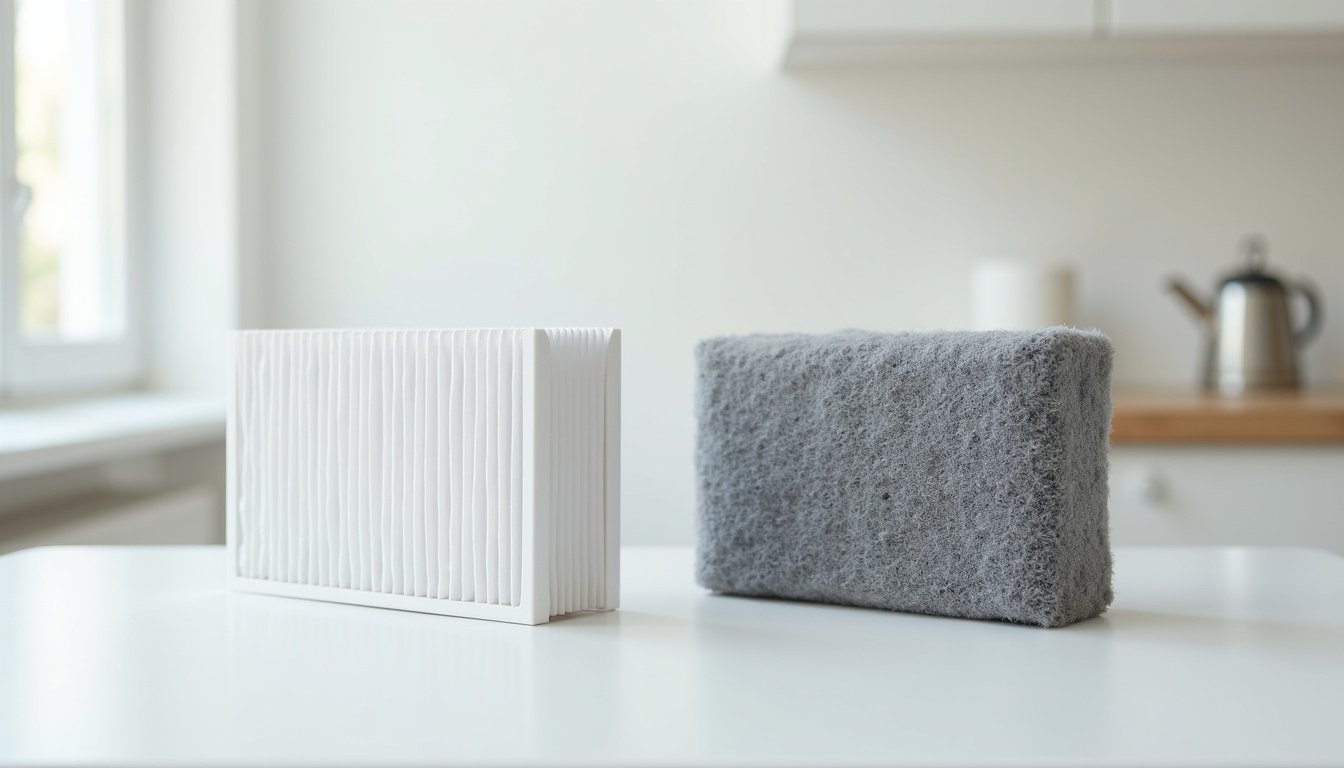
A HEPA filter is a deep mat of fine fibers folded into pleats to pack a large area into a small frame. Particles stick to the fibers by sieving, impaction and diffusion, and the filter is rated to capture 99.97 percent of 0.3 micron particles under test conditions when new. As particles accumulate they form a layer, sometimes called a dust cake, on and within the fibers.
That layer actually improves capture slightly, since it adds more surfaces for particles to stick to. The problem is resistance. Air has to push through a progressively denser mat, so at a given fan speed less air passes. The purifier’s effective CADR falls, the room gets fewer air changes per hour, and the fan motor, if it tries to compensate, draws more power and makes more noise. Replacement intervals are set around this airflow drop.
| Stage of filter life | What is happening | What you notice |
|---|---|---|
| New | Clean fibers, full airflow | Rated performance, quietest at each speed |
| Early loading | Light dust layer forming | No visible change; capture is fine |
| Mid life | Pleats graying, airflow easing off | Slightly louder at the same speed; sensor readings creep up |
| Late life | Dense dust cake, airflow clearly reduced | Weaker outlet breeze, louder fan, longer to clear smells or smoke |
| Spent | Severe restriction | Little cleaning; replace now |
What Makers Actually Say
Manuals and spec pages usually state an interval along with a condition such as based on 24 hour daily use in a typical environment. The spread across the market is wide. Many mid-size units list 12 months. Compact units with a combined HEPA and carbon cartridge often list 6 to 8 months, because the thin carbon layer saturates first. A few larger units with thick media list two years or more, and a handful of premium designs claim several years for the HEPA stage alone.
| Filter type | Typical maker interval | Why |
|---|---|---|
| Combined HEPA plus carbon cartridge, compact unit | 6 to 8 months | Carbon layer saturates; whole cartridge is replaced |
| Separate HEPA stage, mid-size unit | 12 months | Protected by a pre-filter; carbon changed separately |
| Thick media HEPA, large unit | 12 to 24 months or more | More media area loads more slowly |
| HEPA in a smoke or pet focused unit | 6 to 12 months | Heavier loading assumed |
| Washable pre-filter | Rinse or vacuum monthly; replace rarely | Catches hair and lint before the HEPA stage |
Treat the interval as a planning figure. It assumes the pre-filter is maintained and the environment is average. If your situation is not average, the next section explains which way to adjust.
What Shortens Filter Life
Anything that puts more particles into the room, or more air through the filter, loads it faster. The biggest factors in most homes are pets, carpet, cooking and smoke, followed by construction dust, open windows in a dusty area and simply running on high all the time.
- Shedding pets add hair and dander; without a clean pre-filter the hair mats the HEPA face quickly.
- Carpet and upholstery release fibers with every step and sit-down.
- Cooking, especially frying and searing without a range hood, produces fine particles that load filters fast.
- Wildfire smoke seasons can use up months of filter life in a few weeks.
- Nearby construction or renovation fills the air with fine mineral dust.
- Running on high around the clock pushes two or three times the air of medium through the media.
Worked example: a bedroom unit with a 12 month rated HEPA stage runs continuously in a home with a long-haired dog and carpet. The owner vacuums the pre-filter monthly, so most hair never reaches the HEPA layer. A realistic expectation is 9 to 12 months. Skip the pre-filter cleaning and the same unit may need a HEPA change at 6 to 8 months, and the fan will be audibly louder in the meantime.
Signs a HEPA Filter Is Spent
Because filters fail by clogging, the symptoms are about airflow and noise rather than dirtier air leaking through. Learn them, and you can replace on evidence rather than on a timer.
- The outlet breeze is noticeably weaker at the speed you always use.
- The fan sounds louder or strained at the same setting, or auto mode runs on high more often.
- Built-in or standalone particle readings take longer to fall after cooking or vacuuming.
- The pleats look uniformly gray or brown and the surface is fuzzy with trapped fiber.
- Smells linger longer, which usually means the carbon stage is saturated.
- The filter indicator comes on, which is a prompt to inspect, not an order to replace.
A visual check is simple on most units: unplug, open the cover, lift out the filter and look at the pleats in good light against a white surface. A new filter is white; a spent one is dark across the whole face. If one side looks far dirtier than the other, the pre-filter may be missing or damaged.
Filter Indicators: Timers Versus Sensors
Many purifiers include a filter change light, and owners often assume it measures the filter. Most do not. The common design is a run-time timer that lights after a set number of hours, regardless of how dirty the filter is. A smaller number estimate loading from particle sensor data and fan speed history, and a few measure pressure drop across the filter, which is the most direct method.
| Indicator type | How it decides | Reliability | How to use it |
|---|---|---|---|
| Run-time timer | Counts hours since reset | Low; ignores dust load | Treat as a reminder to inspect |
| Sensor-based estimate | Combines particle readings and fan speed | Moderate | Good guide; still inspect |
| Pressure drop sensor | Measures airflow restriction | High | Replace when it indicates |
| None | You decide | Depends on you | Inspect monthly, replace on evidence |
How to Make a HEPA Filter Last Longer
Most of the useful levers are free. The pre-filter is the first: vacuum or rinse it every two to four weeks in a home with pets or carpet, and monthly otherwise, following the manual on whether water is allowed. A clean pre-filter keeps hair, lint and large dust off the HEPA face, which is where early clogging starts.
- Run on medium or auto rather than high; the HEPA stage sees less air and loads more slowly while still meeting the room’s needs if the unit is sized with headroom.
- Place the unit on a hard floor or stand, not deep carpet, so the intake does not pull fiber straight off the pile.
- Reduce sources: wash bedding weekly, use a sealed HEPA vacuum, run the range hood and keep windows closed on dusty or smoky days.
- Upgrade the HVAC filter to a pleated MERV 11 to 13 where the system allows, as the EPA suggests, so the whole-house particle load is lower.
- Keep the unit running rather than cycling it; particles that settle while it is off are not captured anyway, and restarting into a dusty room loads the filter in bursts.
Two things do not extend life and should be avoided. Washing or rinsing a HEPA filter damages the fine fibers and can leave moisture in the media; makers do not warrant it. Blowing it out with compressed air drives particles deeper and can tear pleats. If the HEPA stage is dirty, replace it.
Combined Cartridges Versus Separate Stages
Compact purifiers often bundle pre-filter, HEPA and carbon into one cylinder or panel. It is convenient, but the carbon layer is thin and saturates in a few months, and the whole cartridge is replaced even though the HEPA layer may have life left. Units with separate stages let you change the carbon on its own schedule and the HEPA on its longer one, which usually lowers the yearly cost.
When comparing models, note whether the stated interval refers to the HEPA stage, the carbon stage or a combined cartridge. A 12 month HEPA with a 3 month carbon pad is a different cost picture from a 6 month combined cartridge, even if both units are sized the same.
Buying and Fitting Replacements
Buy the maker’s filter or a replacement explicitly labeled true HEPA for your model. Third-party filters vary in media grade, carbon amount and fit, and a filter that does not seal in its housing lets air bypass the media entirely. Check the gasket or foam edge on the new filter and seat it firmly with the airflow arrow or label facing the direction the manual shows.
Replace on a hard surface, unplug first, and bag the old filter immediately to avoid shaking loose what it caught. Wipe the housing and sensor inlet with a dry cloth. If the fan is still loud with a new filter, check that the pre-filter is clean and nothing is blocking the intake or outlet.
How to Plan Filter Replacement in 6 Steps
- Find the HEPA interval in the manual and note whether it refers to a separate stage or a combined cartridge.
- Adjust for your home: move toward the short end for pets, carpet, cooking or smoke, and toward the long end for a clean room on medium speed.
- Put a pre-filter cleaning reminder on your calendar every two to four weeks.
- Inspect the HEPA stage visually every two or three months and after any smoke event.
- Treat the indicator light as a prompt to inspect unless the manual says it measures pressure or loading.
- Keep a spare filter on hand and record each change date on the frame.
Do and Do Not
Do
- Vacuum or rinse the pre-filter on schedule.
- Run on medium or auto with headroom in CADR.
- Inspect the filter visually; do not rely on a timer alone.
- Buy filters labeled for your exact model.
- Reset the indicator after each change.
Do not
- Do not wash a HEPA filter or blow it out with compressed air.
- Do not run the unit without the pre-filter.
- Do not assume the box interval applies in a dusty or pet home.
- Do not ignore a louder fan or weaker breeze.
- Do not let a saturated carbon layer linger if odors are the goal.
Who Should Skip This
If you are choosing a purifier mainly for a few weeks of wildfire smoke each year, a model with a long-life, separate HEPA stage and a washable pre-filter suits you better than a compact unit with a short-lived combined cartridge, which would need replacing after one season even if it sat idle the rest of the year.
If you cannot or will not maintain a pre-filter and inspect the HEPA stage, consider a unit with a pressure-based filter indicator and a large filter rated for a year or more. It costs more up front but removes the guesswork that leads to clogged filters.
Honest Limits
- Maker intervals are estimates for average conditions; your home may differ in either direction.
- A spent HEPA filter cleans poorly because airflow falls, not because it leaks, so the air can look fine on a sensor while the unit does little.
- Timer-based indicators cannot see dust load.
- HEPA filters do not remove gases; a saturated carbon stage is a separate problem with its own schedule.
- Third-party filter quality varies and may affect warranty coverage.
- No filter maintenance makes an undersized unit adequate for a large room.
When to See a Professional
See a doctor or allergist if symptoms return or worsen even with a fresh filter and a well-sized unit; the trigger may not be airborne, or may need treatment beyond filtration. Nothing on this page is medical advice.
Contact the maker, not a repair attempt, if the fan is loud or weak with a new filter, if the unit smells of burning or if the cord is damaged; stop using it until resolved. Call an HVAC professional if dust from vents is loading your filters quickly, which can point to duct leaks, and a mold professional for growth over about 10 square feet as the EPA suggests.
Frequently Asked Questions
How long does a HEPA filter last in an air purifier?
Most makers rate portable HEPA filters at 6 to 12 months of normal, near-continuous use, with compact combined cartridges often shorter and thick large-unit filters sometimes two years or more. Pets, carpet, cooking, smoke and high fan speed shorten that; a clean pre-filter and medium speed extend it.
How do I know when to replace a HEPA filter?
Look for a weaker outlet breeze, a louder fan at the same speed, slower recovery on particle readings after cooking or vacuuming, and pleats that look uniformly gray or brown. Treat a filter indicator as a prompt to inspect unless the manual says it measures airflow restriction.
Does a dirty HEPA filter let more particles through?
Generally no. A loaded filter captures particles at least as well, but it restricts airflow, so the unit moves less air and cleans the room more slowly while the fan works harder. The drop in airflow, not a loss of efficiency, is why replacement intervals exist.
Can I wash a HEPA filter to make it last longer?
No. Water damages the fine fibers, can leave moisture in the media and voids most warranties. Compressed air drives particles deeper and can tear pleats. Only the pre-filter, if the manual says it is washable, should be rinsed or vacuumed. Replace the HEPA stage when it is spent.
Is the filter change light accurate?
Often not. Many indicators are run-time timers that light after a fixed number of hours regardless of dust load. Sensor-based estimates are better and pressure-drop sensors are best. Inspect the filter when the light comes on and reset the indicator after each change.
Do pets shorten HEPA filter life?
Yes. Hair and dander load the filter quickly, especially if the pre-filter is dirty or missing. Vacuum or rinse the pre-filter every two to four weeks and expect the HEPA stage to reach the short end of the maker’s interval in a multi-pet home.
How does wildfire smoke affect filter life?
Heavily. Fine smoke particles load the HEPA stage fast, and a few weeks of smoke can use up months of rated life. Inspect the filter every week or two during a smoke event and replace it early if it looks gray and matted, so your clean room keeps working.
Should I replace the carbon filter at the same time as the HEPA?
Not necessarily. Carbon saturates faster, often in 3 to 6 months, while a protected HEPA stage lasts 12 months or more. If the stages are separate, change each on its own schedule. Combined cartridges are replaced as one unit when the carbon gives out.
Does running on high wear out the filter faster?
Yes. High speed pushes two to three times the air of medium through the media, so it loads faster. Size the unit so medium meets the room’s CADR target, about two-thirds of the floor area in square feet, and reserve high for short bursts after cooking or cleaning.
Are third-party HEPA replacement filters as good?
Quality varies. Some match the maker’s media and fit; others use looser media, less carbon or a poor seal that lets air bypass the filter. If you use one, confirm it is labeled true HEPA for your exact model, check the gasket, and be aware some warranties exclude them.
Bottom Line
A HEPA filter in a portable purifier typically lasts 6 to 12 months by the maker’s rating, and the real figure in your home depends on dust, pets, smoke, cooking and fan speed. It wears out by clogging, so the signs are a weaker breeze, a louder fan and slower cleaning, not dirtier air leaking through. Replace on those signs and on a visual check, with the indicator light as a reminder rather than a verdict.
The cheapest way to extend filter life is to keep the pre-filter clean, run on medium with a unit sized for headroom, and reduce the sources that load it. Never wash the HEPA stage. Done that way, the filter reaches the long end of its interval and the purifier keeps delivering the performance you paid for.
Related reading: Air purifier maintenance cost, Air purifiers with filter replacement indicators vs without, Does an air purifier clean dust.