Last updated:
As an Amazon Associate we earn from qualifying purchases. This does not change what we recommend. See our affiliate disclaimer.
Once you accept that a portable purifier cleans one room, the next question follows immediately: how many rooms, and therefore how many units, does your home actually need? Buy too few and the bedrooms stay dusty; buy one for every room and you are maintaining a small fleet of filters nobody asked for. The right number is usually smaller than a catalog would suggest and larger than one.
For most homes the answer is one purifier per room where people spend several hours a day with the door closed, which typically means each occupied bedroom plus the main living area. A two-bedroom apartment lands at two or three units; a four-bedroom family home with everyone at home often lands at three or four, not one per room, because guest rooms, dining rooms and hallways do not need their own. Each unit should be sized by AHAM’s rule of thumb, a dust CADR of about two-thirds of the room’s floor area in square feet, and open-plan areas count as one room. Homes with forced-air heating can lower the count by upgrading the HVAC filter, which gives every room a baseline of filtration.
In short: count the rooms you actually live in, not the rooms you own. Start with the bedroom that matters most, add the living area, and expand only where symptoms or dust persist.
The EPA’s guide to air cleaners in the home notes that portable units are designed for a single room and that whole-house filtration comes through the central system. AHAM’s CADR program provides the sizing rule that turns a room’s dimensions into the unit it needs.
The planning method below is research-based, built from EPA and AHAM guidance, maker specifications and the way air moves between rooms. We have not tested the models in the comparison table and quote no prices or ratings, only published room ratings and features.
You probably need one unit if
- You live in a studio or open one-bedroom
- Only one person has symptoms and sleeps in one room
- You can move a unit between living room and bedroom
- Your HVAC already runs a MERV 13 filter on a circulate schedule
You probably need three or more if
- Several bedrooms are occupied nightly by people with allergies
- Pets have the run of the house
- Your region sees long wildfire smoke seasons
- The home has two or more floors with people on each
Key Takeaways
- One purifier per room where people spend hours with the door closed, usually each occupied bedroom plus the main living area.
- Hallways, dining rooms, guest rooms and bathrooms almost never need their own unit.
- Open-plan living, dining and kitchen areas count as one room; size one unit for the combined floor area.
- Each unit’s dust CADR should be about two-thirds of its room’s floor area in square feet.
- Order of purchase: the bedroom of the most affected person, then the living area, then other bedrooms.
- A pleated MERV 11 to 13 HVAC filter, where supported, lowers the number of portable units you need.
- Moving one unit between rooms is a legitimate strategy in small homes.
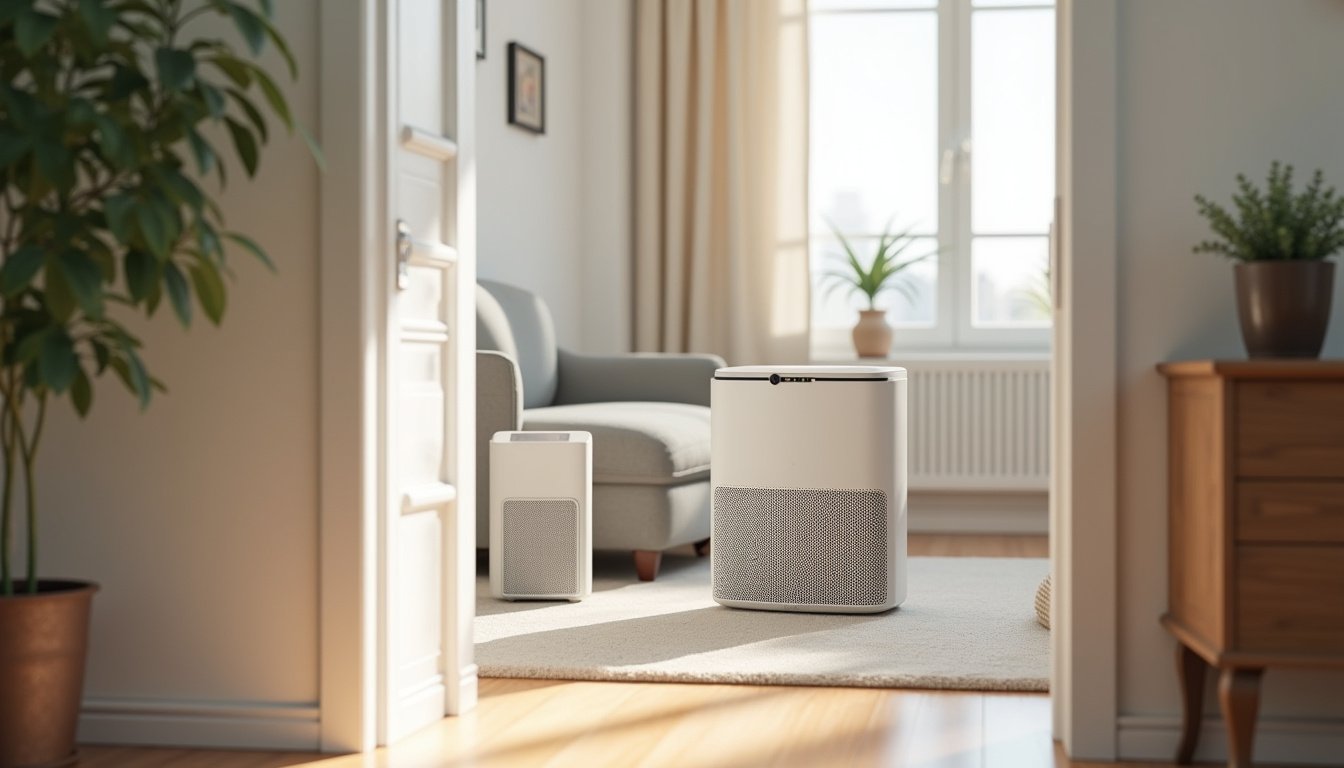
Right-Sized Purifiers for a Multi-Room Plan
These widely reviewed filter-based units range from bedroom to large living room coverage, which makes it easy to pair a smaller unit for each bedroom with a larger one for the main space. Compare maker-listed CADR and room size against the rooms on your list.






How This Planning Method Works
We built the method from three facts: portable units clean one room, AHAM’s CADR rule converts floor area into a required unit size, and people spend most of their indoor hours in a small number of rooms. We then applied it to common home layouts. Model details in the table are the maker’s published figures.
The key simplification is to think in occupied hours rather than square feet. A 400 square foot formal dining room used twice a year needs nothing; a 120 square foot bedroom used eight hours a night needs its own unit. Counting hours is what keeps the number sensible.
Count Occupied Rooms, Not Square Feet
Marketing encourages buyers to add up the whole home’s area and look for a unit that covers it. That math fails because walls and doors stop air. The useful inventory is a list of rooms where someone spends at least a few hours a day, especially with the door closed, since a closed door turns a room into its own airspace.
For most households the list is short: each occupied bedroom, the main living area and perhaps a home office. Children’s bedrooms count fully; a nursery counts double in priority. Kitchens are part of the living area in open plans and rarely need a dedicated unit otherwise, since cooking particles are better handled by a range hood.
| Room | Hours of use | Door usually closed | Needs its own unit? |
|---|---|---|---|
| Occupied bedroom | 8 or more | Yes, overnight | Yes |
| Nursery or child’s room | 10 or more | Yes | Yes, high priority |
| Open living, dining, kitchen | 4 to 8 | No, one open space | Yes, one unit for the combined area |
| Home office | 6 to 8 on work days | Often | Yes if used daily |
| Guest room | Occasional | Yes | No; move a unit in when guests stay |
| Dining room, separate | 1 to 2 | No | No |
| Hallway, bathroom, laundry | Minutes | Varies | No |
Size Each Room With the CADR Rule
Once the list exists, each room gets its own sizing. Multiply length by width for square feet, then take two-thirds of that figure as the minimum dust CADR for the unit serving it, assuming 8 foot ceilings. For 10 foot ceilings add about a quarter; for vaulted spaces add half. Open-plan areas are measured as one combined space.
Worked example: a 12 by 13 foot bedroom is 156 square feet, so its unit needs a dust CADR of about 104. A 10 by 11 foot child’s room is 110 square feet, needing about 73. An open living, dining and kitchen area of 18 by 26 feet is 468 square feet, needing about 312. That is three units of three different sizes, which is cheaper and quieter than three large units or one giant one.
Typical Layouts and Their Counts
The method produces predictable counts for common homes. These are starting points to adjust for pets, allergies and climate.
| Home | Occupied rooms | Suggested count | Notes |
|---|---|---|---|
| Studio or open loft | One space | 1 | Size for the whole floor area; place near the bed |
| One-bedroom apartment | Bedroom plus living area | 1 to 2 | One unit moved daily works; two is more convenient |
| Two-bedroom, two people | Two bedrooms plus living area | 2 to 3 | Second bedroom only if occupied nightly |
| Three-bedroom family home | Three bedrooms plus living area | 3 to 4 | Start with the most affected bedroom and living area |
| Four-bedroom, two floors | Three or four bedrooms plus living area | 3 to 5 | Each floor needs its own units; add HVAC filter upgrade |
| Home with pets everywhere | All of the above | Add one for the pet’s main room | Dander spreads; carbon helps with odor |
Notice that the count rarely equals the number of rooms. Homes have more rooms than they have occupied hours, and the unoccupied ones can wait.
Which Unit to Buy First
Few people buy three or four purifiers at once, so order matters. The bedroom of the person most affected by dust, pollen, dander or asthma comes first; eight hours a night near a mattress is the heaviest exposure in most homes, and a closed door lets a modest unit achieve many air changes. The main living area comes second, sized for the combined open space. Other bedrooms follow in order of occupancy and symptoms, then a home office if it is used daily.
- Bedroom of the most affected person, run overnight with the door closed.
- Main living area, sized for the whole open space, run during the day and evening.
- Remaining occupied bedrooms, by symptoms and hours.
- Home office or nursery if not already covered.
- HVAC filter upgrade to pleated MERV 11 to 13 where the system allows, at any point in the sequence.
Living with one unit for a few weeks also teaches you something: if the bedroom unit changes mornings noticeably, the case for the second unit is made. If it changes nothing, check sizing and door habits before buying more.
Ways to Reduce the Number You Need
Several steps lower the count without lowering air quality. The largest is the HVAC filter: a pleated MERV 11 to 13 filter, where the system supports it, cleans every room with a vent each time the blower runs, and the EPA suggests MERV 13 or higher where possible. Running the blower on a circulate schedule extends that. The portable units then handle the rooms where continuous, higher-rate cleaning matters, mainly bedrooms.
- Move one unit between the living room by day and the bedroom at night in small homes; casters or a handle make this painless.
- Treat open-plan areas as one room and buy one correctly sized unit rather than two small ones.
- Close bedroom doors overnight so each unit works on a small volume.
- Control sources so the overall particle load is lower: door mats, a sealed HEPA vacuum, weekly bedding washes, range hood use.
- Skip units for rooms used only occasionally and roll one in when a guest arrives.
Source control deserves emphasis. Public health guidance is to reduce sources and ventilate before filtering, and a home that does both needs fewer and smaller purifiers to reach the same result.
Adjusting for Pets, Allergies and Smoke
Pets raise the count by about one, because dander follows the animal and carbon-equipped units help with odor in the room where the pet spends most time. If the pet sleeps in a bedroom, that bedroom’s unit should be sized with extra headroom. Multiple shedding pets with the run of the house push toward a unit in every occupied room plus the HVAC upgrade.
Allergies and asthma triggered by particles change priority rather than count: the affected person’s bedroom becomes non-negotiable and should be sized generously. Wildfire smoke seasons add the clean room concept from EPA guidance: at minimum one room, usually a bedroom, that can be closed up with a purifier running continuously. Households in smoke-prone regions often keep a spare unit for this purpose.
Two Floors, Basements and Large Homes
Floors are separate airspaces. Stairwells move air slowly and mainly by temperature, so a unit downstairs does nothing for bedrooms upstairs. Plan each floor on its own: the occupied rooms upstairs get their units, the main living area downstairs gets its own, and a finished basement that people use gets a unit only after moisture is under control, since the EPA advises holding humidity between 30 and 50 percent to limit mold.
Large homes can seem to demand many units. In practice the occupied-rooms rule still holds, and the count for a big house with a family of four is usually four or five, with the HVAC filter doing the baseline work in the many rooms used only in passing. Radon testing is a separate basement task that no purifier addresses.
Budgeting for More Than One Unit
Every unit adds a filter schedule. HEPA stages are typically replaced every 6 to 12 months per the maker and carbon every 3 to 6 months, so three units mean three sets of reminders and three sets of costs. Choosing the same brand for all bedrooms simplifies this, since filters are interchangeable and can be bought together. Washable pre-filters on every unit cut the load on the HEPA stages.
Electricity is modest; a bedroom unit on medium draws a few watts to around 15, comparable to a couple of LED bulbs. The bigger consideration is noise: a unit that is too loud gets switched off, and an off unit is the most expensive kind. Spend on quiet medium speeds before spending on extra units.
| Number of units | Filter sets per year, typical | Simplest way to manage |
|---|---|---|
| 1 | 1 HEPA, 2 to 3 carbon | Calendar reminder on the change date |
| 2 | 2 HEPA, 4 to 6 carbon | Same brand; buy filters in pairs |
| 3 to 4 | 3 to 4 HEPA, 6 to 12 carbon | Same brand across bedrooms; washable pre-filters; one change day per quarter |
| 5 or more | 5 or more HEPA, many carbon | Reconsider: an HVAC filter upgrade may replace some units |
How to Decide Your Count in 7 Steps
- List every room where someone spends a few hours a day, noting which doors are usually closed.
- Remove hallways, bathrooms, laundry, separate dining rooms and rooms used only occasionally.
- Merge open-plan living, dining and kitchen areas into one room.
- Measure each remaining room and take two-thirds of its floor area as the minimum dust CADR; adjust for ceilings.
- Add one unit if pets have the run of the house, and plan a clean room if smoke season is a factor.
- Upgrade the HVAC filter to MERV 11 to 13 where the system allows to lower the portable count.
- Buy in priority order: most affected bedroom, living area, other bedrooms, office; reassess after two weeks.
Do and Do Not
Do
- Count occupied hours, not rooms owned.
- Size each room separately with the CADR rule.
- Buy quiet medium speeds so bedroom units stay on.
- Standardize on one brand for shared filters where practical.
- Close bedroom doors overnight.
Do not
- Do not buy one giant unit for a hallway.
- Do not add units for rooms nobody uses.
- Do not carry one unit’s rating across floors.
- Do not rely on a purifier for radon, CO or humidity.
- Do not skip the HVAC filter upgrade if you have forced air.
Who Should Skip This
If you live alone in a studio or open one-bedroom, a single unit sized for the whole space answers the question. Spend the rest of the budget on a quieter model or a better filter schedule rather than a second unit, and move it near the bed at night.
If your home has forced air, a MERV 13 filter and nobody with symptoms, the answer may be zero portable units for now. Add one for a bedroom if a pet, an allergy or a smoke season changes things.
Honest Limits
- These counts are planning estimates; room shapes, ceilings and habits change the result.
- Even the right number of units cannot overcome a strong, continuous source such as unvented cooking or an active smoker.
- Units clean only while running; a fleet that gets switched off at night cleans nothing.
- HVAC filtration helps only in homes with forced air and only while the blower runs.
- Purifiers do not address humidity, radon or combustion gases, which are whole-house concerns of a different kind.
- Coverage figures on packaging are not comparable across brands unless they cite AHAM CADR.
When to See a Professional
See a doctor or allergist if someone’s symptoms are driving the purchase; identifying the trigger tells you which rooms to prioritize and whether filtration will help at all. A purifier is a supporting measure, and nothing on this page is medical advice.
Call an HVAC professional before fitting a MERV 13 or denser filter in an older system or if dust blows from vents, which suggests duct leaks. Use a certified radon professional for testing and mitigation in basements, and a mold professional for growth over about 10 square feet, as the EPA suggests.
Frequently Asked Questions
How many air purifiers do I need for a 3-bedroom house?
Usually three or four: one for each occupied bedroom and one for the main living area, each sized by the two-thirds CADR rule for its room. Guest rooms, dining rooms and hallways do not need their own. An upgraded HVAC filter can lower the count.
Can one air purifier be enough for an apartment?
Yes for a studio or open one-bedroom, sized for the whole floor area and moved near the bed at night. A two-bedroom apartment with two occupied bedrooms usually needs two or three units, or one unit moved between rooms plus one for the bedroom that matters most.
Do I need a purifier in every room?
No. Count the rooms where people spend hours with the door closed, typically bedrooms and the main living area. Hallways, bathrooms, laundry rooms and rarely used rooms do not need one. Air moves too slowly between rooms for any unit to serve several at once.
How do I size each purifier?
Measure the room, multiply length by width for square feet, and take two-thirds of that as the minimum dust CADR, following AHAM’s rule of thumb for 8 foot ceilings. Add about a quarter for 10 foot ceilings and treat open-plan areas as one combined room.
Which room should get the first purifier?
The bedroom of the person most affected by dust, pollen, dander or asthma. Night-time exposure near a mattress is the heaviest in most homes, and a closed door lets a modest unit achieve many air changes. The main living area comes second.
Does an open floor plan need more than one unit?
Usually not. Living, dining and kitchen areas connected without doors count as one room; size a single unit for the combined floor area. Only if the space is very large or oddly shaped does a second unit at the far end make sense.
Do pets change how many purifiers I need?
Typically by one. Dander and odor concentrate where the pet spends most time, so that room benefits from a HEPA unit with real carbon. Pets that sleep in bedrooms mean sizing those units with extra headroom. Multiple shedding pets push toward a unit in every occupied room.
Can I just move one purifier from room to room?
Yes, and it works well in small homes: living room by day, bedroom by night. Units with casters or a handle make it easy. The room without the unit goes untreated meanwhile, so it is a compromise, but a unit in the right room beats two in the wrong ones.
Does upgrading the HVAC filter mean fewer purifiers?
It helps. A pleated MERV 11 to 13 filter, where the system supports it, filters every room with a vent while the blower runs, giving the whole home a baseline. You still want portable HEPA units in bedrooms for continuous cleaning overnight, but you may skip them elsewhere.
How many purifiers do I need for wildfire smoke?
At least one for a clean room, usually a bedroom you can close up and spend time in, following EPA guidance. Households in smoke-prone areas often add a second for the living area and keep the HVAC on recirculate with the best filter the system allows.
Bottom Line
The number of air purifiers a home needs is the number of rooms people actually live in with the door closed, sized one by one with the two-thirds CADR rule. For most homes that is two to four units, not one per room and not one giant unit in the hall. Open-plan areas count once, guest rooms and hallways count zero, and pets or smoke seasons add one.
Buy in order of exposure, bedroom first, and let two weeks with the first unit tell you how strong the case is for the next. Upgrade the HVAC filter where you can, fix sources, close doors at night, and the count stays small while the air in the rooms that matter stays clean.
Related reading: Can one air purifier clean an entire house, Best air purifiers for bedrooms vs living rooms, Does an air purifier clean dust.