Last updated:
As an Amazon Associate we earn from qualifying purchases. This does not change what we recommend. See our affiliate disclaimer.
Indoor air is invisible, and most of what goes wrong with it is odorless too. People buy purifiers, humidifiers and plants on a hunch, run them for months and never learn whether anything changed. A handful of inexpensive instruments turns that guesswork into numbers, and the numbers usually point at a different problem than the one people assumed.
Checking indoor air quality at home means measuring the handful of things that actually matter, each with its own instrument. Fine particles, PM2.5, are what purifiers remove and what wildfire smoke, cooking, dust and dander produce; a consumer particle monitor shows them in real time. Carbon dioxide is a proxy for how stale and under-ventilated a room is; a CO2 monitor shows when to open a window. Relative humidity, read by a hygrometer, should sit between 30 and 50 percent per EPA guidance to limit mold and dust mites. Radon, a radioactive gas from soil, is measured only by a test kit or a certified tester, and the EPA recommends mitigation at 4 picocuries per liter or above. Carbon monoxide needs a dedicated alarm on every level, not a monitor you glance at. Volatile organic compound sensors give a rough trend for fumes from paint, furniture and cleaning products. Formaldehyde, mold and specific allergens need lab tests or professionals.
In short: a PM2.5 monitor, a hygrometer, a CO2 monitor, a radon test and CO alarms cover most homes. Buy those before buying a solution, and let the readings decide what to fix.
The EPA’s indoor air quality guidance recommends radon testing for every home, CO alarms where fuel-burning appliances exist, and humidity between 30 and 50 percent, and it describes source control, ventilation and filtration as the three strategies for improving indoor air. AHAM’s CADR ratings and PM2.5 readings together let you check whether a purifier is sized and working.
This guide is research-based, drawn from EPA guidance and the capabilities of consumer monitors. We have not tested specific monitors or the purifiers in the comparison table, and we quote no prices or ratings. Nothing here is medical advice; readings describe the air, not a person’s health.
Start measuring if
- You are about to buy a purifier, humidifier or dehumidifier and want to know what the problem is
- Someone has allergies, asthma or unexplained symptoms indoors
- The home is new, newly renovated, near traffic or in a smoke region
- You have a basement, a fuel-burning appliance or an older HVAC system
Act before measuring if
- You smell gas: leave and call the utility
- A CO alarm sounds: get out and call emergency services
- You see mold over about 10 square feet: call a professional
- Water is pooling or materials are soaked: dry within 48 hours
Key Takeaways
- PM2.5 monitors show fine particles in real time and are the single most useful consumer instrument for purifier owners.
- A hygrometer is cheap and tells you whether humidity is in the EPA’s 30 to 50 percent range.
- CO2 monitors measure ventilation, not toxicity; rising readings mean open a window or run the HVAC fan.
- Radon can only be found by testing; the EPA recommends it for every home and mitigation at 4 pCi/L or above.
- Carbon monoxide needs alarms on every level, which is a safety device, not a monitoring project.
- VOC sensors give trends, not identities; formaldehyde and mold need lab tests or professionals.
- A purifier’s air quality light is a particle trend indicator, not a measurement of air quality overall.
Purifiers to Pair With a Particle Monitor
Once a PM2.5 monitor shows particles are the problem, these widely reviewed filter-based units with true HEPA and carbon cover bedrooms through large living rooms. Compare the maker-listed CADR against your room, then use the monitor to confirm the drop.






How This Guide Is Organized
We listed the pollutants that matter most in homes according to EPA guidance, matched each to the instrument that measures it and the action its reading calls for, and set out a simple weekly routine. Purifier details in the table come from maker specifications.
The ordering principle is that safety hazards come first, radon and carbon monoxide, then the things that affect comfort and symptoms, particles, humidity and ventilation, then the harder-to-measure gases.
What to Measure and With What
| Pollutant or condition | Instrument | What a reading tells you | Reference point |
|---|---|---|---|
| Fine particles, PM2.5 | Consumer laser particle monitor | Dust, smoke, dander, spores in the air now | EPA outdoor 24 hour standard is 35 micrograms per cubic meter; indoors, lower is better |
| Coarse particles, PM10 | Same monitor, PM10 channel | Pollen, larger dust | Follows PM2.5 trends; useful for pollen season |
| Relative humidity | Hygrometer | Mold and dust mite risk; dryness | EPA: 30 to 50 percent |
| Carbon dioxide | NDIR CO2 monitor | Ventilation adequacy | Outdoors about 420 ppm; indoors under about 1,000 ppm indicates reasonable ventilation |
| Radon | Short or long term test kit; continuous monitor; certified tester | Radioactive gas from soil | EPA: mitigate at 4 pCi/L or above; consider at 2 to 4 |
| Carbon monoxide | UL-listed CO alarm | Combustion gas; immediate hazard | Alarm sounds per its standard; any alarm means get out |
| Volatile organic compounds | Consumer TVOC sensor | Rough trend of fumes and off-gassing | No standard; use relative changes |
| Formaldehyde | Lab-analyzed passive sampler or professional | Specific VOC from pressed wood, finishes | Follow lab report; ventilate and remove sources |
| Mold | Visual inspection; professional sampling when needed | Growth and moisture | EPA: fix moisture; professional over about 10 sq ft |
| Temperature | Thermometer, often built into other monitors | Comfort; affects humidity readings | Personal comfort range |
Safety First: Radon and Carbon Monoxide
Two of the most important indoor pollutants are the two no purifier or air quality light detects. Radon is a radioactive gas that seeps from soil through foundations and collects in basements and ground floors; the EPA estimates it is a leading cause of lung cancer among non-smokers and recommends that every home be tested. Short-term kits run two to seven days; long-term kits run three months or more and give a better picture; continuous electronic monitors show changes over time. Mitigation at 4 picocuries per liter or above is a vent system installed by a certified contractor.
Carbon monoxide comes from furnaces, water heaters, stoves, fireplaces, generators and attached garages. It is handled with UL-listed CO alarms on every level and near sleeping areas, tested monthly and replaced per the maker’s life, typically five to ten years. A CO alarm is a safety device, not a monitor to read; if it sounds, everyone leaves and emergency services are called.
Fine Particles: The Purifier Owner’s Instrument
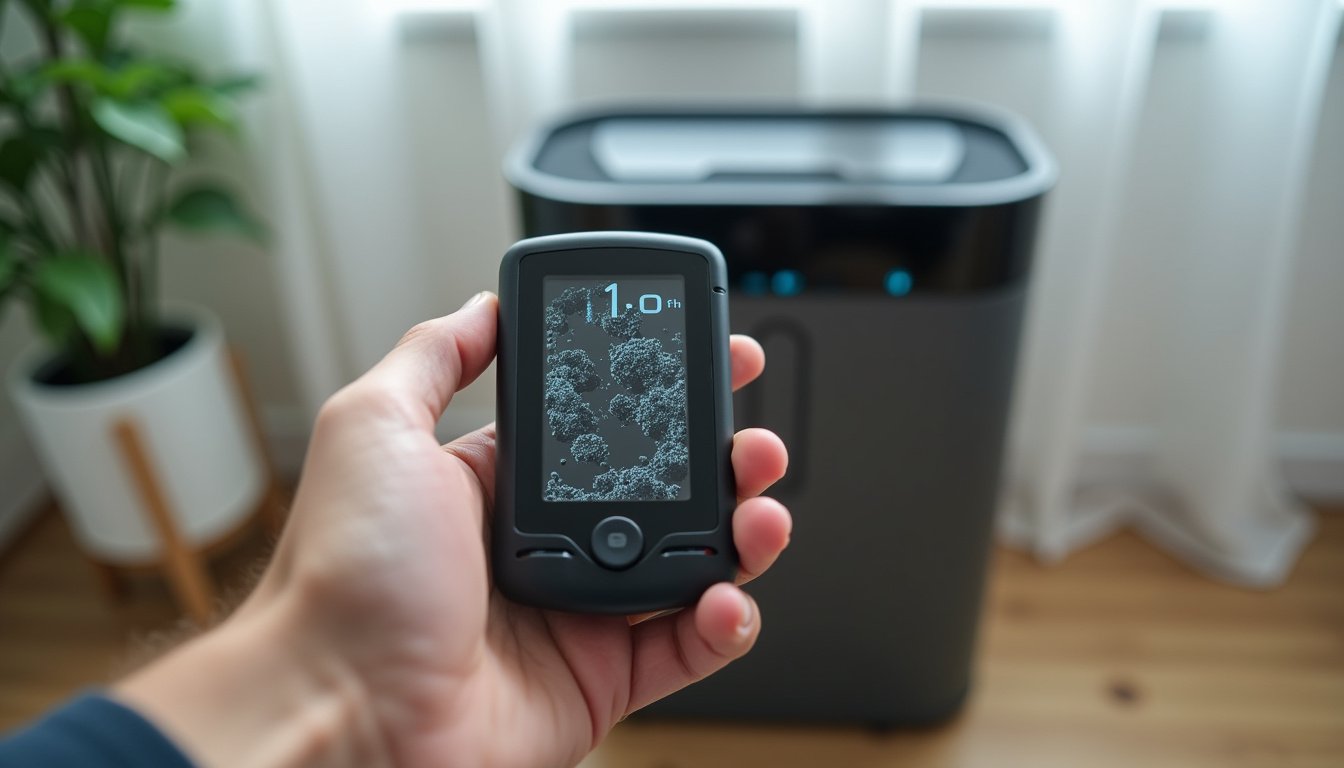
A consumer particle monitor uses a small laser and sensor to count particles passing through a sampling chamber and reports PM2.5 and usually PM10 in micrograms per cubic meter, updating every few seconds. Accuracy varies between brands and they drift over time, but for the purposes that matter at home, seeing how dirty a room is relative to outdoors, watching spikes from cooking or vacuuming, and confirming a purifier lowers the level, they are good enough and far better than guessing.
There is no EPA indoor standard for PM2.5, but the outdoor 24 hour standard of 35 micrograms per cubic meter and the annual standard of 9 give a sense of scale; many indoor readings in a clean room with a purifier running sit in the low single digits, while frying without a hood or a smoky day can push a room past 100.
| PM2.5 reading, micrograms per cubic meter | What it usually means indoors | What to do |
|---|---|---|
| 0 to 10 | Clean; purifier working or little source | Maintain |
| 10 to 35 | Typical lived-in room without filtration; mild sources | Run the purifier; check sizing and door |
| 35 to 100 | Cooking, cleaning, pets, or outdoor pollution leaking in | Range hood, close windows, purifier on high |
| Over 100 | Smoke event, heavy frying, renovation dust | Close the home, clean room with HEPA, avoid the source |
Worked example: a bedroom reads 28 before bed. The purifier, sized to the room, runs on medium with the door closed; thirty minutes later the monitor reads 9 and by morning 4. The next night the owner leaves the door open and it never drops below 18. The monitor just demonstrated both the purifier’s value and the importance of the door.
Humidity: Cheap to Measure, Often the Real Problem
A digital hygrometer costs little and answers whether a room is feeding mold and dust mites or drying out airways. The EPA’s range is 30 to 50 percent relative humidity. Place one at chest height on an interior wall away from vents, windows and appliances, and a second in the dampest room, usually a basement or bathroom. Readings over 50 percent call for ventilation, a dehumidifier or fixing a moisture source; readings under 30 call for careful humidification, with the humidifier kept clean.
Humidity readings on purifiers and thermostats are rough; a standalone hygrometer, ideally two compared against each other, is the measurement. Models with a min-max memory show how far a bedroom swings overnight, which a glance cannot.
Carbon Dioxide: A Ventilation Gauge
CO2 at the levels found in homes is not itself the concern; it is a proxy for everything else that builds up when people breathe in a closed space without fresh air: odors, moisture, VOCs. Outdoor air is roughly 420 parts per million. A bedroom with two sleepers and the door closed can climb past 2,000 by morning, which many people notice as stuffiness and poor sleep. Readings consistently under about 1,000 indicate reasonable ventilation.
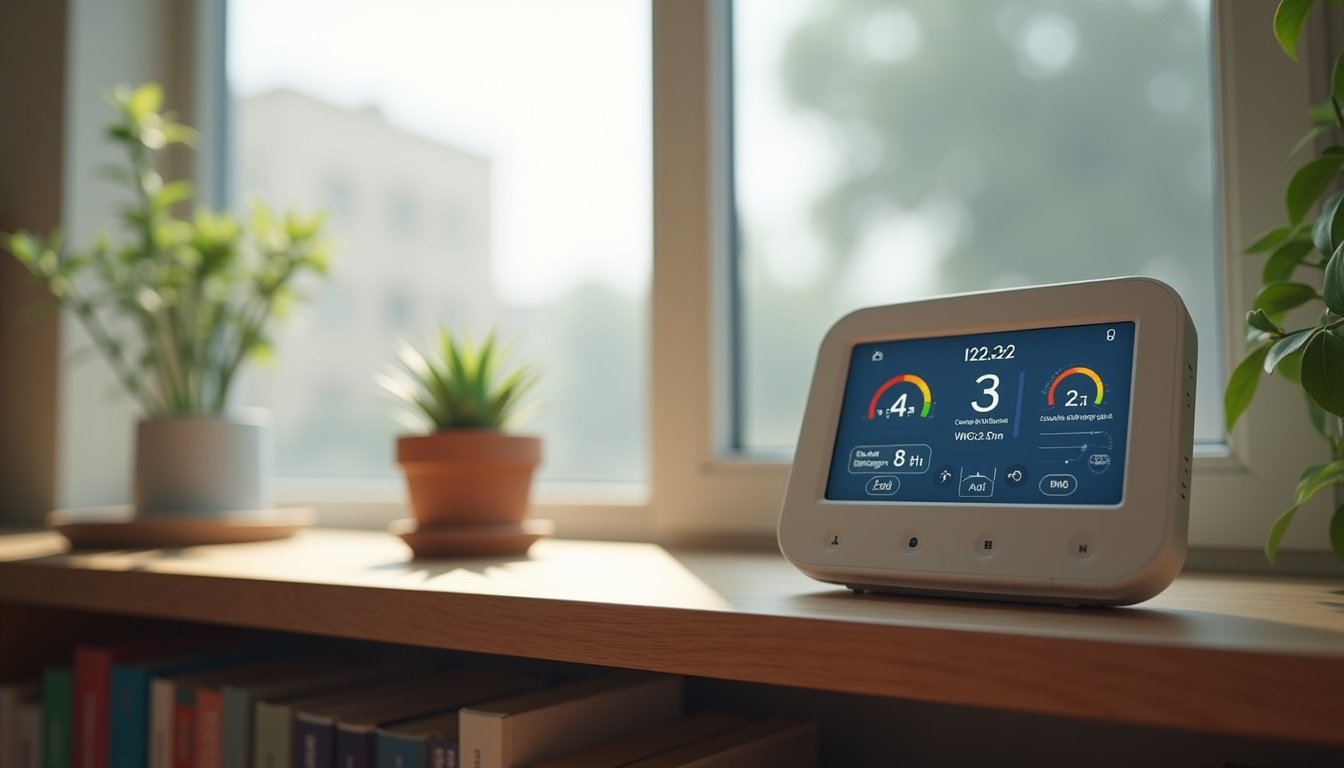
Choose a monitor that uses an NDIR sensor, which measures CO2 directly; some cheap devices estimate CO2 from VOC readings and are unreliable. Rising CO2 is the signal to open a window, crack the bedroom door, run a bathroom exhaust fan or use the HVAC fan’s circulate setting. Note that a purifier does nothing for CO2; filters do not remove gases.
VOCs and Formaldehyde: Trends and Lab Tests
Consumer TVOC sensors respond to a broad mix of volatile organic compounds from paint, furniture, cleaning products, cooking and even breath, and report an index or a rough concentration. They cannot identify which compound is present and are poorly standardized across brands, so treat them as trend indicators: a spike after unboxing new furniture or using a cleaner, a slow fall as a room off-gasses. Formaldehyde, the VOC of most concern from pressed-wood products, needs a passive sampler sent to a lab or a professional with a calibrated instrument.
If a TVOC trend stays high, the fix is source removal and ventilation, with a carbon-equipped purifier as a supplement. Air out new items before they come indoors, choose low-emission products, and open windows after cleaning or painting.
Mold and Allergens: Look Before You Test
Mold is usually found by eyes and nose, not instruments: visible growth, water stains, a musty smell and a hygrometer over 60 percent. The EPA advises that sampling is generally unnecessary when mold is visible, since the response is the same, fix the moisture and remove the growth, and that areas over about 10 square feet or hidden growth call for a professional. Home mold test kits that grow colonies in a dish tell you little, because mold spores are everywhere and the kits do not distinguish problem levels.
Specific allergen testing, for dust mite, pet or cockroach allergen in dust samples, exists through labs and is occasionally useful when an allergist wants to confirm an exposure. For most households the practical path is the allergist’s testing of the person, not the dust.
What the Purifier’s Light Tells You
Most purifiers with auto mode include a particle sensor and a colored indicator. It reads particles only, so it says nothing about CO2, humidity, radon, CO or gases, and its sensor is less accurate than a standalone monitor and prone to dust on the lens. Treat the light as a trend: green while the fan idles means the sensor sees few particles at the intake, not that the air is clean in every respect. Wipe the sensor inlet monthly with a dry swab, and compare it with a standalone PM2.5 monitor occasionally.
A Simple Measuring Routine
- Once, this month: test for radon with a kit or continuous monitor, and confirm CO alarms are installed, tested and within their replacement date.
- Place a hygrometer in the bedroom and the dampest room; read them morning and evening for a week and note the range.
- Place a PM2.5 monitor at breathing height in the bedroom; note the baseline, then watch it with the purifier on and off and the door open and closed.
- If sleep feels stuffy, add a CO2 monitor in the bedroom for a week and note the overnight peak.
- If the home is new, renovated or smells of new materials, run a TVOC sensor for a few weeks and ventilate until the trend falls.
- Act on the readings: moisture fixes and dehumidifier for high humidity, purifier sizing and door habits for particles, ventilation for CO2, source removal for VOCs, mitigation for radon.
- Repeat the quick checks seasonally, and retest radon every two years or after foundation or HVAC work.
| Finding | Likely fix | Instrument to confirm |
|---|---|---|
| Humidity over 50 percent | Dehumidify, ventilate, fix leaks | Hygrometer |
| Humidity under 30 percent | Clean humidifier, used carefully | Hygrometer |
| PM2.5 high at night with door closed | Purifier undersized or off; size by CADR; run continuously | PM2.5 monitor |
| PM2.5 spikes when cooking | Vented range hood on every burner | PM2.5 monitor |
| CO2 over 1,500 overnight | Crack door or window; exhaust fan; HVAC circulate | CO2 monitor |
| TVOC high after new furniture | Air items out; ventilate; carbon purifier as supplement | TVOC sensor |
| Radon at or above 4 pCi/L | Certified mitigation contractor | Follow-up radon test |
| Musty smell, visible mold | Fix moisture; clean or call professional | Hygrometer; eyes |
What Not to Bother With
A few popular purchases measure little. Dish-style mold test kits grow colonies from spores present in every home and cannot indicate a problem level. Devices that claim to report air quality as a single score blend particles and a VOC estimate into a number that cannot be acted on; look for the individual readings instead. Cheap CO2 monitors that lack an NDIR sensor estimate from VOCs and are unreliable. Houseplants are pleasant but do not measure or meaningfully change air quality.
Spend instead on the instruments that map to actions: a PM2.5 monitor, a hygrometer, an NDIR CO2 monitor, a radon test and CO alarms. Together they cost less than most purifiers and tell you whether a purifier is even the right purchase.
How to Check Your Home’s Air in 7 Steps
- Test for radon and confirm working CO alarms; these are the hazards no other instrument catches.
- Buy a hygrometer and a PM2.5 particle monitor; add an NDIR CO2 monitor if rooms feel stuffy.
- Read humidity in the bedroom and the dampest room for a week and compare with 30 to 50 percent.
- Watch PM2.5 at breathing height with the purifier on and off, door open and closed, and during cooking.
- Note CO2 overnight in the bedroom and ventilate if it climbs past about 1,500.
- Act on the readings: moisture, filtration sized by CADR, ventilation, source removal or mitigation as indicated.
- Recheck seasonally and after any renovation, new furniture or change in the home.
Do and Do Not
Do
- Test for radon and install CO alarms first.
- Use standalone instruments, not a purifier’s light, for measurements.
- Place monitors at breathing height away from vents and appliances.
- Watch trends over days, not single readings.
- Fix sources and ventilate before buying more devices.
Do not
- Do not rely on dish-style mold kits or single-score air quality gadgets.
- Do not trust CO2 monitors without an NDIR sensor.
- Do not treat a green purifier light as proof the air is clean.
- Do not expect a purifier to change CO2, humidity or radon.
- Do not ignore a gas smell or a CO alarm to take a reading; leave and call.
Who Should Skip This
If you smell gas, a CO alarm is sounding, water is pooling or mold covers more than about 10 square feet, skip measuring and act: leave and call the utility, get out and call emergency services, dry materials within 48 hours, or call a mold professional. Instruments come after the emergency.
If your home has already been tested for radon, has working CO alarms, holds 30 to 50 percent humidity and nobody has symptoms, you can skip the fuller monitoring routine and keep just the hygrometer, adding a PM2.5 monitor only when smoke season or a new purifier makes it useful.
Honest Limits
- Consumer monitors vary in accuracy and drift; use them for trends and comparisons, not laboratory values.
- There is no official indoor PM2.5 standard; outdoor standards give scale only.
- TVOC sensors cannot identify compounds; formaldehyde needs a lab test.
- Radon kits need correct placement and exposure time; follow the kit’s instructions exactly.
- Readings describe the air, not a person’s health; symptoms belong with a doctor.
- Monitoring is pointless without action; the readings only matter if they change what you fix.
When to See a Professional
Call a certified radon professional for testing confirmation and mitigation at 4 pCi/L or above, a mold professional for growth over about 10 square feet or hidden damp, an HVAC technician for combustion appliance service and ventilation improvements, and the gas utility immediately for any gas smell. A CO alarm sounding means leave and call emergency services.
See a doctor for any symptoms you suspect are related to indoor air; monitors describe the room, not the person, and nothing on this page is medical advice.
Frequently Asked Questions
How can I test the air quality in my home?
Use separate instruments for separate things: a PM2.5 particle monitor for dust and smoke, a hygrometer for humidity, an NDIR CO2 monitor for ventilation, a radon test kit or continuous monitor, and CO alarms on every level. A purifier’s light reads particles only and is a trend indicator, not a measurement.
What is the most important indoor air test?
Radon, because it is a serious hazard that only a test detects, and the EPA recommends testing every home with mitigation at 4 picocuries per liter or above. Working carbon monoxide alarms come next. Then a hygrometer and a PM2.5 monitor for the everyday problems of humidity and particles.
What PM2.5 level is good indoors?
There is no official indoor standard, but readings in the low single digits are typical of a clean room with a purifier running, while 10 to 35 is a normal unfiltered room and over 100 indicates smoke, heavy cooking or renovation dust. The EPA outdoor 24 hour standard of 35 gives a sense of scale.
What humidity should my home be?
Between 30 and 50 percent relative humidity, per EPA guidance, to limit mold and dust mites while avoiding the dryness that irritates airways. Measure with a standalone hygrometer at chest height away from vents, and use a dehumidifier, ventilation or a clean humidifier to stay in range.
Is a CO2 monitor worth having at home?
Yes, as a ventilation gauge. CO2 rises when people breathe in a closed room, and a bedroom passing 1,500 to 2,000 ppm overnight feels stuffy. Choose a monitor with an NDIR sensor, and treat rising readings as a cue to crack a door or window or run an exhaust fan; purifiers do not remove CO2.
Does an air purifier measure air quality?
Only partially. Its sensor counts particles at the intake and drives the colored light and auto mode; it cannot see CO2, humidity, radon, CO or gases, and dust on its lens makes it read clean. Use it as a trend and confirm with a standalone PM2.5 monitor placed across the room.
How do I test for mold in my house?
Mostly by looking and smelling: visible growth, water stains, a musty odor and a hygrometer over 60 percent. The EPA says sampling is usually unnecessary when mold is visible, since the fix is the same, moisture control and removal. Dish-style kits tell you little; call a professional for over about 10 square feet.
Can I measure VOCs at home?
Roughly. Consumer TVOC sensors show a trend, rising after new furniture or cleaning and falling as a room off-gasses, but cannot identify compounds or give reliable concentrations. Formaldehyde needs a lab-analyzed sampler. Treat high trends as a cue to ventilate and remove sources.
How often should I check indoor air quality?
Radon every two years or after foundation or HVAC work; CO alarms tested monthly; humidity watched weekly in damp or dry seasons; PM2.5 whenever a purifier is set up, during smoke season or when symptoms change; CO2 for a week when a room feels stuffy. Recheck after renovations or new furniture.
What should I do if readings are bad?
Match the fix to the reading: dehumidify or fix leaks for high humidity, size a HEPA purifier by CADR and close the door for high PM2.5, ventilate for high CO2, remove sources for high VOCs, and call a certified contractor for radon at 4 pCi/L or above. Gas smell or CO alarm: leave and call.
Bottom Line
Checking indoor air quality at home is less about one gadget than about five cheap measurements, each tied to an action. A radon test and CO alarms cover the hazards nothing else detects. A hygrometer tells you whether the home is breeding mold or drying airways. A PM2.5 monitor shows the particles a purifier removes and proves whether it is sized and placed right. A CO2 monitor says when to open a window. Everything else is a trend sensor or a lab test.
Buy the instruments before the solutions, place them at breathing height away from vents, watch them for a week, and let the readings choose between a dehumidifier, a bigger purifier, an open window and a mitigation contractor. The air stays invisible, but it stops being a mystery.
Related reading: Air purifier humidity sensor issues, What do air purifiers clean, Does an air purifier clean dust.