Last updated:
As an Amazon Associate we earn from qualifying purchases. This does not change what we recommend. See our affiliate disclaimer.
An air purifier gives almost no feedback. It hums, a light glows, and the air looks exactly as before, because clean air and dirty air look the same. After a few months the question surfaces: is this thing doing anything, or is it an expensive fan with a reassuring ring of light?
You can tell whether an air purifier is working with five checks that take an afternoon and cost little. First, airflow: a working unit moves a steady, even stream on every speed, and weak or lopsided flow means a loaded filter or a blocked intake. Second, the filter: after a few weeks a working HEPA has turned grey with what it has caught, while a white filter after months means air is bypassing it or the unit barely runs. Third, a particle meter: a low-cost PM2.5 monitor across the room should show the count halving within twenty to thirty minutes of the unit starting on high in a closed room. Fourth, settling dust: over weeks, surfaces near a working unit collect less dust and the pre-filter more. Fifth, odor, if the unit has real carbon: smells fade faster with the unit on. What tells you nothing is the unit’s own air quality light, which reads from a sensor that sees the cleanest air first, or how the room feels, since fine particles are invisible. If the checks fail, the usual reasons are a loaded or bypassed filter, a unit too small for the room, bad placement, or a low speed held by auto mode.
In short: feel the airflow, look at the filter, measure with a cheap particle meter, watch the dust, smell the room. Trust those, not the ring of light.
The EPA notes that a portable air cleaner’s effect is measured by the fall in particle concentration in the room, that consumer PM2.5 monitors are useful for relative comparisons, and that performance depends on CADR matched to room size, filter condition and placement.
This guide is research-based, drawn from EPA guidance on air cleaners and consumer sensors, AHAM clean air delivery rate standards and maker specifications. We have not tested the units in the table and quote no prices or ratings. Nothing here is medical advice.
Signs it is working
- Steady, even airflow at the outlet on every speed
- A filter that greys over weeks and a pre-filter that fills with lint
- A particle meter across the room falling by half or more in 20 to 30 minutes on high
- Less dust settling nearby; odors fading faster with the unit on
Signs it is not
- Weak or lopsided airflow: loaded filter or blocked intake
- A filter still white after months: bypass, plastic left on, or barely running
- A particle meter that does not move: undersized unit, open room, low speed or faulty fan
- The unit’s own light says clean while a meter across the room says otherwise
Key Takeaways
- Clean air looks and smells like dirty air; feelings and the unit’s own light are not evidence.
- Airflow is the first test: a working unit pushes a steady, even stream on every speed.
- A HEPA that greys over weeks is capturing; one still white after months is being bypassed or barely used.
- A low-cost PM2.5 monitor across the room is the definitive test: the count should halve or better within 20 to 30 minutes on high in a closed room.
- Settling dust on surfaces falls over weeks near a working unit, and the pre-filter fills.
- The unit’s air quality light reads inside the housing, where the air is cleanest, and often reads clean when the room is not.
- If the tests fail, suspect filter condition, room size versus CADR, placement and auto mode before the unit itself.
Purifiers Whose Performance Is Easy to Verify
These widely reviewed units publish AHAM-verified CADR figures, have filters that lift out for inspection and move enough air that a particle meter shows the change quickly. Compare the maker-listed CADR against your room and keep a cheap PM2.5 monitor across the room from the unit.






How This Guide Approaches the Question
We looked at what a purifier does that can be observed, at how CADR is measured and how that translates into a home test, at what consumer particle monitors can and cannot show, and at the reasons a unit fails the tests. Product details in the table come from maker specifications.
The honest statement is that most purifiers that seem not to work are working on the air that reaches them; the problem is how much air that is, and whether the filter is in a state to clean it.
Why You Cannot Feel It Working
Fine particles, the PM2.5 that purifiers exist to remove, are invisible and odorless at the concentrations found in homes, so a room at 40 micrograms per cubic meter and a room at 5 look and smell identical. The sense that air feels fresher after a purifier runs is real for some people and placebo for others, and neither is evidence. Odors are gases that only carbon addresses, so a room can be particle-clean and still smell. And the unit’s own air quality light reads from a sensor inside or beside the housing, which sees the cleanest air in the room, the air the unit just processed, and turns green long before the far corner does. Testing a purifier means measuring or observing something it actually changes.
| Evidence | Tells you | Does not tell you |
|---|---|---|
| How the air feels | Draft and temperature | Particle levels |
| The unit’s air quality light | Air at the intake | Air across the room |
| Noise and fan speed | The fan is running | That air is passing through the filter |
| Filter color over weeks | Particles are being captured | Whether the room is clean enough |
| Particle meter across the room | Room particle levels and their fall | Gases and odors |
| Dust on surfaces over weeks | Coarse particle load | Fine particle levels |
| Odor fading with unit on | Carbon stage working | Particle performance |
Test One: Airflow
Hold a hand a few inches above or in front of the outlet on each speed. A working unit delivers a steady, even stream that grows clearly with each step up; on high it should be unmistakable from a foot away. Weak flow on all speeds points at a loaded filter, a pre-filter matted with hair, shipping plastic left on a new filter or a blocked intake; lopsided flow points at an intake starved on one side. A unit that moves plenty of air on manual high but little in auto is being held low by its sensor, which is a setting, not a fault. Airflow is necessary but not sufficient: a unit with no filter in it moves air beautifully and cleans nothing, which is why the next test matters.
Test Two: The Filter
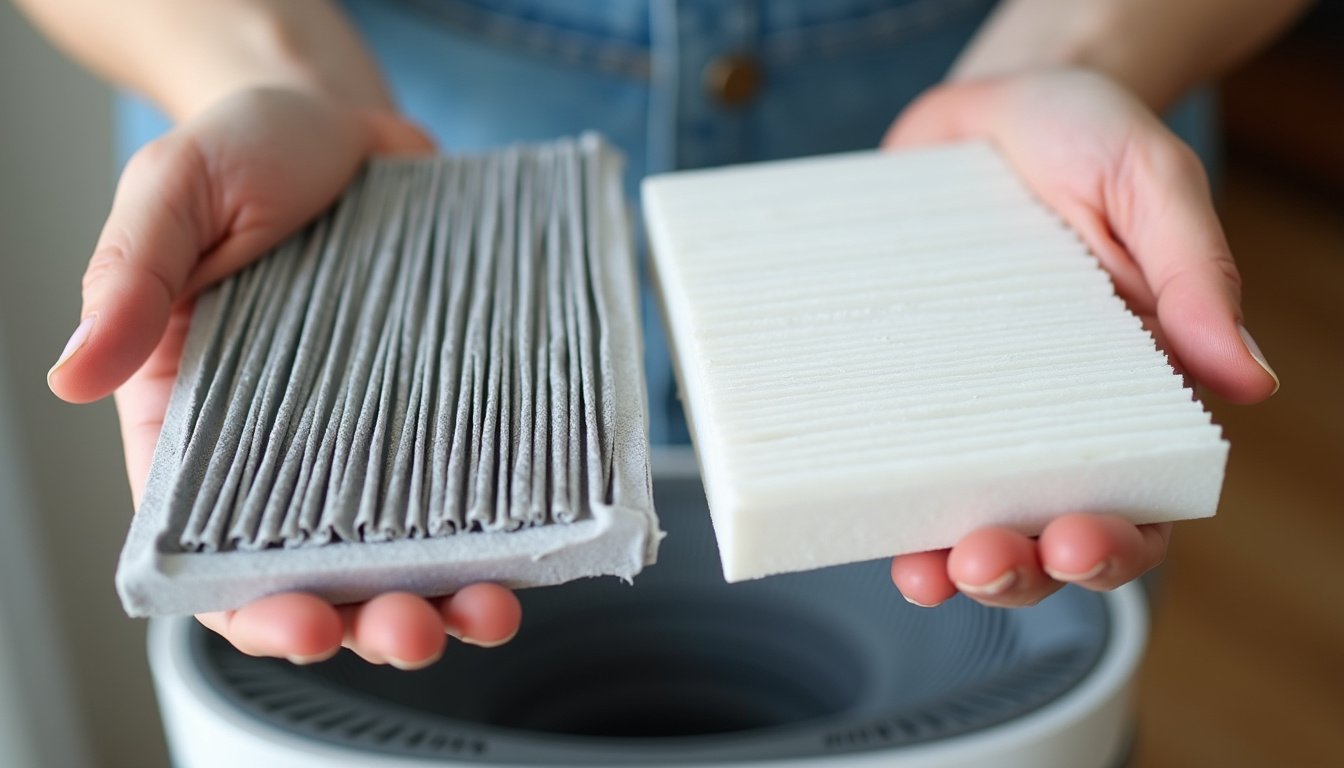
Pull the filters after a few weeks of running and look. A working HEPA in a normal home turns grey across its intake face within a month or two and darker with time; the pre-filter collects a visible mat of hair, lint and dust; a carbon stage may smell faintly of what it has adsorbed. That is the evidence of capture. A HEPA still white after months means one of a few things: the unit has barely run, air is bypassing the filter because it is unseated or the door is open, shipping plastic is still on it, the pre-filter is catching everything because the home is very clean, or the fan is not actually pulling air through the stack. Dust on the inside of the housing downstream of the filter is a bypass sign too.
- Grey HEPA face after weeks: capturing; replace when heavily loaded or airflow falls.
- Matted pre-filter: working; rinse monthly and dry flat.
- White HEPA after months: check for plastic, seating, door, and whether the unit actually runs.
- Dust inside the housing past the filter: bypass; reseat the filter and check the gasket.
- Musty smell from the filter: damp; replace it and move the unit from moisture.
Test Three: A Particle Meter
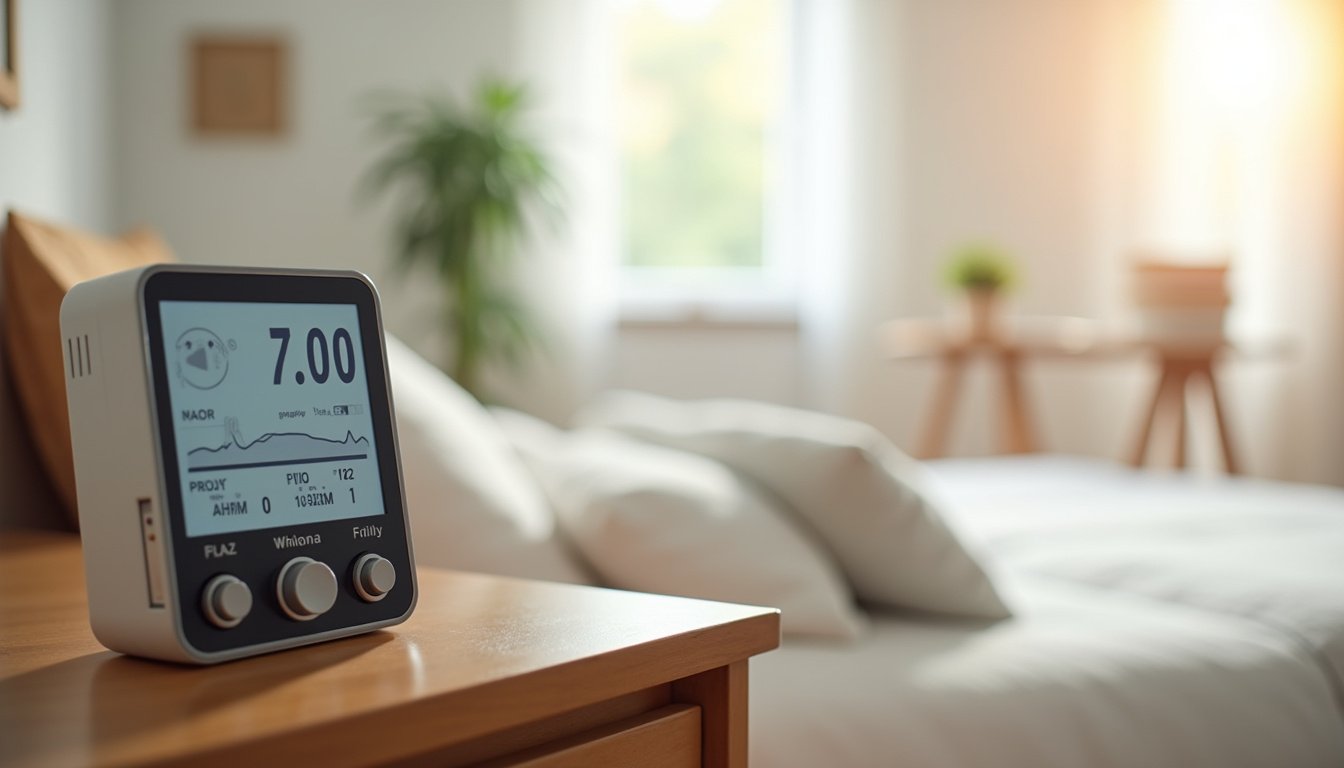
This is the test that settles it, and it mirrors how CADR is measured. Low-cost PM2.5 monitors are widely available; the EPA treats them as useful for relative comparisons even where their absolute accuracy is limited, which is exactly what this test needs. Place the monitor across the room from the purifier, at table height, away from the outlet stream. Close the windows and doors. Note the reading with the unit off and the room undisturbed for a while, or raise the baseline deliberately by lighting and blowing out a match or two. Then run the purifier on high and watch. In a closed room of the size the unit is rated for, the reading should fall by half or more within twenty to thirty minutes and keep falling toward the monitor’s floor. Switch the unit off and the reading drifts back up over an hour or two as particles leak in and resuspend.
| Result on high, closed room | Interpretation | Next step |
|---|---|---|
| Falls by half or more in 20 to 30 minutes | Working and sized for the room | Nothing; run continuously |
| Falls slowly, by a third in an hour | Working but undersized, or filter loaded | Check filter; compare CADR to room; close doors |
| Barely moves | Open room, very loaded filter, bypass or fan fault | Check filter and seating; test in a smaller closed room |
| Falls, then rises while unit still on | Particles entering faster than removed | Find the source: cooking, open window, humidifier mist |
| Unit light says clean while meter is high | Sensor reading its own exhaust | Trust the meter; move the unit; consider manual speed |
Worked example: a 180 square foot bedroom with a unit rated 130 CFM. A monitor on the far dresser reads 28 micrograms per cubic meter after a blown-out match. On high, it reads 14 at twenty-two minutes and 6 at forty-five. Switched off at bedtime, it reads 19 by morning with the door closed. The unit works; it also shows why running continuously matters.
Tests Four and Five: Dust and Odor
Over weeks, a working purifier changes what settles. Surfaces near the unit collect visibly less dust between cleanings, the pre-filter collects more, and the characteristic grey film on a television screen or a dark shelf takes longer to return. This is slow and informal evidence, and it tracks coarse dust more than fine particles, but it is the evidence most owners notice first. Odor is the test for the carbon stage, and only for units with a real carbon bed: a cooking or pet smell should fade noticeably faster with the unit running than it does on its own. A unit with a thin carbon-coated sheet will pass the particle tests and fail this one, which is not a fault; it is the limit of its carbon.
Why a Working Unit Seems Not To
Most purifiers that fail the tests are not broken. They are undersized for an open-plan space, so the air they clean mixes with far more they never reach; they are placed in a corner, behind a sofa or under a desk, where the intake is starved; they run on low because auto mode’s sensor sits in clean exhaust; their filter is loaded or bypassed; or the room has a continuous source, an open window, a gas stove, a humidifier throwing mist, that outpaces them. Each of these is fixed without a repair. Match the CADR to the room at two thirds of the square footage or more, close doors to make the room the unit’s size, put the unit in the open, run it on a fixed medium or high, and replace the filter.
| Cause | Sign | Fix |
|---|---|---|
| Undersized for the space | Meter falls slowly; open-plan room | Close doors; larger unit or a second one |
| Bad placement | Lopsided airflow; meter barely moves | Open floor space; a foot from walls |
| Auto mode idling | Strong on manual high, weak in auto | Fixed speed; clean sensor lens |
| Loaded filter | Weak airflow on all speeds | Replace HEPA; rinse pre-filter |
| Bypass | White HEPA; dust past the filter | Reseat; check gasket and door; remove plastic |
| Continuous source | Meter rises with unit on | Close window; move humidifier; range hood when cooking |
| Fan fault | Weak on manual high with fresh filter | Service |
What Working Does Not Mean
A purifier that passes every test is lowering fine particle levels in one room while it runs. It is not removing carbon dioxide, which needs ventilation; not removing carbon monoxide or radon, which need alarms and a test; not removing gases unless it has a real carbon stage; not cleaning carpets, bedding or the rooms next door; and not treating anyone’s symptoms, which are a matter for a doctor. Keep the tests in proportion: they tell you the appliance does its job, which is a narrow and useful thing. Nothing here is medical advice.
How to Test Your Purifier in 6 Steps
- Feel the outlet on each speed; a steady, even stream that grows with speed means the fan and airflow path are clear.
- Pull the filters: a greying HEPA and a matted pre-filter mean capture; a white HEPA after months means bypass, plastic or a unit that barely runs.
- Place a PM2.5 monitor across the room, close doors and windows, raise the baseline with a blown-out match, and run the unit on high.
- Expect the reading to fall by half or more within 20 to 30 minutes; if it falls slowly, check filter and room size; if it barely moves, check bypass and placement.
- Over the following weeks, watch dust on nearby surfaces and how fast odors fade with the unit on.
- If the tests fail, fix size, placement, speed and filter before suspecting the unit, and keep the HEPA on schedule once it passes.
Do and Do Not
Do
- Test with a particle meter across the room, not the unit’s own light.
- Close doors and windows for the test.
- Inspect the filter for greying and bypass.
- Compare airflow across speeds and against a fresh filter.
- Run continuously once the unit passes.
Do not
- Do not judge by how the air feels.
- Do not trust the unit’s air quality light as a room reading.
- Do not test in an open-plan space larger than the rating.
- Do not confuse odor with particles; carbon and HEPA are separate tests.
- Do not assume a failed test means a broken unit.
Who Should Skip This
If a particle meter across a closed room halves within half an hour on high, skip the other tests; the unit is working and sized for the room, and the only task is to run it continuously and keep the filter on schedule.
If the HEPA is still in its shipping plastic or sitting proud of its seat, skip the testing until it is fitted properly; nothing measured before that means anything.
Honest Limits
- Consumer PM2.5 monitors are relative instruments; absolute readings vary between units.
- Test results depend on room sealing, sources and outdoor levels on the day.
- Filter greying rates vary enormously by home.
- Dust and odor observations are informal and slow.
- We did not test any unit or monitor.
- Nothing here is medical advice; a purifier’s effect on any person’s symptoms is a question for a doctor.
When to See a Professional
Contact the maker if a unit with a fresh, properly seated filter moves little air on manual high, or if a particle meter shows no change in a small closed room; a fan or bypass fault is a service matter.
Use carbon monoxide alarms and a radon test for the gases no purifier addresses, an HVAC professional for whole-house filtration questions, and a doctor for any health concern; nothing on this page is medical advice.
Frequently Asked Questions
How can I tell if my air purifier is actually working?
Five checks: steady, even airflow at the outlet on every speed; a HEPA that greys over weeks and a pre-filter that fills; a PM2.5 monitor across a closed room falling by half within 20 to 30 minutes on high; less dust settling nearby; and odors fading faster with the unit on.
Can I trust the air quality light on the purifier?
Only as a rough trend. The sensor sits in or beside the housing and sees the air the unit just cleaned, so it reads clean long before the far side of the room does, and a dusty lens makes it read clean permanently.
What should a particle meter show if the purifier is working?
5 reading should fall by half or more within 20 to 30 minutes of starting on high and keep falling toward the monitor’s floor, then drift back up over an hour or two after the unit stops.
My filter is still white after months. Is the purifier working?
Probably not as intended. A working HEPA greys across its intake face within a month or two in a normal home. White after months means the unit barely runs, shipping plastic is still on the filter, the filter is unseated so air bypasses it, or the fan is not pulling air through the stack.
Why does the room still smell if the purifier is working?
Because smell is gas and HEPA removes particles. Only an activated carbon stage addresses odor, and the thin carbon sheet bundled with many filters holds little and saturates fast. A unit can pass every particle test and leave a kitchen or pet smell untouched; that is the limit of its carbon.
How long should it take a purifier to clean a room?
With a CADR of two thirds of the room’s square footage, roughly five air changes an hour, so most of the particle load falls within 20 to 30 minutes on high in a closed room and the rest over the following hour.
Why does my purifier seem to do nothing in my living room?
Usually because the space is larger or more open than the unit’s rating, so cleaned air mixes with far more it never reaches, or the unit sits in a corner with a starved intake, or auto mode holds it on low.
Does more dust on the filter mean the air is dirtier?
It means the filter is capturing, which is what you want to see, and the rate reflects both how dirty the air is and how much air the unit moves. A fast-greying filter in a home with pets or smoke is normal and simply means earlier replacement.
Is it normal that I cannot feel any difference?
Yes. Fine particles are invisible and odorless at household levels, so clean and dirty air feel the same, and the only honest evidence is measurement and observation: airflow, filter condition, a particle meter, dust and odor over time. Feeling nothing is not a sign of failure, and feeling fresher is not a sign of success.
How often should I retest the purifier?
Run the particle meter test when the unit is new, after each filter change and whenever you suspect a problem; a meter left across the room gives a running answer at a glance. Check airflow and the filter monthly.
Bottom Line
You can tell whether an air purifier is working, but not by looking at the air or at the unit’s ring of light. Feel the airflow on each speed, pull the filter and look for grey, and above all put a low-cost particle meter across a closed room and watch the count halve within half an hour on high. Over weeks, less dust on nearby surfaces and faster-fading odors confirm it.
When the tests fail, the unit is rarely broken: it is undersized for an open space, badly placed, held on low by auto mode, or working behind a loaded or bypassed filter, and each of those is fixed without a repair. Once it passes, run it continuously, keep the filter on schedule and let the meter, not the light, be the judge.
Related reading: Air purifier CADR explained, Air purifier airflow issues, Does an air purifier clean dust.