
Last updated:
As an Amazon Associate we earn from qualifying purchases. This does not change what we recommend. See our affiliate disclaimer.
Purifier listings increasingly carry a grade next to the word HEPA: H13 on most, H14 on a few that present it as a step up. The letters come from a European filter standard and they do mean something precise. What they do not mean is what the marketing implies, that an H14 unit makes a bedroom noticeably cleaner than an H13 one.
H13 and H14 are adjacent grades in the European EN 1822 standard for high efficiency filters. An H13 filter captures at least 99.95 percent of particles at the most penetrating particle size, typically between 0.1 and 0.3 microns, and roughly matches the American true HEPA definition of 99.97 percent at 0.3 microns. An H14 filter captures at least 99.995 percent at the same size, letting through about one tenth as many of the hardest particles. In absolute terms both let through a tiny fraction, 5 in 10,000 versus 5 in 100,000, and both capture larger household particles such as dust, pollen and dander essentially completely. The denser H14 media resists airflow more, so for the same fan it moves less air, runs louder at a given cleaning rate and loads sooner. For a home, H13 is the right grade, and the number that actually decides how clean the room gets is the unit’s CADR, not its filter class.
In short: H13 is true HEPA and more than enough for a home; H14 is a hospital and cleanroom grade that trades airflow for an efficiency gain you cannot notice in a bedroom.
The EPA’s guide to air cleaners in the home describes HEPA filtration as effective for household particles and makes clear that a unit’s cleaning rate, measured by AHAM as CADR, depends on airflow as well as filter efficiency. Neither agency recommends a filter grade above HEPA for residential use.
This comparison is research-based, drawn from the EN 1822 standard, EPA and AHAM guidance and maker specifications. We have not tested the units in the comparison table and quote no prices or ratings, only published features.
H13 is the right choice if
- The purifier is for a home, office or classroom
- You want the most clean air per hour for the room size
- Noise, filter cost and replacement availability matter
- Your targets are dust, pollen, dander, spores or smoke
H14 is worth considering only if
- A clinical, laboratory or manufacturing standard specifies it
- Airflow has been engineered around the denser filter
- You have a professional reason to minimize sub-0.3 micron penetration
- Cost and noise are secondary to meeting a specification
Key Takeaways
- H13 captures at least 99.95 percent and H14 at least 99.995 percent of the most penetrating particle size under EN 1822 testing.
- H13 corresponds to American true HEPA; both grades capture household particles essentially completely.
- H14 media is denser, so it lowers airflow, raises noise for a given cleaning rate and loads faster.
- CADR, the volume of clean air a unit delivers, decides how fast a room is cleaned; grade alone does not.
- Size by AHAM’s rule: a dust CADR of about two-thirds of the room’s floor area in square feet.
- H14 belongs in hospitals, pharmaceutical areas and cleanrooms with engineered airflow.
- The label to avoid is HEPA-type or HEPA-like, not H13.
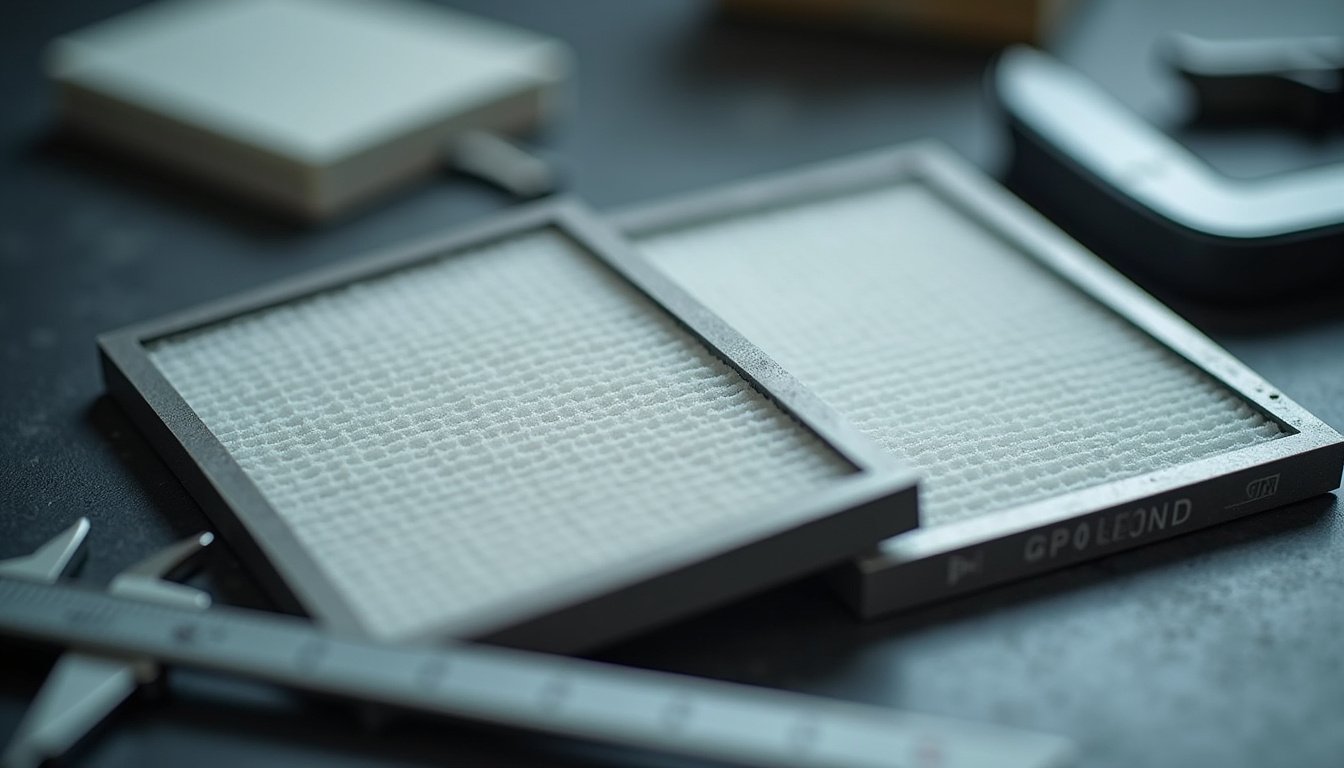
True HEPA Purifiers to Compare
These widely reviewed units use true HEPA filtration with activated carbon and cover bedrooms through large living rooms. Compare the maker-listed CADR and room size, which matter far more for a home than the difference between H13 and H14.






How We Compared the Grades
We compared the EN 1822 definitions, the physics of fiber filtration and pressure drop, the particle sizes that matter in homes and the EPA and AHAM sizing guidance that governs real-world cleaning rates. Product details in the table come from maker specifications.
The central point is that a purifier removes particles at a rate set by efficiency times airflow. Moving from H13 to H14 raises efficiency from 99.95 to 99.995 percent, a change of 0.045 percentage points, while the denser media cuts airflow by a far larger share. The product of the two falls, not rises.
What EN 1822 Grades Mean
EN 1822 is the European standard for EPA, HEPA and ULPA filters. It tests each filter at its most penetrating particle size, the diameter at which fiber filters are least efficient, usually between 0.1 and 0.3 microns. Grades E10 to E12 are efficient particulate air filters below HEPA; H13 and H14 are HEPA; U15 to U17 are ULPA. The American definition of HEPA, 99.97 percent at 0.3 microns, lands between H13 and H14 and is treated as equivalent to H13 in practice.
| Grade | Minimum overall efficiency at MPPS | Maximum penetration | Rough equivalent | Typical setting |
|---|---|---|---|---|
| E11 | 95 percent | 5 percent | MERV 16 territory | Pre-filtration, some HVAC |
| E12 | 99.5 percent | 0.5 percent | Near HEPA | Some purifiers labeled HEPA-type |
| H13 | 99.95 percent | 0.05 percent | US true HEPA | Home purifiers, offices, schools |
| H14 | 99.995 percent | 0.005 percent | Above US true HEPA | Hospitals, pharma, cleanroom supply |
| U15 | 99.9995 percent | 0.0005 percent | ULPA | Cleanrooms |
A key detail is that EN 1822 tests the whole filter including its frame and seal, and H14 filters are also individually leak-tested. That is part of why they cost more: the standard asks more of the manufacturing, not just the media.
How Much Difference 0.045 Percent Makes
At the most penetrating size, an H13 filter lets through up to 5 particles in 10,000 and an H14 up to 5 in 100,000. Ten times fewer sounds dramatic, but the base is already tiny. For every 10,000 of the hardest particles entering the filter, H13 passes at most 5 and H14 at most half of one. Away from that worst-case size, toward the pollen, dander and dust that make up most of a home’s particle load, both grades approach complete capture.
The room’s air is also not cleaned in one pass. A purifier cycles the air several times an hour, and each pass removes almost everything that reaches the filter. After an hour, the difference between the two grades is lost in the noise of doors opening, people moving and the HVAC cycling. An inexpensive PM2.5 monitor could not tell the two rooms apart.
The Airflow and Noise Penalty
Higher efficiency comes from denser or deeper media, which resists airflow. Engineers call this pressure drop, and it rises with grade. For a given fan, an H14 filter passes less air than an H13 filter of the same dimensions, or the fan must spin faster and louder to pass the same amount. In a portable purifier this shows up as a lower CADR at each speed, or more noise at the speed that meets the room’s target.
Because cleaning rate is efficiency multiplied by airflow, and efficiency barely changes while airflow drops noticeably, an H14 unit with the same fan typically cleans a room more slowly than its H13 counterpart. Makers can compensate with a bigger fan or a larger filter, which adds cost and size, but the point stands: at home, the grade upgrade buys nothing you can measure and costs airflow you can hear.
| Factor | H13 in a home purifier | H14 in the same unit |
|---|---|---|
| Capture of household particles per pass | Essentially complete | Essentially complete |
| Airflow for a given fan speed | Higher | Lower |
| Noise at a given CADR | Lower | Higher |
| Filter loading | Standard | Faster, as denser media clogs sooner |
| Replacement cost | Lower | Higher; individual leak testing adds cost |
| Availability of replacements | Wide | Narrower |
| Difference you can detect at home | Baseline | None in particle counts |
Worked example: a 13 by 15 foot bedroom, 195 square feet, needs a dust CADR of about 130 by AHAM’s rule. An H13 unit rated at a dust CADR of 160 on high and about 110 on medium nearly meets the target quietly. Fitted with H14 media and the same fan, the unit might deliver 125 on high, forcing the loud setting to approach the target. The room is equally clean either way; one version is louder and its filter costs more.
Where H14 Is the Right Choice
H14 filters are specified where a standard or a process demands very low penetration: hospital operating rooms and isolation rooms, pharmaceutical and biotech manufacturing, aseptic compounding, and the terminal filters supplying cleanrooms. In those settings airflow is designed around the filter with powerful fans, ducted systems and pressure control, and each filter is leak-tested on installation. The extra efficiency is a requirement with regulatory weight behind it.
Some portable units aimed at clinics, dental offices and laboratories use H14 for the same reason, and that is a sensible match for a professional specification. In a home the same unit works, but its owner pays for engineering they cannot use.
Reading the Labels on Consumer Purifiers
Three labeling habits cause confusion. First, H13 is often described as medical grade, which has no formal meaning and should not be read as a health claim. Second, some listings say H13 or H14 without an EN 1822 certificate; the grade is a claim unless the filter is tested to the standard. Third, and most important, many budget units say HEPA-type, HEPA-like, HEPA-style or 99 percent, all of which describe media below H13 and often well below. That gap, not the H13 versus H14 one, is the one that matters at home.
Cost and Replacement Over Time
H14 filters are more expensive to make because of denser media and individual leak testing, and they load faster because the dense media has less open area. In a home with pets or during a smoke season, an H14 filter could need replacing noticeably sooner than an H13 stage in a comparable unit. Replacement availability is also narrower, since fewer consumer units use the grade.
Over five years, the extra filter cost of H14 compounds without a matching benefit, and the shorter interval means more waste. Our maintenance cost guide gives the general formula; for this comparison the conclusion is simply that H13 costs less per year of equivalent cleaning.
| Cost line | H13 | H14 |
|---|---|---|
| Filter price | Lower | Higher; denser media and individual leak testing |
| Replacement interval | Maker’s standard, often 12 months | Shorter; dense media loads sooner |
| Availability | Wide, many sellers | Narrower |
| Electricity at a given CADR | Lower; fan runs slower | Higher; fan works against more resistance |
| Five-year total for the same room | Baseline | Higher, with no measurable cleaning gain |
What Actually Separates Good Purifiers
With grade settled at H13 or true HEPA, the features that matter are the ones that affect airflow, sealing, noise and odor. CADR relative to room size decides cleaning speed. A gasketed filter housing prevents bypass, which can matter more than the last decimal of filter efficiency. Noise on medium decides whether the unit runs overnight. A washable pre-filter protects the HEPA stage. A carbon stage by weight decides odor performance, which no HEPA grade affects. Filter interval and availability decide running cost.
- Dust CADR at least two-thirds of the room’s floor area in square feet, reached on medium.
- Quiet medium speed with a published noise rating.
- True HEPA or H13 in a gasketed housing; no HEPA-type media.
- Washable pre-filter and a sensor-based filter indicator.
- Activated carbon by weight if odors or smoke matter.
- No ozone-producing features, or ones that switch off.
- Replacement filters stocked widely at a known interval.
A Note on Furnace Filters
Neither H13 nor H14 belongs in a standard furnace filter slot; the resistance would starve the blower. Home heating and cooling systems use pleated filters rated by MERV, and the EPA suggests MERV 13 or higher where the system supports it, with MERV 11 as a safe step for many older systems. Whole-house HEPA is possible only as a separate bypass unit installed by a contractor.
The combination that works is a pleated MERV 11 to 13 HVAC filter for the whole house and portable H13 units in the rooms where people spend the most time.
How to Choose Between H13 and H14 in 6 Steps
- Decide where the purifier will live; for any home, office or classroom, H13 is the right grade.
- Rule out HEPA-type, HEPA-like and unspecified HEPA media, the real downgrade.
- Measure the room and size by CADR: at least two-thirds of the floor area in square feet, ideally on medium.
- Check noise at the speed that meets the target and confirm a gasketed filter housing.
- Compare filter interval, cost and availability; H14 raises cost and shortens life without a home benefit.
- Reserve H14 for settings where a clinical, laboratory or manufacturing standard specifies it.
Do and Do Not
Do
- Choose true HEPA or H13 for home use.
- Size by CADR before anything else.
- Insist on a sealed, gasketed housing.
- Compare noise on medium.
- Budget for filters over several years.
Do not
- Do not pay extra for H14 in a bedroom purifier.
- Do not accept HEPA-type media for fine dust or smoke.
- Do not read medical grade as a health claim.
- Do not put an H13 or H14 filter in a furnace slot.
- Do not ignore airflow when a listing emphasizes efficiency decimals.
Who Should Skip This
If you are specifying filtration for a clinic, laboratory, cleanroom or pharmaceutical space, this consumer comparison is not your guide; work from the applicable standard and an engineer’s airflow design, which may well call for H14 with appropriate fans and leak testing.
If your main concern is odors, gases or humidity, neither grade helps; those need activated carbon by weight, ventilation and source control, or a dehumidifier.
Honest Limits
- Efficiency figures come from standardized tests with new filters; real rooms involve bypass, loading and placement.
- A filter of any grade cleans only the air that passes through it; sizing and run time dominate results.
- The H13 to H14 difference is not measurable with consumer instruments in a home.
- Neither grade removes gases, odors or humidity.
- Grade labels on consumer units are claims unless backed by EN 1822 testing.
- No filter grade supports any health or disease claim.
When to See a Professional
See a doctor or allergist if symptoms are driving the purchase; identifying the trigger matters far more than choosing between filter grades, and a purifier is a supporting measure at most. Nothing on this page is medical advice.
Consult an HVAC or cleanroom engineer for any space with a formal particle specification, and an HVAC professional before changing furnace filter grade or installing a whole-house HEPA bypass.
Frequently Asked Questions
What is the difference between H13 and H14 HEPA filters?
Under the EN 1822 standard, H13 captures at least 99.95 percent and H14 at least 99.995 percent of particles at the most penetrating size, about 0.1 to 0.3 microns. H14 lets through roughly a tenth as many of the hardest particles but uses denser media that reduces airflow and costs more.
Is H14 better than H13 for a home air purifier?
Not in practice. Both capture household particles essentially completely, and the denser H14 media lowers airflow, raises noise at a given cleaning rate and loads faster. For a home, H13 with a CADR sized to the room cleans faster and quieter at lower cost.
Is H13 the same as true HEPA?
Effectively yes. The American true HEPA definition is 99.97 percent at 0.3 microns; H13 is 99.95 percent at the most penetrating particle size under EN 1822. They are treated as equivalent, and H13 is the grade used in most quality home purifiers.
Does H14 remove viruses or bacteria better than H13?
Both grades capture airborne particles in the size range of many biological particles very efficiently, and the difference between them is in small decimals. No purifier grade justifies a claim about preventing illness; follow public health guidance and your doctor for health questions.
Why does airflow matter more than filter grade?
A purifier cleans a room by passing its air through the filter repeatedly, and nearly every particle reaching an H13 or H14 filter is caught. The rate of clean air delivered, measured as CADR, decides how fast the room clears. Denser H14 media lowers that rate for the same fan.
Where are H14 filters used?
In hospital operating and isolation rooms, pharmaceutical and biotech manufacturing, aseptic compounding, laboratories and the supply filters for cleanrooms, where a standard requires very low penetration and airflow is engineered around the denser filter with powerful fans and leak testing.
Are H14 filters more expensive to maintain?
Yes. Denser media costs more to make, each H14 filter is individually leak-tested under EN 1822, and the media loads faster, so replacement intervals shorten. Replacements are also less widely available than H13 filters for consumer units.
What does medical grade HEPA mean?
Nothing formal. It is a marketing phrase often attached to H13 filters. It does not indicate a health benefit or a clinical certification for the purifier. Look for the actual grade, true HEPA or H13, a gasketed housing and the unit’s CADR instead.
What should I avoid instead of worrying about H13 versus H14?
HEPA-type, HEPA-like, HEPA-style and 99 percent efficient labels, which describe media below H13 and often far below. That gap is large and relevant at home. Choose true HEPA or H13 with a sealed housing, then size by CADR.
How do I size an H13 purifier for my room?
Use AHAM’s rule: a dust CADR of at least two-thirds of the room’s floor area in square feet for 8 foot ceilings. A 13 by 15 foot room, 195 square feet, needs about 130; choose a unit that reaches that on medium so it runs quietly all day.
Bottom Line
H13 and H14 are neighbors on the same standard, and the step between them is real but tiny: a tenth as many of the hardest particles pass, from a base that was already five in ten thousand. In a home that gain is invisible, while the denser media’s cost in airflow, noise, filter life and price is not. H13, which is true HEPA, is the right grade for every room in a house.
Put the attention where it changes results: a CADR sized to the room by the two-thirds rule, a gasketed housing, a quiet medium speed, real carbon if odors matter and filters you can afford to replace on schedule. Leave H14 to the hospitals and cleanrooms it was designed for.
Related reading: HEPA vs ULPA filters: what is the difference, What are the different types of air purifiers, Best Levoit air purifier.