Last updated:
As an Amazon Associate we earn from qualifying purchases. This does not change what we recommend. See our affiliate disclaimer.
Walk down the air purifier aisle, physical or virtual, and the vocabulary comes fast: HEPA, true HEPA, carbon, ionic, plasma, UV-C, photocatalytic, electrostatic, ozone. Some of these are different ways of doing the same job, some do a different job entirely, and a few do a job you do not want done in your living room. Sorting them out is the single most useful thing a buyer can do before comparing models.
Air purifiers fall into two broad families. Mechanical filtration pulls air through media that physically traps pollutants: HEPA filters for particles and activated carbon for gases and odors. Electronic and chemical methods try to alter pollutants instead of trapping them: ionizers and electrostatic precipitators charge particles so they stick to plates or surfaces, UV lamps aim to inactivate microbes, photocatalytic oxidation tries to break down gases, and ozone generators release a reactive gas. For nearly every home the mechanical family wins. HEPA plus carbon is well understood, produces no by-products and is what the EPA and AHAM sizing guidance are built around. The electronic family ranges from marginally useful to actively harmful, and the EPA specifically advises against ozone-generating devices.
In short: choose a fan pushing air through true HEPA and, if odors matter, a real carbon stage. Treat UV and ionizers as optional extras at best and ozone as something to avoid.
The EPA’s guide to air cleaners in the home organizes the technologies the same way and notes that filtration is the most common and best supported approach, while cautioning about ozone from some electronic cleaners. AHAM’s CADR ratings, which measure dust, pollen and smoke removal, apply to particle cleaning regardless of technology.
This guide is research-based, drawn from EPA and CARB material, AHAM’s program and maker specifications. We have not tested the units in the comparison table, and we quote only published features, never prices or ratings.
Choose mechanical filtration if
- Your problem is dust, pollen, dander, smoke or spores
- You want results that are measurable and well documented
- You prefer no by-products and simple maintenance
- Odors are part of the problem and you can get a real carbon stage
Be skeptical of
- Any device that produces ozone on purpose or as a by-product
- Ionizer-only units with no filter to replace
- UV as the main cleaning method rather than an extra
- Claims of destroying gases without naming by-products
Key Takeaways
- Mechanical filters trap pollutants: true HEPA for particles, activated carbon for gases and odors.
- Electronic methods such as ionizers and electrostatic precipitators move particles rather than remove them, and some produce ozone.
- UV lamps inside portable units see each particle too briefly to matter much; the EPA treats them as unproven in that role.
- Photocatalytic and plasma devices vary widely and can create by-products.
- Ozone generators are not safe air cleaners for occupied rooms; the EPA advises against them.
- Whole-house options run through the HVAC system: pleated MERV filters, media cabinets and electronic cleaners.
- CADR sizing, about two-thirds of the floor area, applies to any particle cleaner you choose.
Mechanical HEPA and Carbon Purifiers to Compare
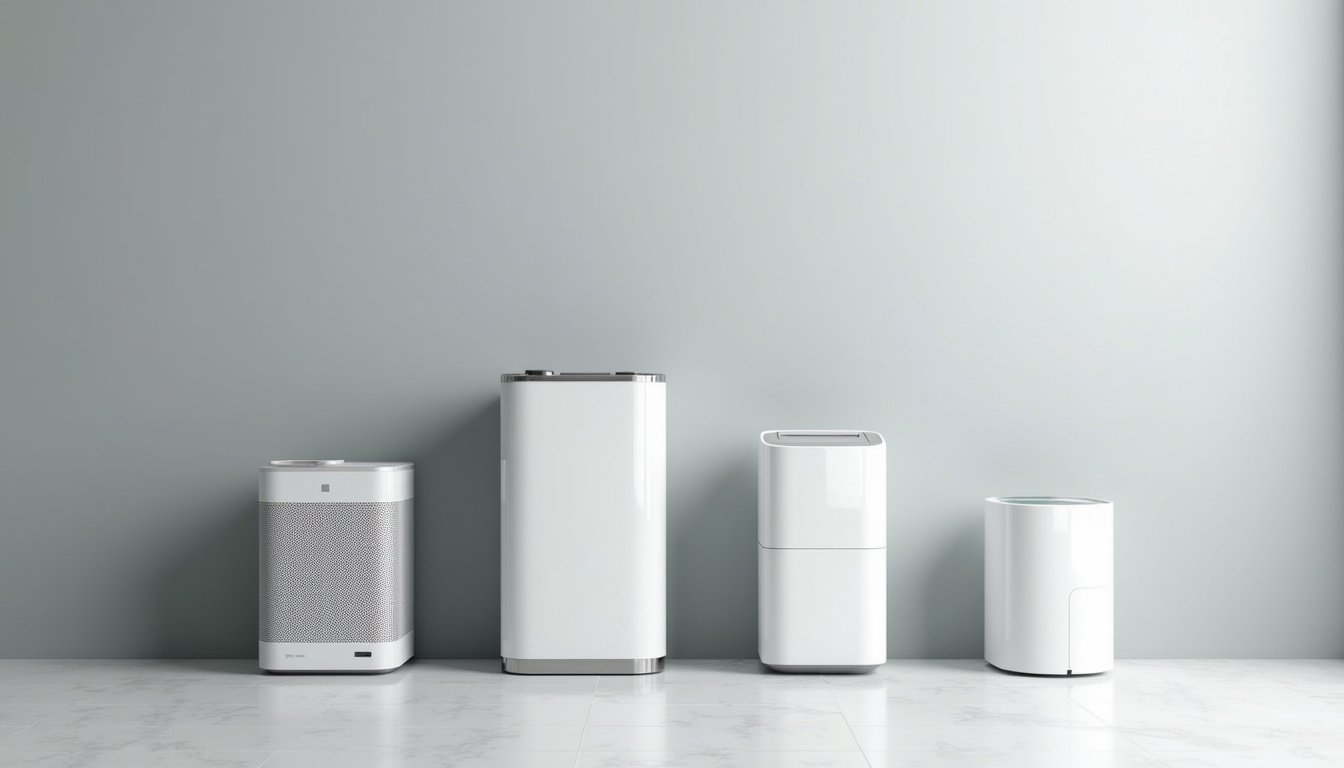
These widely reviewed units all use the mechanical approach, true HEPA with activated carbon, and span bedroom to large living room coverage. Compare the maker-listed CADR, room size and carbon stage, and keep any optional ionizer switched off.






How We Sorted the Types
We grouped technologies by what they do to a pollutant, trap it, move it, or try to change it, then checked each against EPA and CARB guidance, the physics involved and maker documentation. The comparison table uses maker-published specifications only.
A simple test runs through the guide: where does the pollutant go? If the answer is into a filter you replace, the method is well understood. If it is onto your walls, into a different chemical, or nowhere the maker can explain, be cautious.
HEPA and Other Mechanical Particle Filters
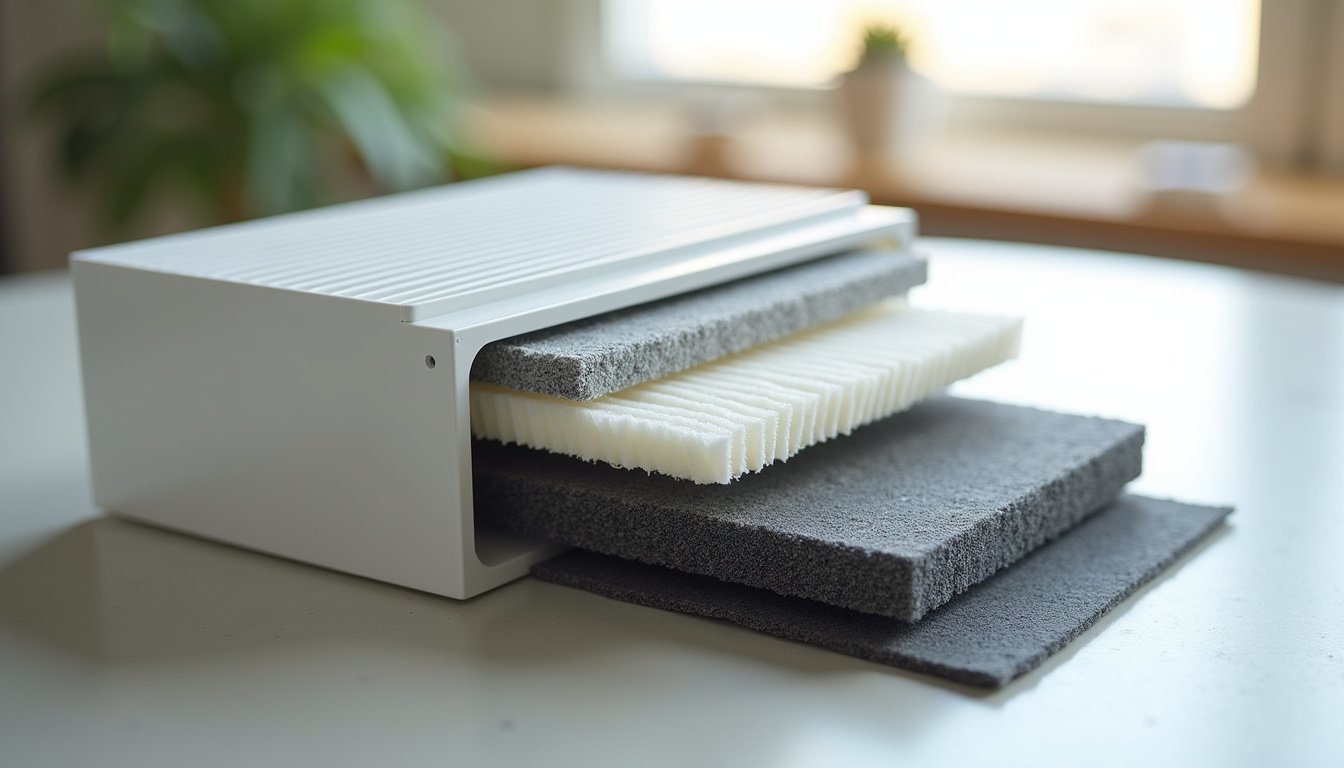
A mechanical filter is a mat of fibers that air is pushed through. Particles are caught by sieving, by colliding with fibers, and by random motion that brings the smallest particles into contact with fibers. True HEPA media is rated to capture 99.97 percent of particles at 0.3 microns under test conditions, the hardest size to catch; larger and smaller particles are captured at even higher rates.
Variants matter. True HEPA or H13 meets the standard. HEPA-type, HEPA-like and 99 percent efficient describe looser media. Pre-filters are coarse layers that protect the main filter from hair and lint. Pleated furnace filters rated MERV 11 to 16 are mechanical filters for HVAC systems, less efficient than HEPA per pass but working on the whole house.
| Mechanical filter | Captures | Typical use | Replacement |
|---|---|---|---|
| True HEPA, H13 | Fine and coarse particles | Portable purifiers | 6 to 12 months per maker, some longer |
| HEPA-type, HEPA-like | Coarse particles, fewer fine | Budget portable units | Varies; often bundled |
| Pre-filter | Hair, lint, large dust | In front of HEPA | Wash or vacuum monthly |
| Pleated MERV 11 to 13 | Many fine particles per pass | HVAC systems | Every 1 to 3 months |
| Media cabinet, MERV 13 to 16 | More fine particles | Ducted whole-house | Every 6 to 12 months |
Mechanical filtration has two honest limits: it does nothing for gases, and the filter must be replaced as it loads. It has no by-products and its performance is what CADR measures, which is why it anchors every reputable sizing guide.
Activated Carbon and Other Sorbents
Gases pass straight through particle filters. Activated carbon, a form of charcoal processed to have an enormous internal surface, traps gas molecules on that surface by adsorption. It handles many odor compounds, a share of volatile organic compounds and some smoke gases. Other sorbents, such as potassium permanganate impregnated media or zeolites, target specific gases like formaldehyde that plain carbon holds poorly.
Quantity decides effectiveness. A thin fabric pad coated with carbon saturates in weeks; a thick bed of granular or pelletized carbon works for months. Spec sheets that state a carbon weight are worth more than ones that just say carbon filter. No sorbent removes carbon monoxide, carbon dioxide or radon in a useful amount.
Ionizers and Electrostatic Precipitators
Ionizers release charged ions into the air that attach to particles, making them cling to the nearest surface: walls, furniture, floors, or a collection plate inside the unit in the case of electrostatic precipitators. The particles are moved rather than captured in replaceable media, and in ionizer-only units they end up on your surfaces, which can leave a gray film near the device.
Two further concerns apply. Some ionizers and electrostatic devices produce ozone as a by-product of the electrical discharge, which the EPA flags, and CARB in California limits ozone emissions from air cleaners sold there. Electrostatic precipitator plates also lose effectiveness quickly as they load and need frequent washing. Many HEPA purifiers include an optional ionizer; it can be left off without losing the filtration.
Ultraviolet Light
UV-C lamps are included in some purifiers with the aim of inactivating bacteria, viruses and mold spores. The idea is sound in principle, but effect depends on dose: intensity multiplied by exposure time. In a portable unit the air passes the lamp in a fraction of a second, and the EPA notes that the UV in typical consumer units has not been shown to be effective in that time. Meanwhile the HEPA filter captures the same microbes physically.
Continuous UV on an HVAC coil is a different application; constant exposure to a wet surface can limit growth there. Some UV lamps also produce ozone depending on the wavelength and design, which is another reason to treat the feature as a minor extra rather than a reason to buy.
Photocatalytic Oxidation, Plasma and Hydroxyl Devices
These technologies try to break down gases and microbes through chemical reactions: UV light on a titanium dioxide surface in photocatalytic oxidation, electrical discharge in plasma or bipolar ionization, and reactive radicals in hydroxyl generators. Reactions in air are rarely complete, and incomplete oxidation can produce by-products such as formaldehyde or ozone. Independent evidence for consumer units is limited, and performance varies widely by design.
| Technology | Intended target | Main concern | Our position |
|---|---|---|---|
| Photocatalytic oxidation | Gases, microbes | Possible by-products including formaldehyde | Not needed for home use |
| Bipolar ionization, plasma | Particles, microbes | Variable evidence; possible ozone | Prefer filtration |
| Hydroxyl generator | Odors, microbes | Reactive chemistry in occupied rooms | Avoid in occupied spaces |
| Ozone generator | Odors, mold, microbes | Ozone is a lung irritant; EPA advises against | Avoid |
The EPA’s guidance is cautious about these approaches for homes, and so are we. If a device cannot say where the pollutant goes or what it becomes, the burden of proof has not been met.
Ozone Generators
Ozone generators release ozone deliberately, marketed to destroy odors, mold and microbes. Ozone is a reactive gas and a lung irritant, and the EPA advises against using ozone generators in occupied spaces, noting that at concentrations that do not exceed public health standards ozone is ineffective at removing most indoor pollutants, and at concentrations that might work it is harmful. CARB bans the sale of air cleaners in California that exceed its ozone limit.
Whole-House and HVAC-Based Types
Everything above comes in a portable box, but several types mount in the heating and cooling system and treat every room with a vent. The simplest is a better furnace filter: pleated MERV 11 to 13, which the EPA suggests where the system supports it. Thick media cabinets installed by an HVAC contractor hold deeper filters rated MERV 13 to 16. Electronic air cleaners mount in the duct and use electrostatic precipitation, with the same loading and ozone considerations as portable versions.
These work only while the blower runs, so a circulate setting on the thermostat matters. They complement portable HEPA units rather than replacing them: the HVAC filter gives every room a baseline, the portable units deliver continuous high-rate cleaning in bedrooms. Dense filters can restrict airflow in older systems, so check the manual or ask a technician before going above MERV 11.
Matching the Type to Your Problem
Most buying mistakes come from matching the wrong type to the problem. A worked example shows the logic. A family has a 12 by 15 foot bedroom, 180 square feet, where one child sneezes every morning, and a kitchen that smells of frying by evening. The bedroom problem is particles, so a true HEPA unit with a dust CADR of about 120, sized by the two-thirds rule, is the answer; a carbon pad is optional. The kitchen problem is gas and odor, which calls for a vented range hood first and, if a purifier is added to the adjoining living area, one with a substantial carbon bed.
| Pollutant | Best type | Also helps | Does not help |
|---|---|---|---|
| Fine dust and PM2.5 | True HEPA | MERV 13 HVAC filter | Ionizer only, UV |
| Pollen and dander | True HEPA | Pre-filter, closed windows | Ozone, UV |
| Wildfire smoke | True HEPA plus carbon | Closed home, HVAC recirculate | Ionizer only |
| Cooking and pet odors | Thick carbon bed | Range hood, source cleaning | HEPA alone |
| Mold spores | True HEPA | Moisture control first | Ozone, UV in airstream |
| Carbon monoxide, radon | None; use alarms and testing | Ventilation, mitigation | Every purifier type |
How to Choose the Right Type in 6 Steps
- Name the pollutant: particles, gases or something a purifier cannot address such as CO, radon or humidity.
- For particles, choose true HEPA and size it so the dust CADR is at least two-thirds of the room’s floor area.
- For odors or VOCs, add a carbon stage with a stated weight, and fix the source and ventilate first.
- Treat UV and ionizer features as optional and keep ionizers switched off; check CARB certification for any electronic unit.
- Reject ozone generators, hydroxyl devices and anything that cannot explain where pollutants go.
- If the home has forced air, upgrade the HVAC filter to pleated MERV 11 to 13 where supported as the whole-house baseline.
Do and Do Not
Do
- Buy mechanical filtration for particles.
- Judge carbon by quantity, not by the word carbon.
- Size any particle cleaner by CADR.
- Pair portable units with a better HVAC filter.
- Keep CO alarms and radon testing separate from purifier decisions.
Do not
- Do not use ozone generators in occupied spaces.
- Do not rely on an ionizer alone to clean a room.
- Do not buy on UV claims.
- Do not expect any type to remove settled dust or surface mold.
- Do not trust HEPA-type labels for fine particles or smoke.
Who Should Skip This
If your real problem is humidity, a musty basement or condensation, none of these purifier types is the right tool. A dehumidifier and ventilation that hold indoor humidity between 30 and 50 percent, as the EPA recommends, address the cause; a HEPA unit can follow for the spores that remain airborne.
If you are concerned about combustion gases or radon, skip the purifier aisle entirely for that problem. Carbon monoxide alarms on every level, a radon test with mitigation at 4 picocuries per liter or above, and professional appliance service are the right spending.
Honest Limits
- This is a general overview; specific models within each type vary in quality and specification.
- Mechanical filters do nothing for gases; sorbents do nothing for particles; neither handles CO, radon or humidity.
- Electronic cleaners’ ozone output depends on design; CARB certification is the practical check.
- Evidence for UV, PCO and plasma in consumer units is limited and varies by product.
- Whole-house options depend on having forced air and on blower run time.
- No type removes settled dust, surface mold or allergen in fabrics.
When to See a Professional
See a doctor or allergist if symptoms are driving your purchase; identifying the trigger tells you which type, if any, will help. A purifier is a supporting measure, and nothing on this page is medical advice.
Call an HVAC professional before installing a dense filter, media cabinet or in-duct cleaner in an older system. Use a certified radon professional for testing and mitigation, a mold professional for growth over about 10 square feet as the EPA suggests, and for any gas smell leave the home and call the utility.
Frequently Asked Questions
What are the main types of air purifiers?
Mechanical filters, true HEPA for particles and activated carbon for gases, trap pollutants in replaceable media. Electronic and chemical types, ionizers, electrostatic precipitators, UV lamps, photocatalytic and plasma devices and ozone generators, try to move or alter pollutants instead. Filtration is the best supported for homes.
Which type of air purifier is best?
For nearly every home, a fan pushing air through true HEPA media, with a substantial activated carbon stage if odors matter. It is measurable by CADR, produces no by-products and is the approach EPA and AHAM guidance is built around. Keep optional ionizers switched off.
Are ionic air purifiers safe and effective?
Ionizers move particles onto surfaces rather than capturing them, which can leave a film near the unit, and some produce ozone as a by-product. The EPA flags that concern and CARB limits ozone emissions. A HEPA unit with the ionizer function off avoids both problems.
Does UV light in an air purifier work?
Not meaningfully in most portable units. Air passes the lamp in a fraction of a second, too short a dose to inactivate microbes reliably, as the EPA notes. The HEPA filter captures those particles anyway. Treat UV as a minor extra, not a reason to buy.
Are ozone air purifiers dangerous?
Ozone is a lung irritant, and the EPA advises against ozone generators in occupied spaces. At safe concentrations ozone does little to pollutants; at effective concentrations it is harmful. California bans air cleaners that exceed CARB’s ozone limit. Choose filtration instead.
What does a carbon filter do that HEPA does not?
Activated carbon adsorbs gas molecules, such as cooking and pet odors, some VOCs and smoke gases, which pass straight through particle filters. Effectiveness depends on the amount of carbon; thin pads saturate in weeks while thick granular beds last months.
What is the difference between HEPA and HEPA-type?
True HEPA, often labeled H13, meets the standard of capturing 99.97 percent of 0.3 micron particles under test conditions. HEPA-type, HEPA-like and similar labels describe looser media that let more fine particles through. Choose true HEPA for dust, smoke and allergens.
What is photocatalytic oxidation and should I buy it?
PCO uses UV light on a catalyst surface to break down gases and microbes. Reactions are often incomplete and can produce by-products such as formaldehyde, and independent evidence for consumer units is limited. For home use, ventilation and activated carbon are the safer choices.
Can I filter the whole house instead of buying portable units?
Partly. A pleated MERV 11 to 13 filter in a forced-air system, where supported, filters every room with a vent while the blower runs, and media cabinets go further. Pair it with portable HEPA units in bedrooms for continuous cleaning where you sleep.
Which type of purifier removes carbon monoxide or radon?
None. No consumer air purifier removes carbon monoxide, radon or carbon dioxide in a useful amount. Install CO alarms on every level, test for radon and mitigate at 4 picocuries per liter or above, and treat purifier air quality lights as particle indicators only.
Bottom Line
The types of air purifiers sort cleanly once you ask what each does with a pollutant. Mechanical filters trap it: true HEPA for particles and activated carbon for gases, replaced on a schedule and measured by CADR. Electronic and chemical types move it or try to change it, with results that range from marginal to harmful, and ozone generators belong in neither a bedroom nor a living room.
For almost any home the choice is a filter-based unit sized by the two-thirds rule, with real carbon if odors matter and a better HVAC filter as the whole-house baseline. Leave UV and ionizers switched off or on the shelf, keep alarms and testing for the gases no purifier touches, and the technology question is settled.
Related reading: What do air purifiers clean, What type of air purifier is best for mold, Best low EMF air purifier.