Last updated:
As an Amazon Associate we earn from qualifying purchases. This does not change what we recommend. See our affiliate disclaimer.
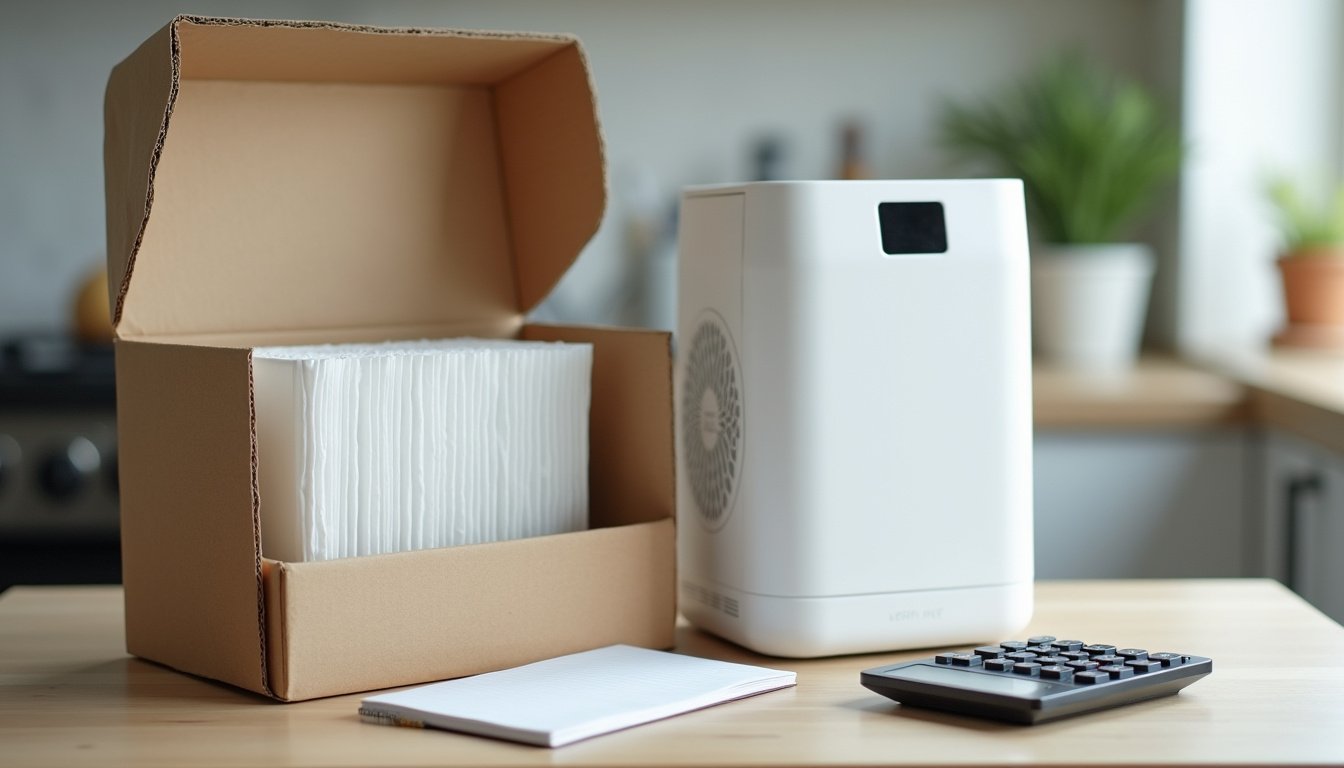
The purchase price of an air purifier is the smallest part of what it costs to own. Over three to five years, the filters you replace and the electricity the fan draws usually add up to more than the box did. Most people never do that math before buying, which is how a bargain unit with expensive, short-lived filters turns into the costliest option in the house.
The yearly maintenance cost of a filter-based air purifier comes down to three things: how often the maker says to replace each filter stage and what those replacements cost at the time you buy them, how many watts the unit draws at the speed you actually use, and how many hours a day it runs. A compact bedroom unit on medium around the clock might use less electricity than a light bulb, while a large living room unit on high can draw as much as a desktop computer. Filter schedules range from every three months for carbon pads to a year or more for some HEPA stages, and the schedules are usually printed in the manual.
In short: budget for filters first, electricity second, and treat the sticker price as a one-time entry fee. The rest of this guide shows how to estimate your own number before you buy.
The EPA’s guide to air cleaners in the home advises checking filter replacement cost and frequency as part of choosing a unit, and the US Department of Energy’s appliance guidance uses the simple watts times hours formula we apply below. We follow both and avoid quoting prices, which change constantly; instead we show you how to find and compare them.
Everything here is research-based, drawn from maker manuals, energy math and public guidance. We have not tested the units in the comparison table and we list no prices or ratings, only the published features that drive ongoing cost.
Maintenance will be modest if
- The unit has a washable pre-filter protecting a 12 month HEPA stage
- You run it on low or medium most of the time
- It carries an Energy Star label or a low published wattage
- Replacement filters are sold directly by the maker and widely stocked
Expect higher running costs if
- Filters are combined into one cartridge replaced every 3 to 6 months
- You run a large unit on high for long stretches
- The home is dusty, smoky or has several pets
- Replacements are hard to find or only sold in bundles
Key Takeaways
- Filter replacement is usually the largest ongoing cost; check the schedule and price of every stage before buying.
- Electricity cost is watts at your usual speed, times hours per day, times your rate per kilowatt-hour.
- Running on medium 24 hours a day often costs less per year than most people guess, and far less than a space heater.
- Washable pre-filters and separate carbon stages extend HEPA life and lower the yearly total.
- Dusty, smoky or pet-heavy homes shorten filter life; plan on the short end of the maker’s range.
- Energy Star certified units publish energy use, which makes comparison straightforward.
- Count five years of filters and power, not the box price, when comparing two models.
Purifiers With Clear Filter Schedules to Compare
These widely reviewed filter-based units publish their filter life and power draw, which makes long-term cost easy to estimate. Compare the maker-listed filter schedule and wattage, then run the numbers for your room before choosing.






How We Built the Cost Picture
We worked from maker manuals for filter schedules and rated power, from the Department of Energy’s standard formula for appliance energy use, and from the EPA’s advice on evaluating air cleaners. We present costs as formulas and relative comparisons rather than dollar figures, because filter and electricity prices change by region and over time.
If you want a precise number for your own home, you need four inputs: the replacement cost of each filter at today’s price, the maker’s replacement interval, the wattage at the speed you use, and your electricity rate from your latest bill. The sections below walk through each.
Filter Costs: The Biggest Line Item
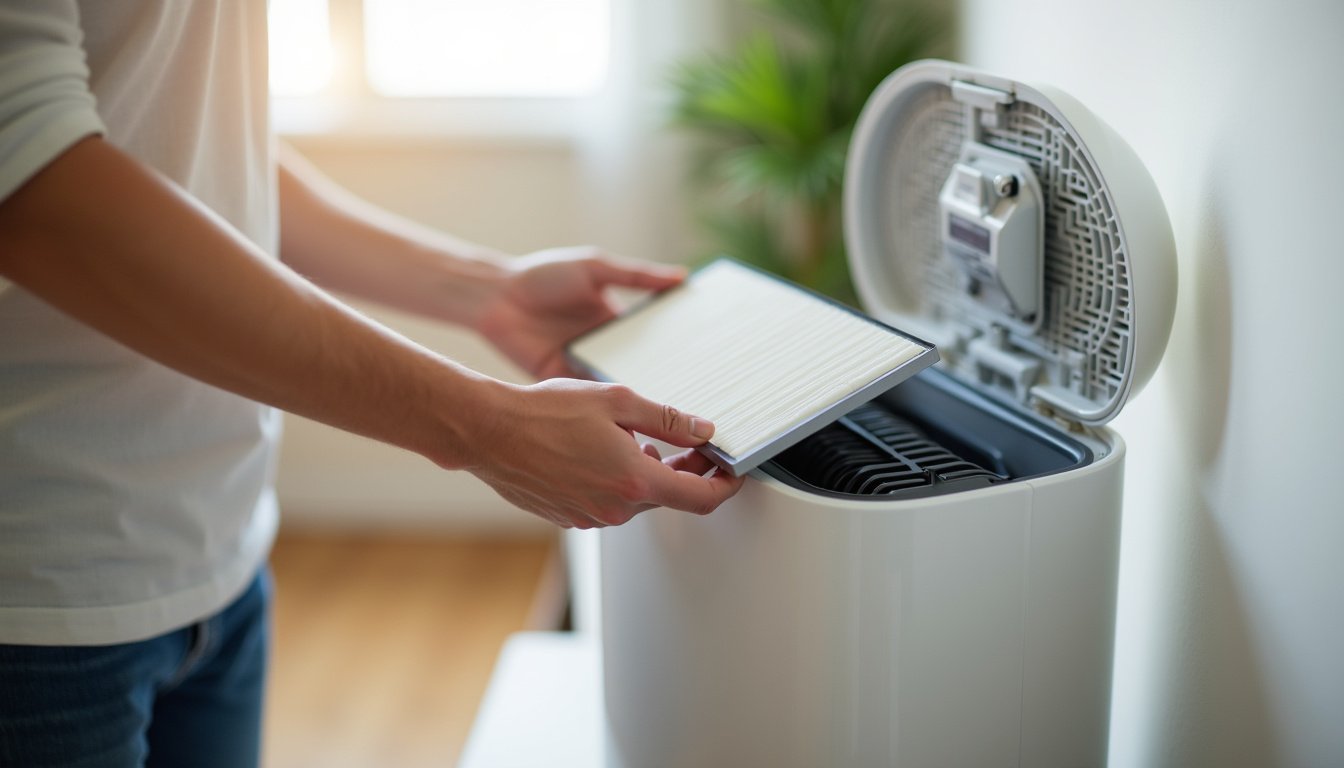
Most purifiers have two or three stages: a pre-filter for hair and lint, a HEPA stage for fine particles and a carbon stage for odors. Some makers bundle all three into one cartridge; others sell them separately. The bundle is convenient but means you replace a perfectly good HEPA layer every time the carbon saturates. Separate stages let you replace only what is used up.
Replacement intervals in manuals are typically 6 to 12 months for HEPA, 3 to 6 months for carbon and never for a washable pre-filter. These are averages for a moderately clean home. Heavy dust, wildfire smoke seasons, cooking smoke and multiple pets push you toward the short end, and some units use a timer rather than a sensor, so the indicator may call for a change before the filter is truly spent.
| Filter stage | Typical maker interval | What shortens it | How to stretch it |
|---|---|---|---|
| Pre-filter, washable | Rinse or vacuum monthly, replace rarely | Pets, carpet, lint | Clean it on schedule; it protects the HEPA |
| Pre-filter, disposable | 3 to 6 months | Same as above | Vacuum gently between changes if the manual allows |
| True HEPA | 6 to 12 months, some longer | Dust, smoke, high fan speeds | Keep the pre-filter clean; run auto mode |
| Activated carbon | 3 to 6 months | Cooking, pets, smoke, VOCs | Fix odor sources; buy thicker carbon beds |
| Combined cartridge | 6 to 12 months | Whichever layer saturates first | Choose separate stages if odors are heavy |
To compare two units, list each stage, divide its price by its interval in years, and add the results. A unit with a cheaper HEPA filter replaced twice a year can easily cost more than one with a dearer filter replaced once. Also check availability: a filter that is only sold in multi-packs or that disappears when a model is discontinued is a hidden cost.
Electricity: Watts, Hours and Your Rate
Electricity cost follows a simple formula. Multiply the unit’s watts at the speed you use by the hours it runs per day, divide by 1,000 to get kilowatt-hours, then multiply by your rate per kilowatt-hour and by 365 for a year. Makers publish rated wattage, usually at the highest speed, and Energy Star listings show typical consumption. Low and medium speeds draw a fraction of the maximum.
Worked example: a mid-size bedroom unit is rated at 45 watts on high and the manual lists about 15 watts on medium. Running on medium 24 hours a day uses 0.36 kilowatt-hours per day, or about 131 kilowatt-hours per year. At a rate of 17 cents per kilowatt-hour, close to recent US residential averages reported by the Energy Information Administration, that is roughly 22 dollars a year. The same unit on high around the clock would use about 394 kilowatt-hours, roughly three times as much.
Standby power is small but not zero. Units with Wi-Fi, displays and sensors draw a watt or two when idle, which is a few kilowatt-hours a year. It is not worth unplugging for, but it is one reason two units with similar fans can show different Energy Star figures.
How Run Time and Speed Change the Bill
The temptation when thinking about cost is to run the purifier less. That saves electricity but defeats the purpose, since dust and other particles return as soon as the fan stops. The better lever is speed. Fan power rises steeply with speed, so medium often moves most of the air of high for a third of the watts, and auto mode drops to low whenever the sensor sees clean air.
| Schedule | Relative electricity use | Relative filter life | Cleaning result |
|---|---|---|---|
| High, 24 hours | Highest | Shortest | Excellent but loud and costly |
| Medium, 24 hours | About one-third of high | Good | Very good; the usual sweet spot |
| Auto mode, 24 hours | Low to moderate | Good to long | Good; depends on sensor quality |
| Low, 24 hours | Lowest | Longest | Fair; may be undersized for the room |
| High, 2 hours per day | Low | Long | Poor; particles return between runs |
Filter life also tracks airflow. More air through the filter means more particles captured, which is the goal, but it also loads the filter sooner. A unit run on medium continuously will usually reach the maker’s full interval; one run on high in a smoky home may not. Sensor-based indicators handle this better than fixed timers.
Why Correct Sizing Lowers the Total
An oversized purifier looks like the expensive option, but it often costs less to run. A unit rated for a room twice the size of yours can hit the AHAM target of roughly two-thirds of the floor area in dust CADR while running on low, where it draws few watts and runs quietly enough to leave on. A unit that is barely big enough has to run on high to do the same job, drawing more power and loading its filters faster.
The same logic applies to filters. Larger units carry larger filters with more media, which hold more dust before airflow drops. The replacement may cost more each time, but it can last longer, so the per-year figure is often similar or lower. Compare per year, not per filter.
Hidden and Occasional Costs
A few costs do not appear in the manual. Dust-heavy homes may need a monthly vacuuming of the pre-filter, which costs nothing but time. Units with sensors sometimes need the sensor lens wiped, again free. Replacement remotes, casters and sensor modules are occasionally lost or fail; the maker’s parts page tells you whether they are available at all.
- Filter indicator resets that run on timers may prompt changes earlier than needed; check the filter visually before replacing.
- Third-party filters can be cheaper, but fit, media grade and carbon amount vary; the maker’s warranty terms may also exclude them.
- Wi-Fi models may lose app features when the maker ends support, which does not affect filtration but can remove scheduling.
- A unit that is too loud ends up switched off, which makes its cost per hour of actual use very high.
Building a Five-Year Cost Picture
Buyers who compare units on a five-year basis rarely regret the choice. The method is simple: purchase price, plus five years of filters at current prices and the maker’s intervals, plus five years of electricity at your speed and run time. Put two or three candidate units side by side and the ranking is often very different from the sticker ranking.
| Line | How to calculate | Notes |
|---|---|---|
| Unit price | Today’s price of the unit | One-time |
| HEPA filters | Price divided by interval in years, times 5 | Use the short end of the interval if your home is dusty |
| Carbon filters | Same method | Skip if combined with HEPA |
| Pre-filters | Same method, or zero if washable | Washable saves a line entirely |
| Electricity | Watts x hours x 365 / 1000 x rate, times 5 | Use the speed you will actually run |
| Total | Add all lines | Compare totals, not unit prices |
A typical pattern emerges. Compact units with inexpensive combined cartridges replaced every few months end up costing about as much as, or more than, mid-size units with annual HEPA filters and washable pre-filters. Energy use rarely decides the ranking on its own, but it does separate efficient mid-size units from older, high-draw designs.
Ways to Lower the Yearly Cost
Most of the savings come from habits rather than hardware. Run on medium or auto instead of high. Vacuum the pre-filter monthly so the HEPA stage lasts its full interval. Close the door of the room you are cleaning so the unit is not fighting the whole house. Fix dust and odor sources, from bedding to range hood use, so the filters have less to catch.
On the hardware side, favor units with washable pre-filters and separate carbon stages, check that filters are stocked by more than one retailer, and look for Energy Star certification, which requires published energy figures. Upgrading the HVAC filter to a pleated MERV 11 to 13 where the system allows, as the EPA suggests, also reduces the load on every portable unit in the house.
How to Budget for a Purifier in 7 Steps
- Measure the room and choose a unit whose dust CADR is at least two-thirds of the floor area so it can run on a low speed.
- Open the manual or spec page and list every filter stage with its replacement interval.
- Look up today’s price of each replacement and divide by the interval in years.
- Find the wattage at the speed you will use and apply the watts times hours formula with your bill’s rate.
- Add five years of filters and electricity to the unit price and compare candidates on that total.
- Prefer washable pre-filters, separate carbon stages and Energy Star listings.
- Check that replacements are widely stocked and that the maker still supports the model.
Do and Do Not
Do
- Compare per-year filter cost, not per-filter price.
- Run on medium or auto rather than high.
- Vacuum or rinse the pre-filter monthly.
- Use your bill’s all-in rate for electricity math.
- Keep receipts and intervals in a note so you replace on schedule.
Do not
- Do not wash a HEPA filter.
- Do not skip filter changes to save money; a clogged filter cuts airflow and raises run time.
- Do not judge a unit by sticker price alone.
- Do not run on high around the clock unless the room demands it.
- Do not assume a timer-based indicator means the filter is spent.
Who Should Skip This
If you need a purifier only for a few weeks a year, such as a wildfire smoke season, the cost picture changes. A simple unit with a long-life HEPA filter and no carbon stage may be the sensible choice, since filters age by use more than by calendar and a carbon pad would go unused.
If the room already has a well-filtered HVAC system running most of the day and nobody in the home has allergies or odor complaints, the added benefit of a portable unit may not justify its ongoing filter cost. Spend the money on a MERV 13 HVAC filter instead.
Honest Limits
- Filter prices and electricity rates change, so any estimate is a snapshot; redo the math yearly.
- Maker intervals assume average conditions; dusty or smoky homes will not reach them.
- Timer-based indicators cannot tell how dirty a filter really is.
- Running costs are only worth paying if the unit runs; a loud unit that gets switched off wastes its price.
- No amount of maintenance makes a HEPA unit remove gases; that needs carbon and ventilation.
When to See a Professional
See a doctor or allergist if you are buying a purifier to manage symptoms such as persistent congestion, wheezing or asthma. Understanding the trigger helps you choose the right filter stages and avoid paying for features you do not need. Nothing on this page is medical advice.
Call an electrician if an outlet trips, warms or shows scorch marks when a purifier is plugged in, and contact the maker rather than repairing a unit yourself if it smells of burning or sparks. An HVAC professional can advise whether your system supports a higher MERV filter, which affects how much portable filtration you need.
Frequently Asked Questions
How much does it cost to maintain an air purifier each year?
It depends on filter prices, replacement intervals, wattage and run time, so there is no single figure. Add each filter’s price divided by its interval in years to the electricity formula, watts times hours times 365 divided by 1,000 times your rate. Filters are usually the larger share.
How much electricity does an air purifier use?
Published wattage ranges from a few watts on low to around 50 or more on high for large units. A mid-size unit on medium at about 15 watts uses roughly 131 kilowatt-hours a year if run around the clock, about 22 dollars at 17 cents per kilowatt-hour.
Is it cheaper to run an air purifier on low all day or high for an hour?
Low or medium all day usually costs little more in electricity and removes far more particles, because pollutants return as soon as the fan stops. Fan power rises steeply with speed, so medium typically moves most of the air of high for about a third of the watts.
How often do air purifier filters need replacing?
Manuals typically list 6 to 12 months for HEPA stages, 3 to 6 months for carbon and rinsing monthly for washable pre-filters. Dust, smoke, cooking and pets shorten those intervals. Check the filter visually, especially if the indicator runs on a timer rather than a sensor.
Can I wash a HEPA filter to save money?
No. Water damages the fine fibers in a HEPA filter and reduces its efficiency, and makers do not warrant washed filters. Only the pre-filter, if the manual says it is washable, should be rinsed or vacuumed. Replace the HEPA stage on the maker’s schedule.
Are third-party replacement filters a good way to cut costs?
They can be cheaper, but fit, media grade and carbon amount vary, and some makers exclude them from warranty coverage. If you try one, confirm it is labeled true HEPA, seals properly in the housing and does not reduce airflow. The maker’s own filters are the safer default.
Does a bigger purifier cost more to run?
Not necessarily. A larger unit can meet the room’s CADR target on a low speed, drawing few watts and lasting its full filter interval, while a small unit must run on high. Compare wattage at the speed each would actually use, not the maximum rating.
What is the cheapest way to improve air quality before buying a purifier?
Upgrade the HVAC filter to a pleated MERV 11 to 13 where the system supports it, as the EPA suggests, and reduce sources: wash bedding weekly, vacuum with a sealed HEPA vacuum, run the range hood and air out new furniture. These lower the load on any purifier you add later.
Do Wi-Fi and sensors add to the running cost?
Only slightly. Standby draw for displays, sensors and Wi-Fi is typically a watt or two, a few kilowatt-hours a year. A good particle sensor can lower costs overall by letting auto mode drop to low speed when the air is clean, saving electricity and filter life.
How do I compare two purifiers on total cost?
Add the purchase price to five years of filters, using each stage’s price divided by its interval, and five years of electricity at your speed, hours and rate. Compare the totals. Units with washable pre-filters and annual HEPA filters often beat cheaper units with frequent combined cartridges.
Bottom Line
The real cost of an air purifier is a running total of filters and electricity, with the purchase price as the down payment. Work out the yearly figure before you buy by listing every filter stage with its interval and applying the simple watts times hours formula to the speed you will actually use. The ranking that comes out is often not the one on the price tags.
Then protect the number with habits: run on medium or auto, keep the pre-filter clean, close the door, and fix the sources that load the filters. Done that way, a well-sized filter-based purifier costs less to run than most people expect and does its job every hour it is on.
Related reading: Air purifiers with filter replacement indicators vs without, How long do HEPA filters last in an air purifier, Best air purifier under 100.