Last updated:
As an Amazon Associate we earn from qualifying purchases. This does not change what we recommend. See our affiliate disclaimer.
You bought a purifier to cut the dust, ran it for weeks, and the shelves and the TV screen still go grey in days. It is natural to conclude that the machine does not work. Often it does, and the dust you are looking at is simply not the dust it can reach.
Dust on surfaces has already left the air. A purifier filters only what floats past its intake, which means the fine, slow-settling fraction, and it cannot lift what has landed. Heavier particles drop out within minutes and never reach the filter in meaningful numbers. Where a purifier genuinely fails to reduce airborne dust, the causes are a handful: a unit too small for the room, a clogged or wrongly fitted filter, a corner or walled-in position, runs too short to keep up, and sources that make dust faster than the unit removes it, such as carpets, bedding, pets, open windows and renovation. The fix is a measured one: judge the air with a particle meter, not the shelf, and cut the sources. Nothing here is medical advice.
In short: match CADR to the room, run it continuously, give it clearance, replace the filter on time, and clean surfaces with a damp cloth and a HEPA vacuum.
This guide is research-based, drawn from EPA guidance on air cleaners and AHAM clean air delivery rate standards. We have not tested the units in the table and quote no prices or ratings. Nothing here is medical advice.
Why surfaces stay dusty
- Settled dust is already out of the air
- Large particles fall before they reach the intake
- Carpets, bedding and clothing keep shedding fibers
- Every footstep and door raises more
What actually helps
- Right-sized CADR and continuous running
- Source control: vacuum with HEPA, wash bedding
- Damp wiping instead of dry dusting
- A particle meter to judge the air
Key Takeaways
- A purifier filters airborne dust; it cannot lift dust that has settled on surfaces.
- Larger dust particles settle within minutes and mostly never reach the filter.
- CADR of at least two thirds of the floor area is the usual sizing rule.
- Short runs let levels climb back; continuous low-speed running holds them down.
- Corners and walled-in positions starve the intake and cut real airflow.
- Carpets, bedding, pets and open windows keep adding dust; cut the sources.
- Judge the air with a PM2.5 monitor, not the look of a shelf.
Purifiers Sized for Dust, With Easy Filter Access
These widely reviewed units use true HEPA, publish AHAM-verified CADR and have accessible filters, which suit homes where dust is the main complaint. Match the maker-listed CADR to your room before choosing.






How This Guide Approaches the Question
We looked at the difference between airborne and settled dust, at the ways a purifier can underperform, and at how to measure whether the air is improving. Product details in the table come from maker specifications.
The question is not whether the shelf is clean, which a purifier cannot affect, but whether the air is cleaner than it was.
Airborne Dust Versus Settled Dust
Household dust is a mix of fibers, skin flakes, soil, pollen and fine particles, and it spans a wide range of sizes. The largest settle in minutes. The finest stay up for hours and are the part a purifier reaches. So the grey film on a shelf is mostly dust the unit never had a chance at, and the filter can be catching plenty of the fine fraction while the surfaces look unchanged. Expecting surfaces to stay clean is expecting the purifier to do what a cloth does.
| Dust type | Where it ends up | Does a purifier help? |
|---|---|---|
| Large fibers and lint | Settles within minutes | Little; vacuum and damp wipe |
| Skin flakes and mid-size particles | Settles over an hour or so | Partly |
| Fine particles, below 2.5 microns | Float for hours | Yes, this is the target |
| Pollen | Mostly airborne, then settles | Yes, if run continuously |
| Pet dander | Airborne and settling | Partly; clean the source |
| Soil tracked in on shoes | Floor and low surfaces | No; doormat and vacuum |
Size and Run Time
AHAM’s rule of thumb is a CADR of at least two thirds of the room’s floor area in square feet. A unit rated 100 CFM suits about 150 square feet; in a 400 square foot room it cleans a fraction of the air, and the rest mixes back in. Running time matters as much: dust is generated all day, and a unit switched on for an hour in the evening leaves the other twenty-three to the room. Continuous running on a low or medium speed holds levels down more cheaply than occasional bursts on high.
| Room size (sq ft) | Minimum CADR (CFM) |
|---|---|
| 100 | 67 |
| 150 | 100 |
| 200 | 133 |
| 300 | 200 |
| 400 | 267 |
Worked example: a 250 square foot living room with a unit rated 90 CFM needs about 167. It is undersized by nearly half, and run for two hours a night it makes no visible difference. A 170 CFM unit run continuously on low gives a particle meter reading that halves in half an hour and stays low.
Placement and Filter Condition
A purifier pushed into a corner, behind a sofa or under a desk starves its intake and delivers far less than its rating. Leave a foot of clearance and keep it in the room where you spend time. The filter matters too: a HEPA loaded with dust restricts airflow, and a filter still in its shipping plastic or fitted backwards lets air bypass it. Check the maker’s interval, look at the filter, and feel the outlet on high.
Sources That Outpace the Unit
Dust arrives constantly. Carpets, rugs and upholstery release fibers with every footstep; bedding sheds as you sleep; pets add dander and hair; open windows let in outdoor dust and pollen; renovation and sanding can overwhelm any home unit. A purifier works downstream of all this, and when the sources are strong the improvement is real but partial. Cutting the sources is the cheaper half of the job.
- Vacuum with a sealed HEPA vacuum, slowly, at least weekly.
- Wash bedding weekly in hot water and use mattress and pillow covers.
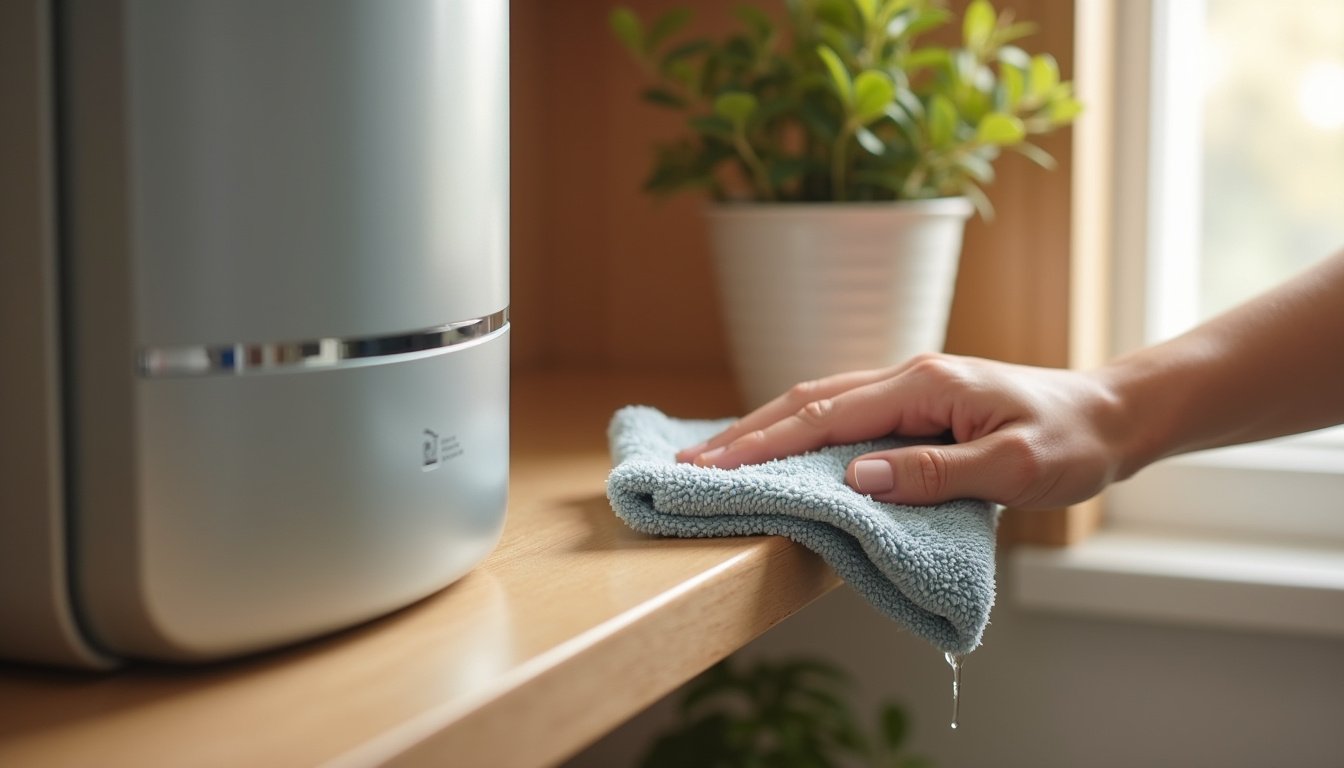
- Wipe surfaces with a damp cloth rather than a dry duster.
- Use doormats and take shoes off at the door.
- Keep windows shut on windy or pollen-heavy days.
- Brush pets outdoors and groom regularly.
| Source | Why it adds dust | Best response |
|---|---|---|
| Carpets and rugs | Fibers released with each footstep | HEPA vacuum weekly |
| Bedding | Skin flakes and fibers | Wash weekly in hot water |
| Pets | Dander and hair | Groom outdoors; clean fabrics |
| Open windows | Outdoor dust and pollen | Shut on windy days |
| Renovation or sanding | Heavy fine dust | Contain the area; clean up wet |
What to Expect
A right-sized, correctly placed, continuously running purifier lowers fine airborne dust and may slow how fast surfaces dull, because less dust is circulating to settle. It will not stop settling. Expect less to wipe, not nothing. If the meter shows the air falling and the shelf still dulls, the unit is working and the sources are winning. If the meter does not move, return to size, placement and filter. Nothing here is medical advice.
How to Get More Dust Reduction From Your Air Purifier in 6 Steps
- Measure the room and compare two thirds of its floor area with the unit’s CADR; add a second unit or upgrade if it falls short.
- Run the unit continuously on low or medium rather than in short bursts.
- Pull it into the open with a foot of clearance, away from corners and furniture.
- Check the filter: remove shipping plastic, seat it correctly, and replace it on the maker’s interval.
- Cut the sources: HEPA vacuum weekly, wash bedding, damp wipe, use doormats and keep windows shut on dusty days.
- Check progress with a PM2.5 monitor across the room instead of by the shelf.
Do and Do Not
Do
- Size by CADR.
- Run continuously.
- Leave clearance.
- Replace filters on time.
- Damp wipe and HEPA vacuum.
Do not
- Do not judge by surface dust alone.
- Do not wash the HEPA or blow it out.
- Do not run it for an hour a day.
- Do not hide it behind furniture.
- Do not rely on a purifier to replace cleaning.
Who Should Skip This
If the particle meter shows the air falling by half in half an hour on high, skip the hardware checks: the unit works and the sources are the issue.
If the unit is new and airflow at the outlet is weak, skip the cleaning advice and check the filter for shipping plastic first.
Honest Limits
- Consumer particle monitors are relative instruments; use them for before-and-after comparison.
- CADR figures are maker-listed under AHAM test conditions.
- Dust composition varies by home, and no purifier stops settling.
- We did not test any unit.
- Nothing here is medical advice.
When to See a Professional
Contact the maker if airflow is weak on high with a fresh, correctly fitted filter, or the fan hums without spinning.
For heavy dust from renovation or a damaged duct system, an HVAC or building professional can assess the source.
Frequently Asked Questions
Why is my room still dusty with an air purifier running?
Most dust you see has already settled on surfaces, where a purifier cannot reach it. A purifier filters airborne particles only. If the air is cleaner but surfaces still dull, the sources, such as carpets, bedding and pets, are adding dust faster than you wipe it.
Can an air purifier stop dust settling on furniture?
No. It can reduce how much fine dust is circulating, so less settles over time, but settling continues because larger particles drop out within minutes and sources keep adding more. Expect less to wipe, not nothing, and keep damp wiping and HEPA vacuuming.
How do I know if my purifier is actually removing dust?
Use a PM2.5 monitor across a closed room. Note the baseline, run the unit on high and watch. A right-sized, working unit halves the reading within about thirty minutes. A slow fall means undersized or loaded; no fall means bypass, placement or hardware.
Is my air purifier too small to reduce dust?
Compare its CADR with two thirds of the room’s floor area: a 100 CFM unit suits about 150 square feet. In a larger room it cleans a fraction of the air. Close doors to shrink the space, or add a larger or second unit.
Should I run my air purifier all day to reduce dust?
Yes, continuously on low or medium usually works better than short bursts on high. Dust is generated all day, and a unit switched off lets levels climb back. Higher speeds cost more noise and filter wear for little extra benefit.
Does a dirty filter stop an air purifier reducing dust?
Yes. A loaded HEPA restricts airflow and the unit moves less air than its rating, while a filter fitted backwards or still in its plastic lets air bypass. Check the maker’s interval, inspect the filter, and replace rather than wash a HEPA.
Does placement affect how well an air purifier reduces dust?
Yes. A unit in a corner, behind a sofa or under a desk starves its intake and delivers far less than rated. Leave about a foot of clearance and put it in the room where you spend time, with doors closed.
What else reduces dust besides an air purifier?
Source control does most of the work: HEPA vacuuming weekly, washing bedding in hot water, damp wiping surfaces, doormats and removing shoes, covers on mattresses and pillows, and keeping windows shut on dusty days. A purifier adds to these; it does not replace them.
Do carpets and pets make an air purifier less effective?
They make the job bigger. Carpets, bedding and pets keep shedding fibers and dander, so a purifier faces constant supply. It still lowers airborne levels, but expect partial improvement. Vacuum with a sealed HEPA vacuum and groom pets regularly.
When should I replace the filter if dust is not reducing?
Follow the maker’s interval, and sooner in dusty, smoky or pet-heavy homes where the indicator runs late. If airflow at the outlet is weak on high, or the filter looks grey across its face, replace it. Never wash a true HEPA.
Bottom Line
An air purifier that does not seem to reduce dust is usually being judged by the wrong measure. The shelf shows dust that has already settled, which no purifier touches. The air is the right measure, and a particle meter across the room says whether it is improving.
If the meter says it is not, the cause is size, run time, placement or filter, in that order, or sources that outpace the unit. Fix those, cut the sources with a HEPA vacuum and damp cloth, and expect less to wipe rather than nothing. Nothing here is medical advice.
Related reading: Does an air purifier clean dust, How to tell if air purifier is working, Air purifier on but not working.