Last updated:
As an Amazon Associate we earn from qualifying purchases. This does not change what we recommend. See our affiliate disclaimer.
The lights are on. The display shows a number or a color, the unit responds to its buttons, maybe the fan is even audible. And the room is as dusty, as smoky or as full of pet smell as it was before the purifier arrived. An appliance that is on but not working is more frustrating than one that is dead, because there is nothing obviously broken to fix.
An air purifier that is on but not working is almost always short of air, or running air around the filter instead of through it. The new-unit cases come first: a HEPA still sealed in its shipping plastic, or a filter fitted backwards or unseated. Then the settings: auto mode idling the fan on low because a sensor reads clean, sleep mode, or a child lock refusing your change. Then the room: a unit too small for the space, or pushed into a corner. Then the filter, loaded until airflow is a trickle. Last, the hardware: a fan that hums without spinning, or a dead sensor. The first fixes take a minute and cost nothing, and a particle meter across the room tells you whether any worked. Nothing here is medical advice.
In short: unwrap and seat the filter, take the unit off auto and run manual high, pull it into the open, check room size and filter condition, and only then suspect the fan or sensor.
Maker manuals list shipping plastic, unseated filters, auto mode and blocked intakes as first checks. The EPA notes that a portable cleaner’s effect depends on CADR matched to room size, filter condition and clear placement.
This guide is research-based, drawn from maker manuals, EPA guidance and AHAM standards. We have not tested the units in the table and quote no prices or ratings.
Check first, free and fast
- Shipping plastic or a cardboard insert still on the filter
- Filter backwards, unseated or the door not closed
- Auto, sleep or eco mode holding the fan on low; child lock blocking changes
- Unit in a corner, under a desk or against a wall
Check next
- Room far larger than the unit’s rating, or an open-plan space
- A loaded HEPA or matted pre-filter cutting airflow
- A continuous source: open window, gas stove, humidifier mist, smoker
- Fan hums without spinning, or sensor never changes: hardware
Key Takeaways
- A new filter still in its plastic is the single commonest reason a new purifier runs but does nothing; unwrap it.
- Air that bypasses an unseated or backwards filter is not cleaned; seat it squarely with the gasket flat and the door latched.
- Auto mode with a dirty or misreading sensor holds the fan on low all day; test on manual high.
- A unit rated for a bedroom cannot change the air in an open-plan living area; match CADR to the room and close doors.
- Intakes against walls or furniture starve the fan; a foot of clearance restores rated airflow.
- A loaded HEPA or matted pre-filter cuts airflow to a trickle; replace or rinse before suspecting the motor.
- A low-cost particle meter across the room, falling by half in half an hour on high, is the proof that the unit works.
Purifiers That Are Easy to Verify and Hard to Misfit
These widely reviewed units have clear filter orientation, firm seating, published AHAM-verified CADR and a manual speed mode for testing, which makes the on-but-not-working complaint easy to diagnose. Compare the maker-listed CADR against your room and unwrap the filter.






How This Guide Approaches the Question
We looked at the ways a running purifier can fail to clean, from a wrapped filter to a dead sensor, at the order that finds the cause cheapest first, and at how to prove the fix with a particle meter. Product details in the table come from maker specifications.
A purifier cleans only the air that passes through its filter. Every cause on this page is a way of stopping air from doing that, and the diagnosis is a search for where the air is going instead.
The New-Unit Cases
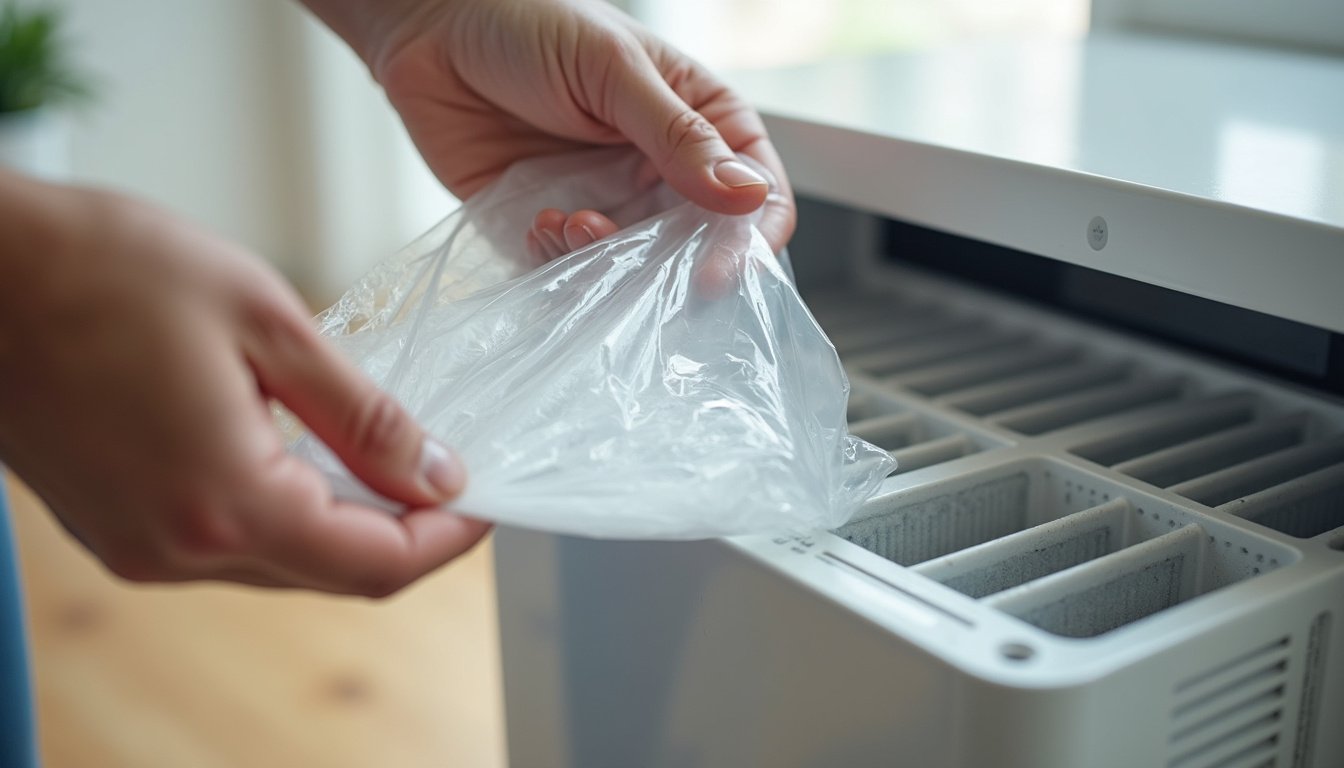
A purifier that has never seemed to work since the day it arrived is usually one of three things, and all three are in the filter compartment. Filters ship sealed in plastic to keep them clean; a surprising number are installed still wrapped, and the fan then runs against a solid sheet while the lights say all is well. Filters have a direction, often an arrow or a labeled face, and a HEPA fitted backwards may not seal; one not pressed fully home, or with its gasket folded, lets air slip round the edge and back into the room unfiltered. Unplug the unit, open the compartment, and look.
- Unplug the unit.
- Open the filter compartment and remove the filter.
- Strip every piece of plastic, tape and cardboard; check the pre-filter too.
- Note the arrow or label; refit with airflow pointing into the unit, gasket flat.
- Press fully home; close the door until it latches.
- Restart; feel the outlet on high. Airflow should be strong and even.
The Settings
A unit doing what it was told can look like one doing nothing. Auto mode sets fan speed from the particle sensor, and if the sensor lens is dusty, misplaced near clean exhaust or simply insensitive to the pollutant you care about, it holds the fan on its lowest speed while the room stays dirty; sensors respond to fine particles and are blind to odors and gases. Sleep mode fixes the lowest speed and dims the display, and some units stay in it until told otherwise. Eco modes cap the speed. A child lock refuses speed changes with a beep or silently. An ionizer or UV button lit does not mean the fan is working hard. Switch to manual and select high for an hour: if the room improves, the setting was the cause.
| Setting | How it looks | Why nothing happens | Fix |
|---|---|---|---|
| Auto with dusty sensor | Light says clean; fan on low | Sensor reads low regardless | Clean lens with dry swab; manual speed |
| Auto in a smelly room | Light says clean; smell remains | Sensor sees particles, not gases | Manual speed; carbon stage; source control |
| Sleep mode left on | Display dark; fan barely audible | Lowest speed all day | Exit sleep mode; set medium |
| Eco or quiet mode | Fan capped | Limited airflow | Normal mode |
| Child lock | Buttons beep or do nothing | Speed change refused | Hold lock button 3 to 5 seconds |
| Timer or schedule | Unit off at odd times | Running fewer hours than you think | Clear timers; check app |
| Ionizer on, fan low | Blue LED lit | Ionizer is not filtration | Switch ionizer off; raise fan speed |
The Room
A purifier is rated for a room size through its clean air delivery rate, and AHAM’s rule is a CADR of at least two thirds of the room’s square footage. A unit rated 100 CFM handles about 150 square feet; put it in a 400 square foot open-plan living area and it cleans a fraction of the air, the rest mixes back in, and the room’s level barely moves. Placement compounds it: an intake against a wall, behind a sofa, under a desk or inside a cabinet starves the fan and the unit delivers far less than its rating. And a continuous source outpaces any filter: an open window on a smoky or pollen-heavy day, a gas stove without a hood, a candle, a smoker, or an ultrasonic humidifier whose mist and mineral dust the sensor reads as pollution.
- Measure the room; compare two thirds of its square footage with the unit’s CADR.
- Close doors to make the room the size the unit can handle.
- Pull the unit into the open with a foot of clearance around intake and outlet.
- Close windows during smoke or pollen; run the range hood when cooking.
- Move any humidifier at least six feet away.
- For open-plan spaces, add a second unit or a larger one rather than expecting one small unit to cope.
Worked example: a unit rated 120 CFM sits in the corner of a 350 square foot open living room behind an armchair, on auto. A particle meter across the room barely moves. Moved into the open, set to manual high and with the kitchen door closed to shrink the space, the meter falls by a third in an hour: working, but outmatched. A second unit in the dining end brings the fall to half in thirty minutes.
| Room size (sq ft) | Minimum CADR (CFM) |
|---|---|
| 100 | 67 |
| 150 | 100 |
| 200 | 133 |
| 300 | 200 |
| 400 | 267 |
The Filter
A HEPA filter loads with dust over months, its resistance rises and the fan pushes less air through it; a pre-filter matted with pet hair does the same thing faster. A purifier whose filter is grey or brown across its face, or past the maker’s interval, may be moving a fraction of its rated air while sounding normal. The indicator light is a timer and runs late in homes with pets, smoke or renovation. Pull the filter and look; if a fresh one is on hand, fit it and compare airflow at the outlet. A unit that was working and gradually stopped is almost always this.
The Hardware
When the filter is fresh and seated, the unit is on manual high in the open in a room it is rated for, and a particle meter still does not move, the fault is in the fan or the sensor. A fan that hums but does not spin, or spins slowly, has a jammed impeller, a failed capacitor or worn bearings; unplug, look for debris, spin the blade by hand. A sensor that reads the same whatever happens in the room has failed and keeps auto mode idling; clean its lens first, then treat it as a service part. A controller that lights up but never drives the fan is a board fault. None of these is a home repair on a sealed appliance; the maker or a technician is the route, and a hot smell or buzzing means unplug first.
| Hardware sign | Likely fault | Action |
|---|---|---|
| Hums, impeller does not turn | Jam, capacitor or seized bearing | Unplug; clear debris; spin by hand; service |
| Spins slowly on high with fresh filter | Capacitor or motor | Service |
| Air light never changes, even near smoke | Sensor failed | Clean lens; then service; use manual speed meanwhile |
| Display works, fan silent on all speeds | Board or motor | Service |
| Strong airflow, meter still flat | Not hardware: room size, placement or source | Re-check the room |
| Hot smell, buzzing, warm plug | Electrical fault | Unplug; do not reuse; contact maker |
Prove It With a Particle Meter
Feelings about air are unreliable, and the unit’s own light reads the cleanest air in the room, the air it just processed. A low-cost PM2.5 monitor placed across a closed room, away from the outlet, settles the matter. Note the baseline, or raise it with a blown-out match, start the unit on high, and watch: a working, correctly sized unit halves the reading within twenty to thirty minutes and keeps it falling. A slow fall means undersized or a loaded filter; no fall means bypass, placement or hardware; a reading that rises with the unit on means a source outpacing it. The meter also catches the sensor lie: when the unit’s light says clean and the meter says otherwise, trust the meter.
What Working Actually Looks Like
A purifier that works lowers fine particle levels in one room while it runs and takes the edge off odors if it has real carbon. It does not remove carbon dioxide or stuffiness, which need ventilation; does not clean rooms it is not in; does not lift hair or dust off floors and furniture; and does not stop a continuous source. If the meter halves in half an hour and the room still smells, the unit is working and the carbon is thin. If the room is still dusty on surfaces, the unit is working and the vacuum is behind. Expect the narrow, real thing it does, and the appliance stops seeming broken. Nothing here is medical advice.
How to Diagnose a Purifier That Is On but Not Working in 6 Steps
- Unplug, open the filter compartment, strip any plastic or cardboard, refit the filter with the arrow pointing in and the gasket flat, and latch the door; feel the outlet on high.
- Take the unit off auto, sleep and eco; release any child lock; switch off the ionizer; run manual high for an hour.
- Pull the unit into the open with a foot of clearance, close doors to shrink the space, and compare two thirds of the room’s square footage with the unit’s CADR.
- Close windows during smoke or pollen, run the range hood when cooking, and move any humidifier six feet away.
- Inspect the filter: replace a grey or overdue HEPA and rinse a matted pre-filter, then compare airflow.
- Place a particle meter across the room: if it halves in half an hour on high, the unit works; if the fan hums without spinning or the sensor never changes, contact the maker.
Do and Do Not
Do
- Unwrap and orient the filter.
- Test on manual high.
- Give the unit clearance and a right-sized room.
- Replace a loaded filter.
- Judge by a particle meter across the room.
Do not
- Do not trust the unit’s air quality light as a room reading.
- Do not expect a bedroom unit to clean an open-plan floor.
- Do not wash the HEPA or blow it out.
- Do not run it in a corner or behind furniture.
- Do not keep running a unit that hums without spinning or smells hot.
Who Should Skip This
If the unit is new and has never seemed to work, skip to the filter compartment: plastic left on the filter or a filter fitted backwards explains the great majority of these cases.
If airflow at the outlet is strong on manual high with a fresh filter, skip the hardware; the unit is healthy, and the complaint is room size, placement, a continuous source or an expectation the filter cannot meet.
Honest Limits
- Consumer particle monitors are relative instruments; use them for before-and-after comparison.
- CADR figures are maker-listed under AHAM test conditions.
- Sensor behavior and mode names vary by model; the manual overrides this guide.
- We did not test any unit or induce faults.
- Odor and gas complaints need carbon and source control, which a particle test does not measure.
- Nothing here is medical advice.
When to See a Professional
Contact the maker for a fan that hums without spinning, a sensor that never responds after lens cleaning, or a unit that moves little air on manual high with a fresh, seated filter; these are service matters on a sealed appliance.
Unplug and keep unplugged any unit with a hot smell, buzzing or a warm plug, and use the maker or a technician; for whole-house or open-plan filtration questions, an HVAC professional can assess central options.
Frequently Asked Questions
Why is my air purifier on but not doing anything?
Most often the filter is still in its shipping plastic, fitted backwards or unseated so air bypasses it; or auto, sleep or eco mode is holding the fan on low; or the unit is too small for the room or starved in a corner; or the filter is loaded.
My new air purifier runs but the room is no cleaner. What did I miss?
Almost certainly the filter. New filters ship sealed in plastic and are often installed wrapped, which stops airflow while the lights glow, or fitted backwards so they do not seal. Unplug, strip all plastic, refit with the arrow pointing in and the gasket flat, latch the door and feel the outlet on high.
Why does my purifier stay on low and never clean the room?
Auto mode is holding it there because the particle sensor reads clean, from a dusty lens, from sitting in the unit’s own clean exhaust, or because the pollutant is an odor or gas the sensor cannot see.
How do I know if the purifier is too small for the room?
Compare its clean air delivery rate with two thirds of the room’s square footage: a 120 CFM unit suits about 180 square feet. In a larger or open-plan space it cleans a fraction of the air and the room’s level barely moves. Close doors to shrink the space, or add a second or larger unit.
Can the air purifier’s own air quality light be wrong?
Yes, routinely. The sensor sits in or beside the housing and sees the air the unit just filtered, so it reads clean long before the far side of the room does, and a dusty lens reads clean permanently.
Why did my purifier work at first and then stop?
The filter loaded. As dust fills the HEPA its resistance rises and airflow falls to a trickle while the fan sounds normal; a pre-filter matted with pet hair does it faster. Pull the filter and look: grey or brown media is done.
How do I test whether the purifier is actually working?
5 monitor across a closed room, note the reading or raise it with a blown-out match, run the unit on high and watch. A working, right-sized unit halves the reading within 20 to 30 minutes.
The fan hums but the purifier does not seem to move air. Why?
The impeller is jammed by debris, a run capacitor has failed, or a bearing has seized. Unplug, remove the filters, clear any obstruction and spin the blade by hand. If it turns freely but only hums when powered, suspect the capacitor, which is a service matter on a sealed unit.
My purifier works but the room still smells. Is it broken?
No. Odor is gas, and HEPA removes particles; only an activated carbon stage adsorbs smells, and the thin carbon sheet in many filters holds little and saturates fast. A particle meter will show the unit working while the smell remains. Add real carbon, place the unit near the source, and clean the source itself.
When is an on-but-not-working purifier a hardware fault?
When the filter is fresh and seated, the unit runs on manual high in the open in a room it is rated for, and a particle meter still does not move. Humming without spinning, a sensor that never responds or a silent fan are service matters. A hot smell means unplug first.
Bottom Line
An air purifier that is on but not working is almost never broken. It is running against a filter still in its plastic, or around a filter that does not seal, or on a low speed its sensor chose, or in a room three times its rating, or behind a sofa, or through a HEPA so loaded that air barely passes. Each of those is found in minutes, in that order, and fixed for nothing or for the price of a filter.
The proof is a particle meter across the room halving in half an hour on high, not the unit’s own light. When that test fails with everything above corrected, the fan or sensor is at fault and the maker is the next call; when it passes but the room still smells or the floor is still dusty, the unit is working and the job belongs to carbon and a vacuum.
Related reading: How to tell if air purifier is working, Air purifier airflow issues, Air purifier auto mode not working.