Last updated:
As an Amazon Associate we earn from qualifying purchases. This does not change what we recommend. See our affiliate disclaimer.
Some purifiers carry a second sensor beside the particle counter: an odor, gas or VOC sensor that is supposed to notice cooking smells, cleaning fumes and pet odor and raise the fan in response. When it works it is a pleasant convenience. When it does not, it either sits on green while the kitchen reeks or screams red every time someone opens a bottle of hand sanitizer, and owners reasonably wonder whether it is broken.
Odor and gas sensors in air purifiers are small metal-oxide or electrochemical elements that respond to a broad mix of volatile compounds, and their behavior is quirky by design rather than by fault. They read total VOCs as a rough index, not any one gas, so they react strongly to alcohols, solvents, perfume and even breath, and weakly to some smells people care about. They drift, need warm-up time after power-on, lose sensitivity with age and are easily fooled by humidity, temperature swings and a dusty inlet. A sensor that never changes at all after cleaning has probably failed; one that behaves oddly is usually doing what such sensors do. Either way the purifier filters perfectly well on a manual speed, and for odor work a manual medium floor is the better choice anyway.
In short: clean the inlet, give it time to warm up, expect it to react to alcohol and humidity, and if it stays flat, run manual speeds. The sensor is a convenience; the carbon and the fan do the work.
Maker manuals describe gas and odor readings as indicative, recommend keeping the sensor inlet clean and dry, and note that readings respond to cleaning products, cosmetics and cooking. The EPA’s guidance on consumer air sensors notes that low-cost VOC sensors report relative changes rather than concentrations and vary widely between models.
This guide is research-based, drawn from maker manuals, EPA material on consumer air sensors and the behavior of metal-oxide gas sensors. We have not tested the units in the comparison table and quote no prices or ratings. Nothing here involves opening the housing; sensor modules and boards belong to the maker.
Probably normal sensor behavior if
- It spikes when you use hand sanitizer, perfume, sprays or cook with alcohol
- It reads high on humid days or near a humidifier
- It drops to green a few minutes after a smell event while the room still smells faintly
- It takes several minutes after power-on to settle
Worth action if
- It never changes at all, even with a strong smell nearby
- It reads maximum constantly in a clean, ventilated room after cleaning
- It triggers error codes
- It drives auto mode so badly that the fan never leaves low or never leaves high
Key Takeaways
- Odor and VOC sensors read a broad index of volatile compounds, not specific smells; quirky behavior is normal.
- They react strongly to alcohols, solvents, perfume and breath, and weakly to some odors people notice.
- Humidity, temperature swings and a dusty inlet skew readings; clean the inlet with a dry swab monthly.
- Sensors need a warm-up after power-on and drift with age; readings are trends, not measurements.
- A sensor that never changes after cleaning has probably failed; the purifier still filters normally on manual speeds.
- For odor work, set a manual medium floor; a sensor idling the fan on low defeats the carbon stage.
- Gas sensors do not detect carbon monoxide or natural gas; use dedicated alarms.
HEPA and Carbon Purifiers to Compare
These widely reviewed filter-based units pair true HEPA with activated carbon and several include particle and gas sensors. Compare the maker-listed CADR and carbon stage against your room; treat any odor sensor as a convenience and plan to run a manual speed for odor work.






How This Guide Approaches the Sensor
We looked at how low-cost gas sensors work and fail, what maker manuals say about their readings and care, and how auto mode uses them, then matched common complaints to likely causes and set out what an owner can do without opening the unit. Product details in the table come from maker specifications.
The framing that saves frustration is this: the odor sensor is an approximate trend indicator bolted onto a filter. Its job is to nudge the fan; the filtration never depended on it.
What the Odor Sensor Actually Is
Most purifier gas sensors are metal-oxide semiconductor elements: a heated ceramic surface whose electrical resistance changes when volatile organic compounds adsorb onto it. A few use electrochemical cells. Either way they respond to a broad class of compounds, alcohols, aldehydes, aromatics, terpenes and many others, and report a single total-VOC index or a color. They cannot tell perfume from paint or cooking from a pet, and they have no way to measure a specific concentration.
That broadness is why they behave oddly. Hand sanitizer, a glass of wine, a scented candle, a cleaning spray and someone breathing on the unit all read as high VOCs. Meanwhile some odors people notice, musty mold compounds or a litter box’s ammonia, register weakly. The sensor is reacting to chemistry, not to what a nose considers a smell.
| What the sensor reacts to strongly | What it reacts to weakly or not at all |
|---|---|
| Alcohol: sanitizer, perfume, wine, mouthwash | Carbon monoxide, carbon dioxide, radon, natural gas |
| Solvents: paint, nail polish, markers, glue | Ammonia from litter boxes, in many designs |
| Fragrance: candles, air fresheners, cosmetics | Musty mold odor compounds, often faint on the index |
| Cooking vapors: frying, onions, garlic | Dust, pollen, smoke particles, which the particle sensor sees |
| Human breath, especially up close | Odors already below the sensor’s threshold |
| Humidity and temperature changes | Odors absorbed into fabrics, which re-emit slowly |
Quick Diagnosis Table
| Symptom | Likely cause | What to do |
|---|---|---|
| Spikes to red when sanitizer, perfume or sprays are used | Normal response to alcohol and fragrance | Nothing; it settles in minutes |
| Reads high on humid days or near a humidifier | Humidity cross-sensitivity | Move away from mist; dehumidify to 30 to 50 percent |
| Reads high constantly in a clean room | Dusty inlet, contaminated element, or a persistent VOC source | Clean the inlet; ventilate; check for new furniture, paint, fresheners |
| Never changes, even with a strong smell | Blocked inlet or failed sensor | Clean the inlet; if still flat, sensor has failed; use manual speeds |
| Erratic readings in the first minutes after power-on | Normal warm-up | Wait 10 to 30 minutes |
| Reads clean while the room smells of cooking | Weak response to that odor type, or dusty inlet | Clean inlet; set manual medium for odor work |
| Readings slowly drift high or low over months | Sensor aging | Expect it; rely on manual speeds; sensor modules are maker parts |
| Error code on display | Sensor fault detected | Power cycle; clean inlet; contact maker if it persists |
Cleaning the Inlet and Allowing Warm-Up
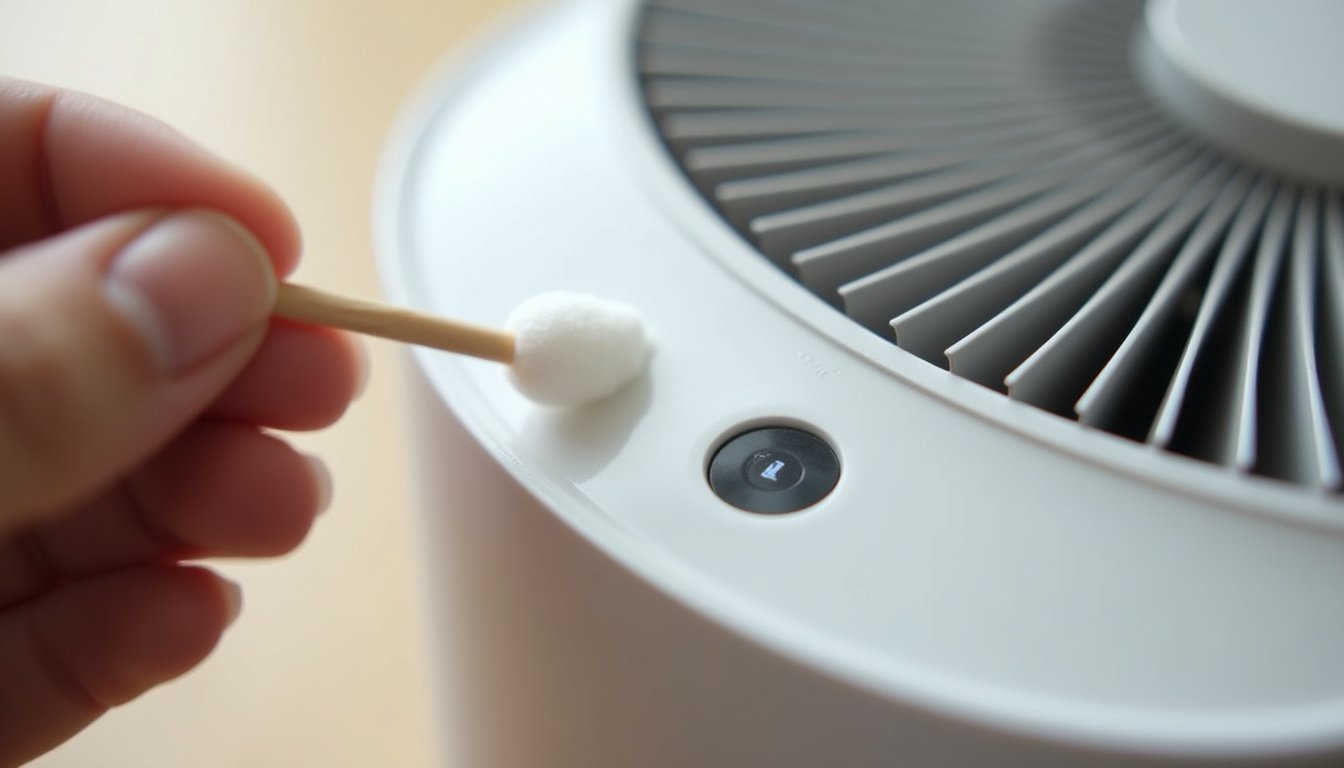
Gas and particle sensors usually share a small vented window on the side or back of the unit. Dust settles on it over months, slowing the gas sensor’s response and insulating the heated element, so readings lag or sit at one value. Cleaning is monthly and dry.
- Unplug the unit.
- Locate the sensor inlet from the manual’s diagram.
- Clean the grille with a dry cotton swab or a gentle puff of air from a hand bulb; never liquids, sprays or canned compressed air, which can damage or contaminate the element.
- Wipe the surrounding housing with a dry cloth.
- Plug in and leave the unit running for 10 to 30 minutes before judging the reading; metal-oxide sensors need their heater to stabilize.
When It Reads High for No Reason
A sensor pinned at red in a room that smells fine is reacting to something. Common culprits are a plug-in air freshener or scented candle nearby, a new piece of furniture or fresh paint off-gassing, a humidifier raising local humidity, cleaning products in the same room, a bottle of nail polish remover left open, or simply someone sitting close enough that their breath reaches the inlet. Low-cost VOC sensors are also sensitive to temperature, so a unit by a sunny window or a radiator reads differently through the day.
Move the unit away from fresheners, mist and heat, open a window for an hour, clean the inlet and see whether the reading settles. If it stays high in a ventilated room with the inlet clean, either the room has a real VOC source worth finding, new materials being the usual one, or the element is contaminated and aging.
Worked example: a living room purifier reads high every evening. The owner finds a plug-in freshener in the same outlet strip and a scented candle lit at dinner. Removing both and airing the room drops the reading to green within an hour; the sensor was reporting fragrance accurately, and the fragrance was the thing to remove.
When It Reads Clean While the Room Smells
The reverse complaint is a sensor that sits on green while the kitchen smells of fish or the hallway of wet dog. Three things cause it. The inlet is dusty and the sensor is barely sampling. The odor is one the sensor responds to weakly; many designs barely register ammonia or musty compounds. Or the smell has already fallen below the sensor’s threshold while remaining obvious to a nose, which can detect some compounds at concentrations far lower than any consumer sensor.
Clean the inlet first. Then stop expecting the sensor to run odor control. Set a manual medium speed as the floor whenever odors are the goal, and use high during and after cooking or litter changes. The carbon stage removes odor only from air that reaches it, and a sensor idling the fan on low is starving it.
Auto Mode Problems Caused by the Sensor
Auto mode on many units takes the higher of the particle and gas readings. A gas sensor that reads high constantly keeps the fan on high and the room loud; one that never reads anything leaves odor control to the particle sensor, which cannot smell. Some units let you choose which sensor drives auto, or offer a sleep mode that caps the fan regardless; check the manual.
| Auto mode behavior | Sensor cause | Workaround |
|---|---|---|
| Fan stuck on high in a clean room | Gas sensor reading high; fragrance, humidity or contamination | Remove fresheners; clean inlet; use sleep mode or manual at night |
| Fan never leaves low despite smells | Gas sensor flat or weak for that odor | Manual medium floor for odor work |
| Fan surges when someone walks past | Breath or cosmetics near the inlet | Move the unit; accept it or use manual |
| Fan surges with the shower running | Humidity cross-sensitivity | Move away from the bathroom door; manual at those times |
| Fan cycles up and down every few minutes | Sensor hunting at a threshold | Manual speed; some units allow sensitivity adjustment |
Resetting and Adjusting the Sensor
Many units recalibrate the gas sensor on power-up, taking the first minutes as a baseline. If a unit was switched on in a smelly room, that baseline is wrong and readings skew for days. Power cycle it in clean air: unplug for a minute, plug in with windows open or the room aired, and leave it alone for half an hour. Some models offer a sensor sensitivity setting, low, medium or high; turning it down stops surges from breath and sanitizer without disabling the function. The manual lists the procedure and any sensor-specific reset.
If none of this changes a sensor that is flat or pinned, the element has failed or aged out. Sensor modules are replaceable on a few units and not on most; the manual or maker support will say. A purifier with a dead gas sensor still filters perfectly on manual speeds and the particle sensor may still run auto mode for dust and smoke.
What the Sensor Will Never Detect
An odor or VOC sensor is not a safety device. It does not detect carbon monoxide, which is odorless and needs UL-listed alarms on every level. It does not detect natural gas leaks reliably, which call for leaving the home and phoning the utility. It does not detect radon, which is tested and mitigated, or carbon dioxide, which is a ventilation matter. A purifier showing green says nothing about any of these.
Living With a Quirky Sensor
The useful way to treat an odor sensor is as a rough companion rather than a controller. Let it run auto by day if its behavior is tolerable, and use its spikes as reminders: a surge when you clean points to a product worth swapping for a fragrance-free one; a steady high reading after new furniture arrives says the room needs airing. For actual odor removal, run manual speeds and rely on carbon by the pound and source control.
- Clean the inlet monthly, dry.
- Power cycle in clean air if readings seem stuck.
- Lower sensitivity if the manual allows and surges are a nuisance.
- Keep fresheners, candles, sanitizer and humidifiers away from the unit.
- Use a manual medium floor for odor work and high after events.
- Replace carbon on its 3 to 6 month interval regardless of what the sensor says.
- Do not replace a purifier because its gas sensor misbehaves; the filtration is unaffected.
How to Troubleshoot the Odor Sensor in 6 Steps
- Note what sets it off: sanitizer, perfume, sprays, humidity or breath are normal triggers; a constant high in a clean room or a flat reading with a strong smell is not.
- Unplug, clean the sensor inlet with a dry swab or hand bulb, and wipe the housing dry; never spray it.
- Move the unit away from fresheners, candles, humidifier mist, bathroom doors, radiators and sunny windows.
- Power cycle in aired, clean air and leave it 30 minutes to re-baseline; lower sensitivity in the menu if available.
- If it still never changes or stays pinned, treat the sensor as failed: use manual speeds, let the particle sensor run auto if it works, and ask the maker about a module.
- For odor control, set a manual medium floor and high after events; replace carbon on schedule and rely on source control.
Do and Do Not
Do
- Clean the sensor inlet monthly, dry.
- Expect spikes from alcohol, fragrance and humidity.
- Power cycle in clean air to re-baseline.
- Run manual speeds for odor work.
- Keep CO alarms separate from any purifier reading.
Do not
- Do not spray cleaners near the sensor.
- Do not trust auto mode to handle smells.
- Do not read a green light as a safety check.
- Do not open the housing to reach the sensor.
- Do not replace the purifier for a failed gas sensor alone.
Who Should Skip This
If the sensor only spikes when you use sanitizer, perfume, cleaning sprays or cook with alcohol, and settles within minutes, skip troubleshooting entirely. It is working exactly as metal-oxide VOC sensors do, and the fix is to clean and freshen the room away from the unit.
If the smell you want detected is gas, sewer or burning, skip the sensor and act: leave and call the utility for sulfur smells, call a plumber for sewer odor, unplug the suspect appliance and call an electrician for burning. No purifier sensor is designed for these.
Honest Limits
- Consumer VOC sensors report relative indices, not concentrations, and vary widely between models.
- Cross-sensitivity to humidity, temperature and alcohols is inherent, not a defect.
- Sensors drift and lose sensitivity over one to three years; replacement modules are available on few units.
- A clean reading says nothing about carbon monoxide, radon, natural gas or carbon dioxide.
- Some odors people notice fall below the sensor’s threshold entirely.
- Nothing here applies to the sensor board or housing interior, which are not owner serviceable.
When to See a Professional
Contact the maker for persistent error codes, a sensor that stays flat or pinned after cleaning and a clean-air power cycle, or to ask whether a sensor module is replaceable on your model; do not open the housing. Leave the home and call the gas utility for any sulfur smell, and rely on CO alarms rather than any purifier reading.
See a doctor for symptoms you suspect are related to indoor fumes; a purifier sensor is not a diagnostic instrument, and nothing on this page is medical advice.
Frequently Asked Questions
Why does my air purifier’s odor sensor go red when I use hand sanitizer?
Because it is a VOC sensor that responds strongly to alcohols, along with perfume, sprays, solvents and even breath. That is normal metal-oxide sensor behavior, not a fault. It settles within minutes once the vapor disperses. Clean and freshen the room away from the unit if the surges bother you.
Why does the odor sensor stay green when the room smells?
Either the inlet is dusty and the sensor is barely sampling, the odor is one it responds to weakly such as ammonia or musty compounds, or the smell is below its threshold while still obvious to a nose. Clean the inlet dry, then set a manual medium speed for odor work instead of auto.
How do I clean the odor sensor on my purifier?
Unplug, find the small vented sensor inlet from the manual, clean the grille with a dry cotton swab or a gentle puff from a hand bulb, and wipe the housing dry. Never use liquids, sprays or canned air. Plug in and allow 10 to 30 minutes of warm-up before judging the reading.
Why does the gas sensor read high on humid days?
Low-cost VOC sensors are cross-sensitive to humidity and temperature, so damp air, a nearby humidifier or a shower running down the hall pushes the reading up. Move the unit away from mist and bathroom doors, hold humidity at 30 to 50 percent and expect some drift with weather.
How do I reset the odor sensor?
Many units take a baseline in the first minutes after power-on, so power cycle in clean air: unplug for a minute, air the room, plug in and leave it undisturbed for half an hour. Check the manual for a sensor sensitivity setting; lowering it stops surges from breath and sanitizer without disabling the sensor.
Is the odor sensor broken if it never changes?
Clean the inlet dry and power cycle in clean air first. If it still never moves when you hold an open bottle of rubbing alcohol a foot away, the element has likely failed or aged out. The purifier still filters normally on manual speeds; sensor modules are replaceable on only a few models.
Does the odor sensor detect carbon monoxide or gas leaks?
No. VOC sensors do not detect carbon monoxide, which needs UL-listed alarms on every level, and are not designed to detect natural gas leaks, which call for leaving the home and phoning the utility. They also miss radon and carbon dioxide. Never treat a purifier’s display as a safety check.
Why does auto mode run on high all the time?
The gas sensor is probably reading high from a plug-in freshener, candle, humidifier, cleaning products, new furniture off-gassing or a contaminated element. Remove fragrance sources, air the room, clean the inlet and re-baseline; use sleep mode or a manual speed at night if it persists.
Should I use auto mode for odor control?
No. Gas sensors respond weakly to some odors and drop to green while a smell lingers, leaving the fan on low where little air reaches the carbon. Set a manual medium speed as the floor for odor work, use high during and after cooking or litter changes, and let auto handle dust by day.
Can I replace the odor sensor myself?
Not on most units; the sensor sits on a board inside the housing and opening it is not owner maintenance. A few models sell a plug-in sensor module; the manual or maker support will say. Otherwise run manual speeds, which filter exactly as well, and treat the sensor as a lost convenience.
Bottom Line
An air purifier’s odor sensor is a small VOC element with large quirks: it shouts at hand sanitizer and perfume, mumbles at a litter box, drifts with humidity and age, and needs a dry swab and a warm-up to behave at all. Most complaints about it are descriptions of how such sensors work, and the ones that are faults, a reading that never moves or never leaves maximum after cleaning and a clean-air reset, mean the element has aged out.
None of that changes what the purifier does. The fan and the carbon remove odors from air that passes through them, and a manual medium speed delivers that air far more reliably than any sensor. Clean the inlet, keep fragrances and mist away, use the spikes as hints about the room, and run odor control by hand.
Related reading: Air purifier humidity sensor issues, What is a carbon filter in an air purifier, Can air purifiers reduce VOCs.