Last updated:
As an Amazon Associate we earn from qualifying purchases. This does not change what we recommend. See our affiliate disclaimer.
That new-carpet smell, the sharp note from a freshly painted room, the chemical tang of a flat-pack bookcase on its first day: these are volatile organic compounds, and they are the pollutants people most often hope a purifier will handle. The hope is reasonable, the marketing is enthusiastic, and the truth sits somewhere in between, with a lot riding on one word: carbon.
Air purifiers can reduce some VOCs, but only through a sorbent stage, almost always activated carbon, and only in proportion to how much of it the unit carries. VOCs are gases, so they pass straight through HEPA media, which captures particles. Activated carbon adsorbs many heavier VOC molecules, the ones behind paint, solvent, fragrance and many odor smells, onto its vast internal surface, and a unit with a pound or more of granular carbon makes a measurable difference in a closed room. Thin carbon-coated pads saturate within weeks and then do nothing. Light, small molecules such as formaldehyde are held poorly by plain carbon and need chemically treated media, and even then the EPA notes that effectiveness varies by product. Some electronic technologies, photocatalytic oxidation and plasma devices, claim to destroy VOCs but can create by-products including formaldehyde and ozone. Above all, a purifier is the third line of defense. Removing the source and ventilating remove far more VOCs than any filter.
In short: yes, with real carbon and modest expectations; no, with a HEPA-only unit or a token carbon pad. Open the windows and get the source out of the house first.
The EPA’s guide to air cleaners in the home states that gas-phase filters such as activated carbon can reduce some gaseous pollutants, that their effectiveness depends on the amount and type of sorbent, that they saturate and must be replaced, and that no portable air cleaner is expected to remove all gaseous pollutants. The EPA’s guidance on VOCs puts source control and ventilation first.
This guide is research-based, drawn from EPA material on VOCs, formaldehyde and air cleaners, the chemistry of adsorption and maker specifications. We have not tested the units in the comparison table and quote no prices or ratings. Nothing here is medical advice.
A carbon purifier will help if
- The VOC source is moderate and intermittent: new furniture, occasional painting, cleaning products
- The unit carries a pound or more of granular or pelletized carbon
- You can close the room and run it continuously
- You have already ventilated and moved what you can outdoors
It will disappoint if
- The unit is HEPA-only or has a thin carbon-coated pad
- The source is strong and continuous: fresh paint in a sealed room, indoor smoking, solvent use
- Formaldehyde is the concern and the media is plain carbon
- You expect it to replace opening windows
Key Takeaways
- VOCs are gases; HEPA filters do nothing for them, and only a sorbent stage such as activated carbon captures them.
- Carbon quantity decides results: a pound or more of granular carbon works for months, a coated pad for weeks.
- Plain carbon holds formaldehyde poorly; chemically treated media is needed, and the EPA notes effectiveness varies.
- Photocatalytic, plasma and ozone devices can create VOC by-products and ozone; the EPA cautions against them.
- Source removal and ventilation remove far more VOCs than any purifier.
- Saturated carbon stops working and can release what it holds; replace it on schedule or when odors return.
- Particle sensors cannot detect VOCs, so auto mode does not respond to fumes.
Purifiers With Real Carbon Stages to Compare
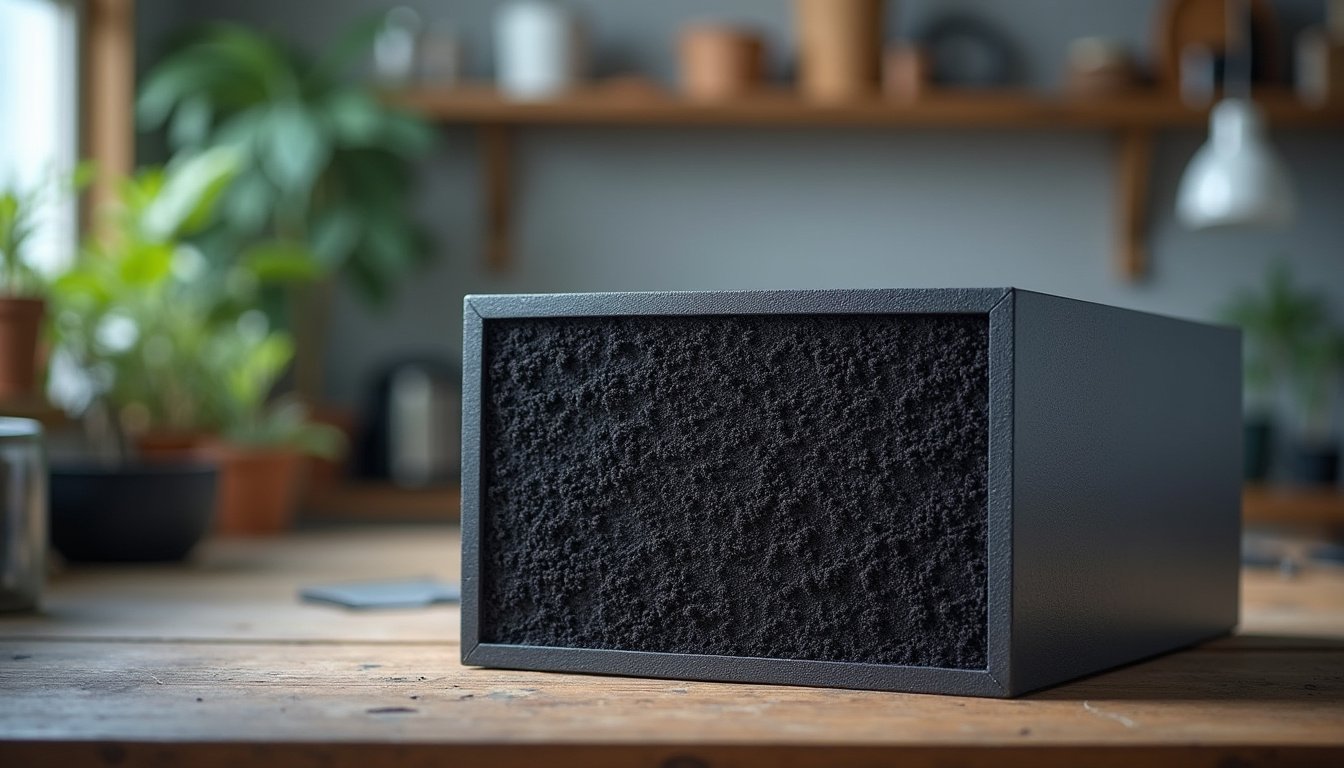
These widely reviewed filter-based units pair true HEPA with an activated carbon stage across bedroom to large-room sizes. For VOC work, compare the maker-listed carbon quantity and form, favor units that state a weight, and size by CADR so the whole room’s air passes the carbon several times an hour.






How This Guide Approaches VOCs
We worked from the EPA’s descriptions of VOCs, formaldehyde and air cleaners, the chemistry of adsorption on activated carbon and treated media, and the carbon specifications makers publish, then matched common VOC situations to what a purifier can realistically do in each. Product details in the table come from maker specifications.
The question to carry through is capacity. Carbon is a sponge with a finite surface; how much of that surface a unit carries, and how fast the room refills with VOCs, decides whether the purifier is meaningful or decorative.
What VOCs Are and Where They Come From
Volatile organic compounds are carbon-based chemicals that evaporate at room temperature. Indoors they come from paints and finishes, adhesives, pressed-wood furniture and cabinetry, carpet and vinyl flooring, cleaning and personal care products, air fresheners, cooking, combustion and dry-cleaned clothing. The EPA notes that indoor VOC levels are routinely several times outdoor levels and can be far higher during and after activities such as painting or stripping.
Hundreds of compounds fall under the label, and they differ enormously in behavior. Heavy, complex molecules such as those in fragrances and many solvents stick readily to carbon. Light, small molecules such as formaldehyde, acetaldehyde and some alcohols pass through plain carbon with little capture. That difference is why a purifier’s VOC performance depends on which VOC you mean.
| Source | Typical VOCs | Carbon capture | Primary fix |
|---|---|---|---|
| Fresh paint and finishes | Solvents, glycols, aromatics | Good for heavier solvents | Ventilate during and after; low-VOC products |
| Pressed-wood furniture and cabinets | Formaldehyde | Poor with plain carbon; fair with treated media | Air out before bringing in; choose low-emission products |
| New carpet and vinyl | Mixed aromatics and plasticizers | Moderate | Ventilate for days; air out off-site if possible |
| Cleaning sprays and fragrance | Terpenes, alcohols, fragrance compounds | Good for fragrance; weak for alcohols | Fragrance-free products; ventilate; clean when the room is empty |
| Cooking and combustion | Aldehydes, aromatics | Partial | Vented range hood; no indoor smoking |
| Dry cleaning | Perchloroethylene | Moderate | Air garments outdoors before storing |
Why HEPA Does Nothing for VOCs
HEPA filters are fiber mats that trap particles by sieving, impact and diffusion. VOC molecules are individual gas molecules, thousands of times smaller than the smallest particle a filter is designed to catch, and they move through the fiber mat as freely as oxygen. A HEPA-only purifier running in a freshly painted room clears the dust from sanding and leaves every bit of the solvent smell.
Marketing sometimes blurs this by listing VOCs among the things a HEPA unit addresses because it also has a carbon layer. The HEPA layer is irrelevant to the claim; look at the carbon.
How Activated Carbon Captures VOCs
Activated carbon is charcoal processed to open a vast network of microscopic pores; a single gram can have an internal surface of several hundred square meters. VOC molecules passing through the bed stick to that surface by weak attractive forces, which is adsorption. Larger, heavier molecules with more surface to attract are held strongly; small, light molecules barely stick and can be displaced by heavier ones or by water vapor, which carbon also adsorbs.
Capacity is finite. As the surface fills, capture falls off, and a saturated bed in a warm room can release some of what it holds. Humidity above about 60 percent reduces capacity further. These are the reasons carbon is sold as a consumable with intervals of roughly three to six months and why thin pads are spent in weeks.
| Carbon stage | Typical carbon amount | VOC performance in a closed room | Useful life under a moderate source |
|---|---|---|---|
| Coated fabric pad | A few ounces | Brief, slight | Weeks |
| Carbon sheet or honeycomb | Under a pound | Noticeable for lighter loads | One to three months |
| Granular or pelletized bed | One to three pounds | Meaningful reduction of heavier VOCs | Three to six months |
| Deep canister | Three pounds and up | Strong reduction; best for renovation or smoke | Six months or more |
| Treated carbon or blended media | Varies | Adds capture of formaldehyde and other light gases | Similar to the bed it is in |
Formaldehyde: The Hard Case
Formaldehyde is the VOC of most concern in many homes, released by pressed-wood products, some insulation, finishes and fabrics, and by combustion. It is a very small molecule that plain activated carbon holds poorly. Makers address it with carbon impregnated with potassium permanganate, potassium iodide or amine compounds, or with blended media such as activated alumina or zeolite pellets that react with or hold the molecule. The EPA notes that the effectiveness of these media varies by product and that they, too, saturate.
If formaldehyde is the specific worry, look for a filter that names it and describes the media, and still treat ventilation and source choice as the main defense. Emissions from new products fall over weeks to months on their own, faster with warmth and airflow, which is why airing items out before they come indoors works so well.
Technologies That Claim to Destroy VOCs
Several electronic approaches promise to break VOCs down rather than trap them. Photocatalytic oxidation shines UV on a titanium dioxide surface to oxidize gases; plasma and bipolar ionization devices use electrical discharge; ozone generators release a reactive gas. In practice oxidation in air is often incomplete, and incomplete oxidation of VOCs can produce formaldehyde, acetaldehyde and other irritants, while several of these devices also emit ozone. The EPA cautions that these technologies may produce harmful by-products and advises against ozone generators in occupied spaces.
For a home, the safe, well-understood approach is to trap VOCs on carbon or treated media and replace the filter, not to attempt to chemically convert them in the living room.
| Technology | VOC claim | Concern | Position |
|---|---|---|---|
| Activated carbon | Adsorbs many VOCs | Finite capacity; weak on light gases | Use, by the pound |
| Treated media | Holds formaldehyde and light gases | Varies by product; saturates | Use for formaldehyde concerns |
| Photocatalytic oxidation | Breaks down VOCs | Possible formaldehyde and other by-products | Not recommended for homes |
| Plasma or bipolar ionization | Breaks down VOCs | Variable evidence; possible ozone and by-products | Not recommended for homes |
| Ozone generator | Oxidizes VOCs | Ozone is a lung irritant; EPA advises against | Avoid |
| UV lamp alone | Sterilizes | No meaningful VOC effect | Irrelevant |
Why Source Control and Ventilation Come First
The EPA’s guidance on VOCs is to increase ventilation when using products that emit them, follow label precautions, buy only what you will use, store containers outside living space, and choose low-emission products. Every one of those steps removes more VOCs than a purifier can, because they either keep the compounds out of the air or carry them out of the house in volume. A purifier recirculates and filters a room’s air; an open window replaces it.
- Move the source outdoors or to a garage: air out new furniture, mattresses and rugs for days before they come in.
- Ventilate during and after painting, finishing and heavy cleaning, with windows open and a fan exhausting outward.
- Choose low-VOC or no-VOC paints, adhesives and finishes, and formaldehyde-free or certified pressed-wood products.
- Store solvents, fuels and paints in a detached space, tightly closed.
- Switch to fragrance-free cleaning and personal products; fragrance is a major household VOC source.
- Then run a carbon-equipped purifier continuously in the room to lower what remains.
Worked example: a bedroom gets a new pressed-wood wardrobe and a fresh coat of paint. The owner assembles the wardrobe in the garage and lets it stand a week, paints with a low-VOC product on a mild day with windows open and a box fan exhausting, keeps the windows open for two days after, and then moves the wardrobe in and runs a purifier with two pounds of granular carbon continuously for a month. The purifier’s role is real but small next to the week in the garage and the open windows.
Sizing and Running a Purifier for VOCs
Carbon only works on air that passes through it, so the fan matters as much as the bed. Size by AHAM’s particle rule, a dust CADR of at least two-thirds of the room’s floor area in square feet, so the whole room’s air reaches the carbon several times an hour. Place the unit near the source, with a foot of clearance, and keep the door closed so the unit is not trying to clean the whole house.
- Run continuously; VOC sources emit around the clock and a saturated or idle unit removes nothing.
- Set a manual medium speed as the floor and use high after painting or unboxing; particle sensors cannot see VOCs and auto mode will idle on low.
- Replace carbon on the maker’s schedule or when the smell returns, whichever is first; a spent bed in a warm room can release compounds.
- Keep humidity between 30 and 50 percent; damp air reduces carbon’s capacity.
- Choose units with a separate carbon stage so it can be replaced alone on its shorter interval.
What Results to Expect
In a closed bedroom with a moderate source and a unit carrying a pound or more of granular carbon, expect a noticeable drop in solvent, fragrance and new-product smells within hours and a steady lower level while the unit runs, with the carbon lasting a few months. Expect little for formaldehyde without treated media, little from any purifier against fresh paint in a sealed room until ventilation has done its work, and nothing from a HEPA-only unit or a coated pad beyond the first weeks.
| Situation | Realistic purifier effect | What does the heavy lifting |
|---|---|---|
| New sofa or mattress off-gassing | Moderate reduction with a carbon bed | Airing out beforehand; ventilation |
| Fresh paint, windows open | Modest supplement | Ventilation and low-VOC paint |
| Fresh paint, sealed room | Overwhelmed | Open the windows |
| Fragrance and cleaning products | Good reduction if products are removed | Switching to fragrance-free |
| Formaldehyde from cabinetry | Small with plain carbon; fair with treated media | Low-emission products; time; ventilation |
| Indoor smoking | Overwhelmed | Smoking outdoors |
When Fumes Are an Emergency
Some gases are not purifier problems at any carbon weight. A rotten egg or sulfur smell can be natural gas: leave the home and call the utility from outside. Carbon monoxide has no smell and is handled by alarms on every level. Strong solvent exposure that causes dizziness, headache or nausea means leaving the space for fresh air and seeking medical advice. Radon is tested, not filtered. A purifier should never delay any of these responses.
For everyday VOCs, the rule is simpler: if a smell is strong enough to notice from the doorway, the room needs ventilation before it needs a filter.
How to Reduce VOCs in 7 Steps
- Identify the source and get it out: air new items outdoors or in a garage, store solvents outside living space, switch to fragrance-free products.
- Ventilate during and after any painting, finishing or heavy cleaning, with windows open and a fan exhausting outward.
- Choose low-VOC paints and adhesives and low-emission or certified pressed-wood products for future purchases.
- Measure the room and set a dust CADR target of two-thirds of its floor area so the purifier moves the whole room’s air through the carbon several times an hour.
- Choose a unit with a stated carbon weight, a pound or more in granular or pelletized form, and treated media if formaldehyde is the concern; reject PCO, plasma and ozone devices.
- Run it continuously on a manual medium, high after events, near the source with the door closed.
- Replace carbon on schedule or when the smell returns, and watch a TVOC trend or your nose to judge progress.
Do and Do Not
Do
- Put source control and ventilation first.
- Judge a purifier by carbon weight.
- Use treated media for formaldehyde.
- Run continuously on a manual speed.
- Replace saturated carbon promptly.
Do not
- Do not expect HEPA alone to touch VOCs.
- Do not rely on a coated carbon pad.
- Do not buy PCO, plasma or ozone devices for VOCs.
- Do not trust auto mode to respond to fumes.
- Do not treat a purifier as a substitute for opening windows.
Who Should Skip This
If the VOC source is fresh paint or finish in a room that can be ventilated, skip buying a purifier for the job. Open the windows, run a fan exhausting outward and wait a few days; the carbon in any home purifier is a small supplement next to that airflow.
If the concern is natural gas, carbon monoxide or radon, skip the purifier aisle for those entirely. Gas smells mean leaving and calling the utility, CO means alarms, radon means a test and a mitigation contractor.
Honest Limits
- Carbon capacity is finite and saturation is invisible; replacement is on schedule and smell.
- Plain carbon holds light gases such as formaldehyde poorly; treated media helps but varies by product.
- A strong continuous source outpaces any portable unit.
- Humidity above about 60 percent reduces carbon’s capacity.
- Consumer TVOC sensors show trends only and cannot identify compounds.
- No health claims are made; VOC exposure questions belong with a doctor.
When to See a Professional
Leave the home and call the gas utility for any sulfur or rotten egg smell; rely on CO alarms for carbon monoxide; and use a certified radon professional for testing and mitigation. For strong solvent exposure with dizziness, headache or nausea, get to fresh air and seek medical advice. Nothing on this page is medical advice.
Consult an HVAC or indoor air professional for persistent high VOC readings after ventilation and source removal, and a lab-analyzed formaldehyde test if pressed-wood products are suspected; some issues need source replacement rather than filtration.
Frequently Asked Questions
Do air purifiers remove VOCs?
Some do, partly. VOCs are gases that pass through HEPA media, so only a sorbent stage such as activated carbon captures them, and results scale with the amount of carbon. A unit with a pound or more of granular carbon reduces many heavier VOCs in a closed room; a thin coated pad does little.
Does a HEPA filter remove VOCs?
No. HEPA captures particles; VOC molecules are thousands of times smaller and flow through the fiber mat untouched. Any VOC reduction a HEPA purifier offers comes from its carbon stage, so judge the unit by the carbon weight on the spec sheet, not by the HEPA grade.
How much carbon does a purifier need for VOCs?
A pound or more of granular or pelletized activated carbon for a moderate source in a closed room, two to three pounds for renovation odors or a larger living area, and treated media if formaldehyde is the concern. Thin carbon-coated pads saturate within weeks and are not suited to VOC work.
Can an air purifier remove formaldehyde?
Only partly, and only with the right media. Plain activated carbon holds formaldehyde poorly; filters with chemically treated carbon or blended media such as alumina or zeolite do better, though the EPA notes effectiveness varies by product. Low-emission products, airing items out and ventilation remain the main defense.
Is a carbon filter better than opening windows for VOCs?
No. Ventilation replaces a room’s air with outdoor air and carries VOCs out in volume; a purifier recirculates and filters a share of what passes through it. Open windows during and after painting or unboxing, then use a carbon purifier to lower what remains once the windows are closed.
Do photocatalytic or plasma purifiers destroy VOCs?
They claim to, but oxidation in air is often incomplete and can produce by-products such as formaldehyde and ozone, and the EPA cautions against these technologies and against ozone generators in occupied spaces. For homes, trapping VOCs on carbon or treated media and replacing the filter is the safe approach.
How long does a carbon filter last against VOCs?
Roughly three to six months for a one to three pound bed under a moderate source, longer for deep canisters and only weeks for coated pads. Strong sources shorten all of these. Replace when the smell returns or on the maker’s schedule, since a saturated bed can release compounds in a warm room.
Why does auto mode not react to paint fumes?
Most purifier sensors count particles and cannot detect gases, so a room full of solvent vapor reads as clean and the fan idles on low. Set a manual medium speed as the floor and use high after painting or unboxing. A few units add VOC sensors, which help somewhat.
Will a purifier get rid of new furniture smell?
It will reduce it if it has a real carbon bed and runs continuously in the closed room, but the smell comes from off-gassing that continues for weeks. Airing the piece out in a garage or ventilated room before bringing it in, and ventilating afterward, does far more than the filter.
What VOC situations are emergencies rather than purifier problems?
A sulfur or rotten egg smell may be natural gas: leave and call the utility. Carbon monoxide is odorless and handled by alarms. Strong solvent exposure causing dizziness, headache or nausea means fresh air and medical advice. Radon is tested and mitigated, never filtered.
Bottom Line
Air purifiers can reduce VOCs, with two conditions attached. The unit must carry real activated carbon, a pound or more in granular form, with treated media if formaldehyde is the worry, and the expectation must be a useful reduction of what remains in a closed room rather than a cure for fumes. HEPA grades, UV lamps and the electronic VOC-destroyers add nothing or add risk, and the EPA’s caution about by-products and ozone is reason enough to pass.
Put the purifier third. Get the source outdoors or choose products that do not emit, open the windows during and after the work, and then let a carbon bed sized for the room quietly lower the level that is left, replacing it when the smell comes back. That order is what the EPA recommends, and it is the order that works.
Related reading: What type of air purifier is best for odors, Air purifier carbon filter problems, How to check indoor air quality at home.