Last updated:
As an Amazon Associate we earn from qualifying purchases. This does not change what we recommend. See our affiliate disclaimer.
Every purifier spec sheet lists a carbon filter, and almost none of them explain what it is for. Buyers assume it is a second particle filter, or a general-purpose layer that makes the HEPA stage work better. It is neither. The carbon stage does a job the HEPA stage cannot do at all, and understanding that job is the difference between a purifier that handles the kitchen smell and one that does not.
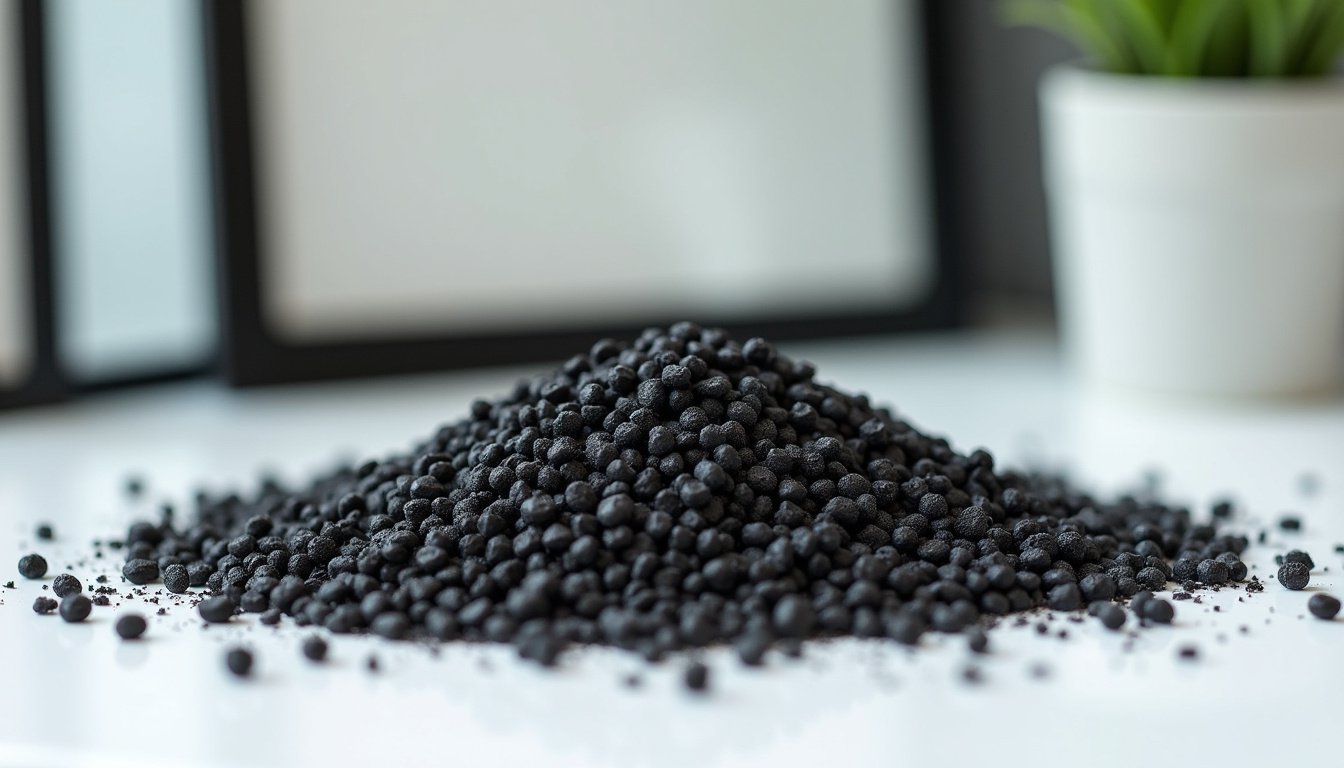
A carbon filter in an air purifier is a layer of activated carbon, charcoal processed to open an enormous network of microscopic pores, that removes gases and odors from the air passing through it. HEPA media captures particles such as dust, pollen and smoke specks; it lets gas molecules through untouched. Activated carbon works by adsorption: gas molecules stick to the vast internal surface of the carbon, a single gram of which can have the area of several hundred square meters. It handles cooking and pet odors, smoke smell, fragrance and many volatile organic compounds from paint and furniture. It does not capture particles, carbon monoxide, carbon dioxide or radon, holds small molecules such as formaldehyde poorly unless chemically treated, and has a finite capacity: once the surface is full, the filter stops working and must be replaced. Carbon quantity decides whether odor claims last weeks or months.
In short: HEPA is for particles, carbon is for smells and gases, and the carbon stage is only as good as the quantity of carbon in it.
The EPA’s guide to air cleaners in the home describes activated carbon as the common gas-phase filter in portable units, notes that its effectiveness depends on the amount and type of sorbent and the pollutant in question, and states that sorbent filters saturate and need replacement. AHAM’s CADR ratings cover particles only, so no standard rating describes carbon performance; the spec sheet’s carbon weight is the closest proxy.
This guide is research-based, drawn from the chemistry of adsorption, EPA guidance and maker specifications. We have not tested the units in the comparison table and quote no prices or ratings, only published features relevant to carbon stages.
The carbon stage matters a lot if
- Cooking, pet or smoke odors are part of why you are buying
- New furniture, paint or cleaning product fumes bother you
- You want the air to smell neutral, not just measure clean
- You live near traffic or a smoker
It matters little if
- Your concern is dust, pollen, dander or smoke particles only
- Nobody in the home notices odors
- You already ventilate well and control sources
- You would rather spend on CADR and quiet than on carbon weight
Key Takeaways
- Activated carbon removes gases and odors; HEPA removes particles. Each ignores the other’s job.
- It works by adsorption, gas molecules sticking to a vast internal surface, not by trapping anything you can see.
- Quantity decides performance: a coated pad lasts weeks, a bed of a pound or more lasts months.
- Plain carbon holds small molecules such as formaldehyde poorly; chemically treated media helps.
- Carbon does nothing for carbon monoxide, carbon dioxide, radon or natural gas.
- A saturated carbon filter looks new, stops working and can release what it holds; replace on schedule or when odors return.
- Particle sensors cannot detect gases, so auto mode will not react to smells; set a manual speed for odor work.
HEPA and Carbon Purifiers to Compare
These widely reviewed filter-based units combine true HEPA with an activated carbon stage across bedroom to large-room sizes. Compare the maker-listed carbon stage and form alongside CADR, and favor models that state a carbon weight and sell the carbon stage separately.






How This Guide Explains Carbon
We worked from the physical chemistry of activated carbon, EPA guidance on gas-phase filtration and the carbon specifications makers publish, then connected each to what an owner can expect in a room. Product details in the table come from maker specifications.
One picture carries the whole topic: a sponge. Carbon soaks up gas molecules until it is full, holds them until it is warm or overloaded, and never wrings out. Everything about choosing and maintaining a carbon stage follows from that.
What Activated Carbon Is
Activated carbon starts as a carbon-rich material, coconut shell, coal, wood or peat, that is charred and then treated with steam or chemicals at high temperature. The treatment burns out tiny channels and pores throughout the material, leaving a structure that is mostly internal surface. A gram of good activated carbon can have an internal surface area of 500 to 1,500 square meters, roughly the floor area of several houses, folded into something that fits in a teaspoon.
In a purifier the carbon appears in a few forms. Granular or pelletized carbon is loose material held in a cage or canister; it has the most carbon per filter and the longest life. Carbon sheets, honeycombs and foams bond carbon into a shape that is easier to manufacture and lighter but holds less. Carbon-coated pads sprinkle carbon dust onto a fabric or fiber layer; they contain very little carbon and are the type found in most compact units and combined cartridges.
| Form | Typical carbon amount | Where it appears | Useful life under everyday odors |
|---|---|---|---|
| Carbon-coated fabric pad | A few ounces | Compact units, combined HEPA cartridges | Weeks |
| Carbon sheet, foam or honeycomb | Several ounces to about a pound | Mid-size units | One to three months |
| Granular or pelletized bed | One to three pounds | Odor-focused mid and large units | Three to six months |
| Deep canister or drum | Three pounds and up | Large and specialty units | Six months or more |
| Chemically treated or blended media | Varies | Units targeting formaldehyde or specific gases | Similar to the bed it is part of |
How Adsorption Works
Adsorption, with a d, is different from absorption. Nothing soaks into the carbon; molecules stick to its surface, held by weak attractive forces between the molecule and the carbon. Air passes through the bed, gas molecules bump into pore walls and stay there, and the air leaves with fewer of them. Larger, heavier molecules with more surface to attract, which is what most odor compounds are, stick readily and stay. Small, light molecules barely stick and can be knocked off by heavier ones or by water vapor, which carbon also adsorbs.
That explains both what carbon is good at and where it fails. Cooking smells, pet odor, smoke odor, perfume, many solvent vapors: heavy molecules, well held. Formaldehyde, ammonia, carbon monoxide: light molecules, poorly held or not at all. Humid air competes for the same surface, which is why carbon performs worse in damp rooms and why makers suggest keeping the stage dry.
What a Carbon Filter Removes and What It Does Not
| Pollutant | Carbon captures it? | Notes |
|---|---|---|
| Cooking and food odors | Yes, well | Heavier molecules; capacity dependent |
| Pet and litter odor | Yes for most compounds; ammonia weakly | Treated media helps with ammonia |
| Tobacco and wildfire smoke smell | Yes, well | Smoke particles need HEPA; odor needs carbon |
| Perfume, fragrance, air fresheners | Yes, well | Source removal still matters |
| Paint, solvent and adhesive VOCs | Yes for heavier VOCs | Ventilation does far more |
| Formaldehyde | Poorly with plain carbon | Needs chemically treated carbon or blended media |
| Musty mold odor compounds | Partly | Fix the moisture; carbon treats the symptom |
| Dust, pollen, dander, smoke particles | No | HEPA stage does this |
| Carbon monoxide | No | CO alarms only |
| Carbon dioxide | No | Ventilation only |
| Radon | No | Testing and mitigation only |
| Natural gas | No | Leave and call the utility |
The gaps at the bottom of the table are the ones that matter for safety. A purifier with a large carbon bed still does nothing about carbon monoxide, radon or a gas leak, and its air quality light cannot see any of them.
Why the Amount of Carbon Decides Everything
Because carbon has a fixed capacity per gram, the quantity in the filter sets how much odor it can hold before it is full. A coated pad weighing a few ounces is spent in weeks in a kitchen-adjacent or pet room. A bed of two or three pounds in the same room lasts months. The difference is not quality or technology; it is simply how much sponge there is.
Makers rarely state the weight unless it is impressive, and marketing describes a few ounces on fabric and three pounds in a canister with the same phrase, carbon filter. The spec sheet, the manual or the filter’s own packaging sometimes gives a weight or describes the carbon as granular or pelletized; product photos show whether the carbon is a thin black sheet or a visibly thick cage. If none of that is available, assume the amount is small.
Worked example: a family wants a purifier for an open kitchen and living area of 14 by 20 feet, 280 square feet, with a gas range and a dog. The particle target is a dust CADR of about 190. For the odor load, a unit whose carbon is a coated pad will smell of frying within a week of every filter change; a unit with two to three pounds of granular carbon, replaced every three to four months, keeps the room neutral between meals, with the range hood doing the heavy lifting while cooking.
How Carbon and HEPA Work Together
Most purifiers stack the stages: a pre-filter for hair and lint, then HEPA for particles, then carbon for gases, or carbon before HEPA in some designs. The order matters less than the fact that both are present, since each handles what the other ignores. Smoke is the clearest case: HEPA captures the particles that make the haze and carbon adsorbs the compounds that make the smell. Clear one without the other and the room is either hazy and odorless or clear and reeking.
Combined cartridges bond the two into one replaceable part, which is convenient but means the HEPA layer is discarded whenever the thin carbon layer saturates, typically every six to eight months. Units with a separate carbon stage let you replace carbon on its own shorter schedule, roughly three to six months, and keep the HEPA for its longer interval, which usually costs less per year.
Treated Carbon and Blended Media
To capture the small molecules plain carbon misses, makers impregnate carbon with chemicals or blend it with other sorbents. Potassium permanganate, potassium iodide and amine compounds react with formaldehyde and some other light gases rather than merely holding them; activated alumina and zeolite pellets add surfaces suited to small molecules. These appear in filters marketed for formaldehyde, new-home VOCs or specific chemical sensitivities. The EPA notes that their effectiveness varies by product and that they saturate like any sorbent.
If formaldehyde from pressed-wood furniture or new flooring is the concern, look for a filter that names the target gas and describes its media, and still treat airing items out and ventilation as the main defense.
Saturation and Replacement
A carbon filter gives no visible sign of being spent. It looks the same full as new, and most purifiers have no indicator for it; the filter light is tied to the HEPA interval or a simple timer. The signs are smell: odors that used to clear begin to linger, and in a warm room a saturated bed can release some of what it holds, so the purifier briefly seems to add smell rather than remove it.
- Note the install date on the carbon frame and set a reminder at three months.
- Replace when odors return, or at the maker’s interval of roughly three to six months, whichever comes first.
- Replace sooner in kitchen-adjacent, pet, smoking or renovation rooms.
- Replace any carbon filter that smells musty or has been damp.
- Never rinse, bake or air out a carbon filter to refresh it; none of these restore capacity at home and rinsing can release held compounds.
- Buy genuine or model-specific filters; shedding black dust means a damaged or poor-quality carbon stage.
Getting the Most From a Carbon Stage
Carbon only works on air that passes through it, so the fan matters as much as the bed. Size the unit by AHAM’s rule, a dust CADR of at least two-thirds of the room’s floor area in square feet, so the room’s air reaches the carbon several times an hour. Place the unit near the odor source with a foot of clearance, close the door for quick results and run it continuously, since odor sources rarely stop.
- Set a manual medium speed as the floor; particle sensors cannot detect gases and auto mode will idle on low while the room smells.
- Use high during and after odor events, such as cooking or cleaning the litter box, then return to medium.
- Keep humidity between 30 and 50 percent; damp air competes with odors for the carbon’s surface.
- Control the source: range hood on every burner, litter scooped daily, fragrance-free products, items aired out before they come indoors.
- Keep the unit away from humidifier mist and damp floors so the carbon stays dry.
| Situation | Carbon stage that fits | Also needed |
|---|---|---|
| Bedroom, no odor issue | Thin pad is fine; spend on CADR and quiet | Nothing |
| Living area with daily cooking | One to three pounds granular | Range hood; CADR for the open area |
| Pet room or litter area | One to three pounds; treated media for ammonia | Daily scooping; washing bedding |
| Smoking room | Heavy bed, three pounds or more | Smoking outdoors is the real fix |
| New furniture or renovation | Two pounds or more; treated media for formaldehyde | Ventilation; airing items out first |
| Musty basement | One to three pounds | Dehumidifier to 30 to 50 percent; mold removal |
What a Carbon Filter Is Not
A few confusions recur. A carbon filter is not a particle filter; a purifier with only carbon does nothing for dust or dander. It is not washable; rinsing removes nothing useful. It is not an ozone or ionizer substitute, and it produces no by-products, which is one of its virtues next to electronic technologies the EPA cautions about. It is not a safety device for carbon monoxide or gas. And it is not a replacement for ventilation and source control, which remove far more gas from a home than any sorbent bed.
Used for what it is, a consumable sponge for odors and some VOCs, sized by weight for the room’s load and replaced when the smell returns, the carbon stage is a quiet, reliable part of a purifier.
How to Choose and Use a Carbon Filter in 6 Steps
- Decide whether odors or gases are part of the problem; if not, a thin carbon layer is fine and the money is better spent on CADR and quiet.
- If they are, look for a stated carbon weight, a pound or more in granular or pelletized form, and treated media if formaldehyde or ammonia is the concern.
- Prefer units with a separate carbon stage so it can be replaced alone on its shorter schedule.
- Size the fan by the two-thirds CADR rule so the room’s air reaches the carbon several times an hour.
- Run continuously on a manual medium, high after odor events, near the source with the door closed.
- Date the carbon frame, replace at three to six months or when odors return, and keep the unit dry.
Do and Do Not
Do
- Judge the carbon stage by weight.
- Pair carbon with true HEPA.
- Replace carbon when odors return.
- Set a manual speed for odor work.
- Control the source and ventilate first.
Do not
- Do not expect carbon to remove particles.
- Do not rinse, bake or air out a carbon filter.
- Do not rely on a coated pad for a kitchen or pet room.
- Do not trust auto mode to react to smells.
- Do not treat carbon as protection from CO, radon or gas.
Who Should Skip This
If dust, pollen or dander is the only concern and nobody notices odors, skip the carbon question. Any thin carbon layer that comes with the unit is harmless, and the purchase should turn on true HEPA, CADR and noise.
If the smell is natural gas, sewer gas or burning, skip the purifier entirely: leave and call the utility for gas, call a plumber for sewer odor, and unplug the suspect appliance and call an electrician for burning smells.
Honest Limits
- Carbon capacity is finite and saturation is invisible; replacement is on schedule and smell.
- Plain carbon holds light gases such as formaldehyde and ammonia poorly; treated media helps but varies by product.
- No standard rating like CADR exists for carbon performance; weight is the best proxy.
- Damp air reduces carbon’s capacity.
- A strong continuous odor source outpaces any portable unit.
- No health claims are made; odor and VOC exposure questions belong with a doctor.
When to See a Professional
Leave the home and call the gas utility for any sulfur or rotten egg smell; rely on CO alarms for carbon monoxide; call a plumber for persistent sewer odor and an electrician or the maker for burning smells. None of these are carbon filter matters.
Consult an indoor air professional or arrange a lab-analyzed formaldehyde test if VOC concerns persist after ventilation and source removal, and see a doctor for any symptoms linked to fumes. Nothing on this page is medical advice.
Frequently Asked Questions
What does a carbon filter do in an air purifier?
It removes gases and odors. Activated carbon is charcoal processed to have a vast internal surface, and gas molecules from cooking, pets, smoke, fragrance and many VOCs stick to that surface as air passes through, a process called adsorption. HEPA captures particles; carbon handles what HEPA lets through.
Is a carbon filter the same as a HEPA filter?
No. HEPA is a dense fiber mat that traps particles such as dust, pollen, dander and smoke specks, and it lets gas molecules pass untouched. Carbon adsorbs gases and odors and does nothing for particles. Most purifiers include both because each handles what the other ignores.
How much carbon should an air purifier have?
For odor work, a pound or more of granular or pelletized activated carbon; two to three pounds for kitchens, pets or smoke; more for heavy sources. Carbon-coated pads containing a few ounces saturate within weeks and are fine only where odors are not a concern.
What can a carbon filter not remove?
Particles, which need HEPA; carbon monoxide, carbon dioxide, radon and natural gas, which no purifier addresses; and small molecules such as formaldehyde and ammonia, which plain carbon holds poorly unless it is chemically treated. It also cannot keep up with strong continuous sources such as indoor smoking.
How often should a carbon filter be replaced?
Roughly every three to six months per most makers, sooner in kitchen-adjacent, pet, smoking or renovation rooms, and whenever odors that used to clear begin to linger. Coated pads are spent in weeks. Date the frame at installation, since carbon shows no visible sign of saturation.
Can I wash or reactivate a carbon filter?
No. Rinsing does not remove adsorbed molecules and can release some of them, water reduces the carbon’s capacity, and baking or airing out at home does not restore it. Carbon is a consumable; replace it with a genuine or model-specific filter.
Why does my purifier smell worse on warm days?
A saturated carbon filter in a warm room can release some of the compounds it holds, so an old carbon stage near a sunny window or heater can add odor rather than remove it. That is a clear sign the carbon is overdue for replacement.
Does the carbon filter remove formaldehyde?
Plain activated carbon holds formaldehyde poorly because the molecule is very small. Filters with chemically treated carbon or blended media such as alumina or zeolite capture it better, though the EPA notes effectiveness varies by product. Ventilation and low-emission products remain the main defense.
Why does auto mode not turn up the fan when the room smells?
Most purifier sensors count particles and cannot detect gases, so a room full of odor reads as clean air and the fan idles on low, where little air reaches the carbon. Set a manual medium speed for odor work and use high during and after odor events.
Is a carbon filter worth paying extra for?
Yes, if cooking, pet, smoke, fragrance or new-product odors are part of why you are buying, and only if the extra buys a real carbon bed measured in pounds rather than a coated pad. If the concern is dust, pollen or dander alone, spend on CADR and quiet instead.
Bottom Line
A carbon filter in an air purifier is a bed of activated carbon that pulls gases and odors out of the air by adsorption, doing the one job the HEPA stage cannot. It handles cooking, pet, smoke and fragrance smells and many VOCs, misses particles and the dangerous gases entirely, and holds small molecules like formaldehyde only when chemically treated. Its performance is set almost entirely by how much carbon it contains.
Buy it by weight when odors matter, pair it with true HEPA and a CADR sized for the room, run it on a manual speed, keep it dry and replace it when the smell comes back. Treated as the consumable sponge it is, and backed by ventilation and source control, the carbon stage keeps a room smelling as clean as it measures.
Related reading: What type of air purifier is best for odors, Air purifier carbon filter problems, Can air purifiers reduce VOCs.