
Last updated:
As an Amazon Associate we earn from qualifying purchases. This does not change what we recommend. See our affiliate disclaimer.
A sour, sharp smell from an air purifier, the kind people describe as vinegar, pickles or something gone off, is unsettling because a purifier is supposed to remove smells, not make them. It is also one of the more specific odors a unit can produce, which narrows the search considerably. Most of the time the source is moisture meeting an organic filter, and most of the time the fix is a new filter and a drier spot.
An air purifier that smells like vinegar is usually telling you that something in it has been damp. The leading cause is a filter, HEPA or carbon, that has absorbed moisture from a humidifier nearby, a steamy bathroom, a damp basement, a spill or wet storage, and has begun to grow bacteria or mold that produce sour, acidic odors. A saturated carbon filter in a warm room can release acidic compounds it has adsorbed, including those from cooking, which can read as vinegar. Less often the smell comes from outside the unit and is being pulled through it: vinegar-based cleaners used nearby, fermenting food waste, a pet accident on carpet, or a drain.
In short: unplug, smell the filters, replace anything damp or musty, move the unit away from moisture and check the room for a vinegar source. If the smell is sharp and the housing is warm, stop and contact the maker.
Maker manuals are consistent that filters must be kept dry, that HEPA and carbon stages are never washed, and that a unit with an unusual smell or any sign of overheating should be unplugged and the maker contacted. The EPA’s mold guidance notes that damp materials can grow mold within 24 to 48 hours and recommends keeping indoor humidity between 30 and 50 percent.
This guide is research-based, drawn from maker manuals, EPA guidance and the chemistry of damp filters and saturated carbon. We have not tested the units in the comparison table and quote no prices or ratings. Nothing here involves opening the unit beyond the filter compartment.
Likely a damp or spent filter if
- The purifier sits near a humidifier, bathroom or damp basement
- The smell is strongest at the outlet when the fan starts
- The filter smells sour or musty when removed
- The carbon stage is past its 3 to 6 month interval
Look outside the unit or stop and call if
- The room smells of vinegar even with the purifier off
- Vinegar cleaners or fermenting food are nearby
- The housing is warm or discolored, or the fan sounds different
- There is any hint of burning, smoke or sparking
Key Takeaways
- A vinegar smell from a purifier almost always means moisture has reached a filter and something is growing on it.
- Carbon filters past their interval can release sour compounds in warm rooms; replace them.
- A filter that smells sour or musty when removed is replaced, never washed or dried and reused.
- Keep the unit away from humidifiers, steam, damp floors and spills; hold humidity at 30 to 50 percent.
- Check the room for vinegar sources being pulled through the intake: cleaners, food waste, pet accidents, drains.
- New units and filters can off-gas a faint sour note for a few days; run them in a ventilated room first.
- Any smell with heat, discoloration or a change in fan sound is treated as electrical: unplug and contact the maker.
Filter-Based Purifiers to Compare
If a persistently sour unit is heading for retirement, these widely reviewed filter-based models use true HEPA with carbon and have accessible filter bays that are easy to keep dry and inspect. Compare maker-listed CADR against your room and keep any new unit well away from humidifiers.






How This Guide Approaches the Smell
We listed the ways a purifier can produce or transmit a sour, acidic odor, sorted them into things inside the unit and things in the room, and matched each to its clues and fix. Safety symptoms are separated out because the response is to stop. Product details in the table come from maker specifications.
The organizing question is where the smell comes from. Remove the filters and smell each one, then smell the empty housing, then the room with the unit off. The answer is usually in one of those three places.
First Steps
- Note whether the smell is sour and vinegary, musty and earthy, or hot and plastic-like. Hot plastic, burning or a sharp metallic edge is not a filter problem; unplug and skip to the safety section.
- Unplug the unit.
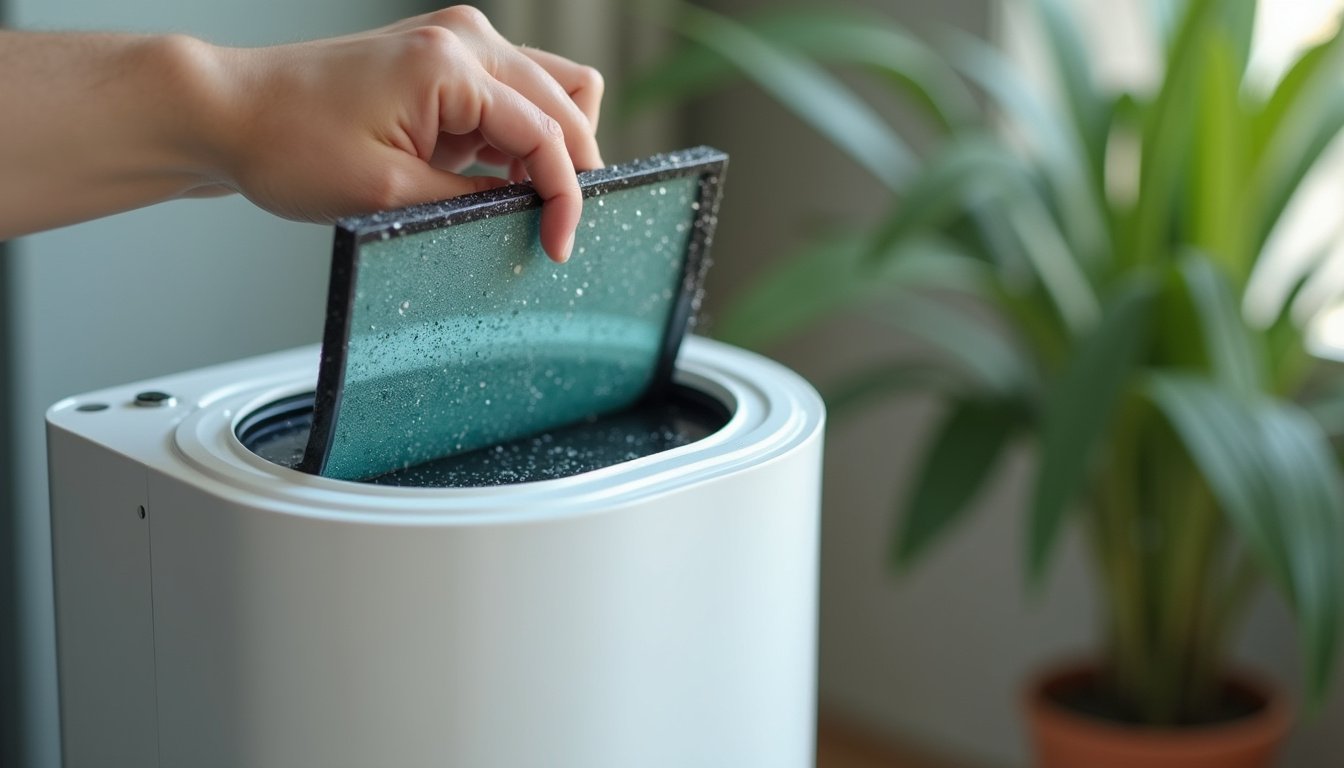
- Remove the pre-filter, HEPA and carbon stages one at a time and smell each from a short distance.
- Smell the empty filter bay and fan area.
- Switch the unit off and leave the room for ten minutes, then return and smell the room itself.
- Look around the unit for moisture: a humidifier, a steamy doorway, condensation on the floor, a plant that is watered nearby, a spill.
Quick Diagnosis Table
| What you find | Likely cause | Fix |
|---|---|---|
| HEPA or pre-filter smells sour or musty | Filter has been damp; microbial growth | Replace the filter; remove the moisture source |
| Carbon filter smells sour; it is months old | Saturated carbon releasing acidic compounds | Replace the carbon stage |
| Filters smell fine; housing smells sour | Moisture or residue in the bay or fan | Wipe housing with mild soapy water on a cloth; dry fully |
| Room smells of vinegar with the unit off | External source pulled through the unit | Find and remove the source; ventilate |
| New unit or new filter, faint sour note, fades | Off-gassing | Run in a ventilated room for a day or two |
| Smell plus warm housing or changed fan sound | Electrical fault | Unplug; contact the maker |
| Smell appears only when humidity is high | Damp filter in a humid room | Dehumidify to 30 to 50 percent; replace filter if it persists |
Cause 1: A Filter That Has Been Damp
HEPA and pre-filter media are fibrous and absorbent. In a humid room, next to a humidifier, in a steamy bathroom doorway or after a spill, they take on moisture, and the dust they hold provides nutrients. Within a day or two bacteria and mold can begin growing, and their by-products include acetic and other organic acids that smell distinctly sour. The fan then blows that smell into the room every time it starts, which is why the odor is often strongest at startup.
The fix is replacement. A filter that smells sour cannot be dried and reused; the growth is in the media and drying does not remove it, and washing damages HEPA fibers and voids warranties. Replace any filter that smells wrong regardless of age, wipe the housing with a cloth dampened with mild soapy water, dry it thoroughly, and address the moisture before fitting new filters.
- Move the purifier at least several feet from any humidifier and out of the direct path of its mist.
- Keep it out of bathroom doorways and off damp floors; set it on a stand in basements.
- Hold indoor humidity between 30 and 50 percent, as the EPA recommends, with ventilation or a dehumidifier.
- Store spare filters sealed in a dry closet, not a basement or garage.
- Never refit a filter that has caught a spill or been rinsed.
Cause 2: A Saturated Carbon Filter
Activated carbon adsorbs odor molecules until its surface is full. In a warm room a saturated filter can release some of what it holds, and if the household load has included cooking, especially frying and vinegar-based dishes, fermented foods, or acidic cleaning products, the released mix can read as sour. Carbon also adsorbs water vapor, and a damp carbon stage can host the same microbial growth as a damp HEPA.
Check the carbon stage’s age against the maker’s three to six month interval and against when the smell began. If it is near or past the interval, replace it; carbon cannot be refreshed by airing, rinsing or baking at home. Date the new filter and set a reminder, and where the carbon is separate from the HEPA, replacing it alone is enough.
Cause 3: The Smell Is in the Room
A purifier concentrates and redistributes the room’s air, so an odor source nearby can seem to come from the unit. Vinegar-based cleaners and descalers, a compost bin or fruit bowl past its best, a pet accident soaked into carpet, a floor drain or dishwasher with a sour trap, a wine or kombucha project, and sour laundry left damp all produce acetic or similar odors that the fan pulls in and pushes out.
Switch the purifier off, leave the room for ten minutes and come back. If the room still smells of vinegar, the source is external. Find and remove it, ventilate, and if the unit has real carbon it will help clear what remains; a thin carbon pad will saturate quickly on a strong source, so fix the source first.
| External source | How it reaches the purifier | Fix |
|---|---|---|
| Vinegar or acidic cleaner used nearby | Vapor drawn into the intake | Ventilate; let surfaces dry; clean away from the unit |
| Food waste, fruit, fermenting projects | Volatile acids in the air | Remove or seal; ventilate |
| Pet accident in carpet | Bacterial breakdown produces sour odors | Enzyme cleaner; dry; HEPA vacuum |
| Dry or dirty drain trap | Sewer-adjacent sour odor | Run water; clean trap; plumber if persistent |
| Damp laundry or towels | Mildew and sour smell | Wash hot and dry fully |
| HVAC drain pan or coil | Sour, musty air from vents | HVAC technician |
Cause 4: A New Unit or New Filter
New purifiers and new filters can carry a faint sour, chemical or dusty smell from binders, adhesives and packaging. It is usually mild and fades within a few days of running. Run a new unit or a freshly fitted filter on high in a well-ventilated room, or an unoccupied one, for a day or two before moving it into a bedroom.
A new filter that smells strongly sour or of solvent, or whose smell does not fade in a week, may be low quality or counterfeit, or may have been stored damp before sale. Return it and buy the maker’s part.
| Smell | Character | Likely source | Response |
|---|---|---|---|
| Vinegar, sour, pickled | Organic, acidic | Damp filter growth or saturated carbon | Replace filters; dry; move from moisture |
| Musty, earthy | Organic, damp | Mold in a damp filter or room | Replace filters; dehumidify; check the room |
| Sharp, metallic, after a storm | Clean-sharp | Ozone from an ion or UV feature | Switch the feature off |
| New plastic, dusty, faint sour | Chemical, fades | Off-gassing of a new unit or filter | Ventilate; fades in days |
| Hot plastic, burnt, acrid | Burning | Electrical fault | Unplug; contact the maker |
A Note on Sharp, Metallic Smells
Some owners describe ozone as sour or sharp. If the unit has an ionizer, plasma or UV feature and the smell is clean-sharp, metallic or like the air after a thunderstorm rather than sour-organic like vinegar, suspect ozone from that feature. The EPA advises against ozone-generating air cleaners in occupied spaces; switch the feature off and leave it off. The filtration continues unaffected.
If switching the feature off ends the smell, the diagnosis is made. If the smell is distinctly vinegary and organic, return to the filter and moisture causes above.
Cleaning the Housing After a Sour Filter
- Unplug and remove all filters; bag any that smelled wrong.
- Wipe the filter bay, grilles and fan blades you can reach with a cloth dampened with warm water and a drop of mild dish soap, then a dry cloth. Do not spray liquid into the fan or electronics.
- Clean the sensor inlet with a dry swab only.
- Let the housing air dry completely, ideally overnight with the cover open.
- Fit new filters, latch the cover until it clicks, and run on high in a ventilated room for an hour.
- Smell the outlet; a faint new-filter note is normal and fades, a sour note means moisture remains or another filter is affected.
Worked example: a bedroom purifier placed beside a cool-mist humidifier began to smell of vinegar at startup after a humid month. The HEPA filter smelled sour when removed; the carbon stage was six months old and stale. Both were replaced, the housing wiped and dried overnight, and the humidifier moved across the room. The smell did not return, and the hygrometer showed the room had been sitting at 60 percent, which the owner brought down to 45 with a dehumidifier.
Preventing It Next Time
- Keep the purifier several feet from humidifiers, bathroom doors, kitchens and damp floors; set it on a stand in basements.
- Hold indoor humidity at 30 to 50 percent and check with a hygrometer.
- Replace carbon on its 3 to 6 month interval and date the frame.
- Inspect and smell filters every two to three months as part of the maintenance routine.
- Store spares sealed and dry.
- Address pet accidents, drains and damp laundry promptly so the purifier is not asked to mask them.
- Run new units and filters in a ventilated room first.
How to Fix a Vinegar Smell in 6 Steps
- Check for heat, discoloration, a changed fan sound or any burnt quality; if present, unplug and contact the maker and stop here.
- Unplug, remove each filter and smell it; replace any that smell sour, musty or stale, and replace carbon that is near or past its 3 to 6 month interval.
- Wipe the housing and reachable fan blades with mild soapy water on a cloth, dry fully, and clean the sensor inlet with a dry swab.
- Switch the unit off for ten minutes and smell the room; if it still smells of vinegar, find and remove the external source.
- Move the purifier away from humidifiers, steam and damp floors, and bring room humidity to 30 to 50 percent.
- Fit new filters, run on high in a ventilated room for an hour, and confirm the outlet smells neutral.
Do and Do Not
Do
- Smell each filter individually.
- Replace any damp, sour or musty filter.
- Dry the housing fully before refitting filters.
- Keep the unit away from moisture sources.
- Date and replace carbon on schedule.
Do not
- Do not wash or dry and reuse a sour filter.
- Do not spray cleaners or deodorizers into the unit.
- Do not run a unit that is warm or smells burnt.
- Do not place the purifier in a humidifier’s mist.
- Do not use ozone or fragrance features to mask the smell.
Who Should Skip This
If the housing is warm, discolored or the fan sounds different, skip every filter check. Unplug the unit, do not run it again and contact the maker; that is an electrical matter regardless of what the smell resembles.
If the room smells of vinegar with the purifier switched off, skip replacing filters until the external source is found and removed. New filters in a room with an active source will simply absorb the same smell.
Honest Limits
- Smell descriptions are subjective; sour, musty and sharp overlap, so use the filter-by-filter check rather than the name of the smell.
- A replaced filter will smell sour again if the moisture source remains.
- Carbon cannot be refreshed at home; replacement is the only remedy for a saturated stage.
- Cleaning the housing removes residue but not growth inside media; filters are replaced.
- Electrical odors can be subtle; when in doubt, treat warmth or discoloration as decisive.
- Nothing here applies to the humidifier reservoir or wick on combination units, which have their own cleaning rules and are a common sour-smell source.
When to See a Professional
Contact the maker and stop using the unit for any smell accompanied by warmth, discoloration, a changed fan sound, smoke or sparking, and for a genuine new filter that smells strongly within a week. Call a plumber for sour drain odors that persist and an HVAC technician for sour air from vents.
See a doctor if anyone develops respiratory symptoms after exposure to a musty or sour purifier, and call a mold professional for visible growth over about 10 square feet in the room, as the EPA suggests. Nothing on this page is medical advice.
Frequently Asked Questions
Why does my air purifier smell like vinegar?
Most often a filter has been damp, from a humidifier, steam, a damp room or a spill, and bacteria or mold growing in it produce sour acidic odors. A saturated carbon filter in a warm room can also release sour compounds. Unplug, smell each filter, replace any that smell wrong and move the unit.
Is a vinegar smell from a purifier dangerous?
The smell itself usually indicates a damp or spent filter rather than a hazard, but a filter growing mold should be replaced promptly. A smell paired with a warm housing, discoloration, a changed fan sound or any burnt quality is an electrical concern: unplug and contact the maker.
Can I dry out or wash the filter to get rid of the smell?
No. Growth in a damp filter is inside the media and does not leave when it dries, and washing damages HEPA fibers and voids warranties. Carbon cannot be refreshed by rinsing or airing. Replace any filter that smells sour or musty and fix the moisture source.
Why does the smell come mostly when the fan starts?
Odors build up inside the housing and filters while the unit is off, and the first burst of airflow pushes them out. A sour puff at startup that fades points to the filters or housing rather than the room, and smelling the filters individually will usually find the culprit.
Could a saturated carbon filter smell like vinegar?
Yes. Once activated carbon is full, a warm room can cause it to release some of the compounds it holds, including acidic ones from cooking and cleaning. Check its age against the maker’s 3 to 6 month interval and smell it directly; a sour or stale note means replace it.
How do I know if the smell is from the room instead?
Switch the purifier off, leave the room for ten minutes and return. If it still smells of vinegar, the source is external: vinegar cleaners, food waste, a pet accident in carpet, a drain or damp laundry. Remove the source and ventilate before judging the purifier.
A new purifier smells slightly sour. Is that normal?
A faint sour, chemical or dusty note from binders and packaging is common for the first few days and fades. Run the unit on high in a ventilated or unoccupied room for a day or two. A strong solvent smell, or one that lasts beyond a week, suggests a low-quality filter or a damp one.
How do I clean the inside of the purifier after a sour filter?
Unplug, remove and bag the filters, wipe the bay, grilles and reachable fan blades with a cloth dampened with mild soapy water, then dry with a cloth and leave the cover open overnight. Clean the sensor inlet with a dry swab. Never spray liquid into the fan or electronics.
How do I stop the vinegar smell coming back?
Keep the purifier several feet from humidifiers, steam and damp floors, hold room humidity at 30 to 50 percent, replace carbon on its 3 to 6 month interval, inspect and smell filters every two to three months, and store spares sealed and dry. Fix pet accidents and drain odors promptly.
Could the smell be ozone from an ionizer instead?
If the unit has an ionizer, plasma or UV feature and the smell is sharp and metallic rather than sour and organic, it may be ozone, which the EPA advises against in occupied spaces. Switch the feature off and leave it off; filtration is unaffected. A true vinegar smell points to damp or spent filters.
Bottom Line
A purifier that smells like vinegar has almost always been asked to run damp. A filter that absorbed moisture from a humidifier, a steamy doorway or a basement floor has started to grow something sour, or a carbon stage past its interval is giving back what it took in. Smell each filter, replace the ones that are wrong, wipe and dry the housing and move the unit somewhere drier, with the room held at 30 to 50 percent humidity.
Rule out the room and the electrics along the way: a vinegar smell with the unit off is a source in the room, and any smell with a warm housing or a changed fan sound is a maker conversation, not a filter change. Done in that order, the sour purifier is a new-filter problem, and a drier spot keeps it from coming back.
Related reading: Air purifier causing a chemical smell, Air purifier carbon filter problems, Air purifier leaking oil or greasy liquid.