Last updated:
As an Amazon Associate we earn from qualifying purchases. This does not change what we recommend. See our affiliate disclaimer.
A purifier with a washable filter sounds like the end of a recurring bill. Rinse it in the sink, let it dry, slide it back in, and never buy a replacement again. Some of that is true, some of it is a labeling trick, and the difference decides whether you end up with a cheaper purifier or a worse one.
Air purifiers with washable filters fall into two groups. In the first, which includes most quality units, the washable part is the pre-filter, a coarse mesh or foam layer that catches hair, lint and large dust in front of a true HEPA stage that is not washable and is replaced on the maker’s schedule. That design is excellent: the washable layer takes the bulk of the load, extends HEPA life and costs nothing to maintain. In the second group, the main filter itself is marketed as washable or permanent. Those filters are not true HEPA; they are looser electrostatic or foam media that captures less fine dust, and washing degrades them further over time. True HEPA media cannot be washed, because water damages the fine fibers and leaves moisture in the mat. So the right purifier with a washable filter is one with a washable pre-filter and a replaceable true HEPA stage, not one that promises you will never buy a filter again.
In short: washable pre-filter, yes; washable HEPA, no such thing. Choose a unit that has the first and is honest about the second.
The EPA’s guide to air cleaners in the home describes HEPA filtration as effective for household particles and advises following the manufacturer’s maintenance instructions, which for every true HEPA filter means replacement, not washing. Permanent filter claims should be read against that: if the main filter can be washed, it is not HEPA.
This guide is research-based, drawn from filter standards, maker manuals and EPA guidance, plus maker specifications for the units in the comparison table, which we have not tested and for which we quote no prices or ratings.
A washable pre-filter design suits you if
- Pets, carpet or dust load filters quickly in your home
- You want to cut yearly filter cost without giving up true HEPA
- You will rinse or vacuum the pre-filter every two to four weeks
- You accept replacing the HEPA stage every 6 to 12 months
Be wary of permanent filter units if
- Fine dust, smoke or allergies are the reason you are buying
- The listing says washable HEPA or permanent HEPA
- No replacement filter is sold at all
- The media is a thin foam or electrostatic sheet
Key Takeaways
- True HEPA filters are never washable; water damages the fibers and leaves moisture in the media.
- The washable part of a good purifier is the pre-filter, which protects the HEPA stage and extends its life.
- Permanent or washable main filters use looser media that captures less fine dust and degrades with washing.
- A washable pre-filter in a pet or carpet home can noticeably extend the HEPA interval.
- Rinse or vacuum the pre-filter every two to four weeks and dry it fully before refitting.
- Carbon stages are not washable either; rinsing removes nothing adsorbed and can release it.
- Judge any unit by true HEPA plus CADR first, then by whether the pre-filter is washable.
Purifiers With Washable Pre-Filters to Compare
These widely reviewed filter-based units pair a replaceable true HEPA stage with activated carbon, and many include a washable or vacuumable pre-filter layer. Compare the maker-listed CADR and room size against your space and check the manual for which layer is washable.






How We Approached Washable Filters
We separated the filter layers in a typical purifier, checked which can tolerate water according to filter standards and maker manuals, and looked at how permanent filter units are built. Product details in the table come from maker specifications.
The rule to carry through: the finer the filter, the less it can be washed. Coarse mesh survives the sink; HEPA media does not.
What Washable Actually Means
A purifier typically has up to four layers: a pre-filter for hair and lint, a HEPA stage for fine particles, a carbon stage for gases and odors, and sometimes a mesh or foam outer screen. Only the coarsest layers tolerate washing. A pre-filter made of plastic mesh, nylon or open-cell foam can be rinsed, dried and reused many times. HEPA media, a dense mat of glass or synthetic microfibers, is damaged by water: fibers break, the mat compresses, and moisture trapped inside can grow mold. Carbon is porous and holds what it has adsorbed; rinsing does not clean it and can release trapped compounds.
| Layer | Material | Washable? | Maintenance |
|---|---|---|---|
| Outer screen or pre-filter | Plastic or nylon mesh, open foam | Yes | Rinse or vacuum every 2 to 4 weeks; dry fully |
| Disposable pre-filter | Thin fiber sheet | No; may be vacuumed gently | Replace every 3 to 6 months |
| True HEPA | Dense microfiber mat | Never | Replace every 6 to 12 months per maker |
| Activated carbon | Granules or coated sheet | No | Replace every 3 to 6 months |
| Permanent or washable main filter | Electrostatic or foam media, not HEPA | Yes, with declining performance | Rinse monthly; expect lower capture |
When a listing says washable filter, find out which layer it means. A washable pre-filter in front of a replaceable HEPA stage is the design to want.
Why True HEPA Cannot Be Washed
True HEPA media is rated to capture 99.97 percent of particles at 0.3 microns under test conditions, and it achieves that with fibers far finer than a human hair packed into a deep, pleated mat. Water wets and clumps those fibers, pulls the mat out of shape as it dries, and leaves channels through which air and particles pass unfiltered. The dust the filter has captured does not rinse out; it mats into the fibers. Any moisture left inside becomes a place for mold to grow, which then releases spores and a musty smell into the room the purifier is meant to clean.
Makers state plainly in manuals that HEPA filters must not be washed, and washed filters are excluded from warranty. Blowing them out with compressed air is also discouraged, since it drives particles deeper and can tear pleats. A loaded HEPA filter is replaced; there is no restoring it.
How Permanent Filter Purifiers Work
Units sold with permanent or lifetime filters usually use one of two approaches. Electrostatic filters are layers of charged plastic fibers or mesh that attract particles; they capture coarse dust well when clean and lose efficiency as they load and as repeated washing dissipates the charge. Foam or thick mesh filters are essentially large pre-filters, capable of catching hair and lint but passing most particles under a few microns. Some pair these with an ionizer to improve the numbers, which brings the EPA’s caution about ozone from electronic cleaners into play.
These units have a place: a workshop, a garage or a room where visible dust and hair are the only concern and running cost must be near zero. They are the wrong tool for allergies, smoke, fine dust or anyone with a lung condition, because the fine fraction that matters most is what they miss.
| Design | Fine particle capture | Washing effect | Best use | Avoid for |
|---|---|---|---|---|
| Replaceable true HEPA with washable pre-filter | Excellent | Pre-filter only; no effect on HEPA | Bedrooms, allergies, smoke, general use | Nothing in particular |
| Permanent electrostatic main filter | Fair when new, declining | Gradually reduces charge and capture | Coarse dust, hair, workshops | Allergies, smoke, fine dust |
| Permanent foam or mesh main filter | Poor for fine particles | Little effect; it never captured fines | Garage, hair and lint | Any health-driven use |
| Permanent filter plus ionizer | Fair; relies on ionizer | Same as above | Not recommended for homes | Asthma and allergy households |
The Real Benefit: Washable Pre-Filters
In a home with pets, carpet or heavy dust, the pre-filter does a surprising share of the work. Hair, lint, large fibers and coarse dust that would otherwise mat the face of the HEPA stage are caught on the mesh and rinsed away. That keeps airflow up, keeps the fan quiet and lets the HEPA stage reach the long end of the maker’s 6 to 12 month interval instead of the short end.
Worked example: a two-dog household runs a bedroom purifier continuously. The maker rates the HEPA stage at 12 months assuming a clean pre-filter. With the washable pre-filter rinsed every two weeks, the HEPA stage still looks reasonable at ten months. The same unit with the pre-filter neglected would likely need a HEPA change at six or seven months, the fan would be louder in the meantime, and the owner would be paying for an extra filter a year.
How to Wash a Pre-Filter Properly
- Unplug the unit and remove the pre-filter per the manual; note how it was oriented.
- Vacuum it first with a brush attachment to remove loose hair and dust.
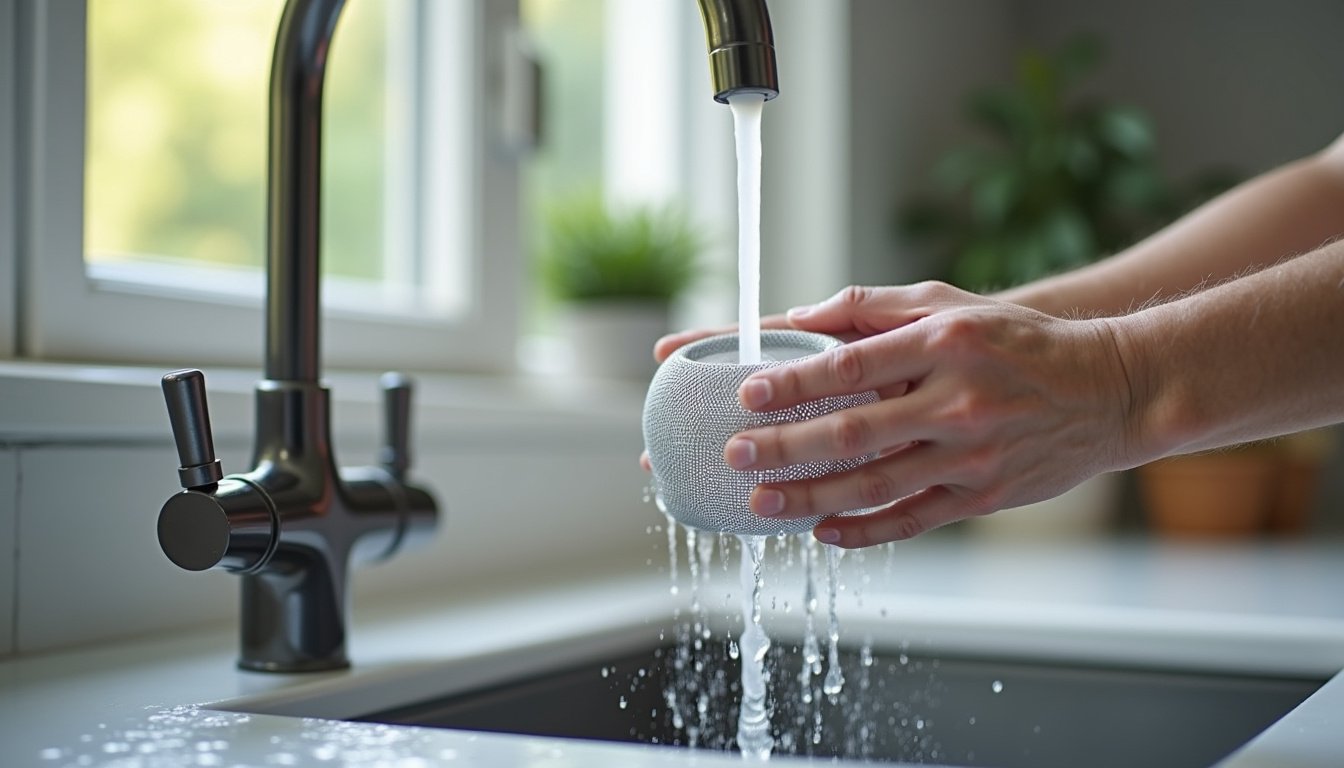
- Rinse under cool or lukewarm running water from the clean side toward the dirty side; use a drop of mild dish soap only if the manual allows.
- Do not scrub hard or use brushes on foam, which tears; do not use hot water, which can warp plastic mesh.
- Shake off excess water and let it air dry completely, usually several hours to a day, on a towel out of direct sun.
- Refit only when fully dry; a damp pre-filter puts moisture directly in front of the HEPA stage.
- Close the cover until it clicks and reset any pre-filter reminder if the unit has one.
What Not to Wash and Why
- HEPA filters: fibers damaged, mat deformed, moisture retained, warranty voided. Replace instead.
- Carbon filters: rinsing does not remove adsorbed compounds and can release them; moisture also reduces adsorption. Replace instead.
- Disposable fiber pre-filters: they fall apart when wet; vacuum gently or replace.
- Combined cartridges: the HEPA and carbon layers make the whole cartridge unwashable even if it has a mesh face.
- Sensor inlets: dry swab only; liquids damage the optics.
- The housing interior: wipe with a damp cloth, never spray or rinse near the fan or electronics.
A useful test is to ask whether the layer would survive a normal shower. Plastic mesh and open foam do. Paper-like, fibrous or granular media do not.
Choosing a Purifier With a Washable Filter
Start with the same fundamentals as any purifier: a true HEPA main stage in a sealed housing, a dust CADR of at least two-thirds of the room’s floor area in square feet so it meets AHAM’s rule of thumb on a quiet speed, and no ozone-producing features. Then look for a pre-filter described as washable or reusable, ideally one that comes off without tools and is sold separately as a spare. Check the HEPA interval and the price of the HEPA replacement, because that is the recurring cost the washable pre-filter is protecting.
| Check | What to look for | Why |
|---|---|---|
| Main filter | True HEPA or H13, replaceable | Fine particle capture |
| Pre-filter | Washable mesh or foam, tool-free removal | Cuts cost and protects HEPA |
| Carbon | Separate stage if odors matter | Replace on its own schedule |
| CADR | At least two-thirds of floor area | Enough cleaning on a quiet speed |
| Indicators | Separate pre-filter and HEPA reminders if available | Prompts the right task |
| Spares | Pre-filter sold separately | Swap while one dries |
| Marketing | No washable HEPA or permanent HEPA claims | Honest about replacement |
What a Washable Pre-Filter Saves
Disposable pre-filters are typically replaced every three to six months, so a washable one removes two to four small purchases a year. The larger saving is indirect: a clean pre-filter lets the HEPA stage reach its full interval, which in a pet or dusty home can mean one fewer HEPA filter a year. Against that, washing costs a few minutes every two to four weeks. For most households the washable design wins on cost without any compromise in filtration, because the HEPA stage is unchanged.
The false economy is the permanent main filter. It removes the HEPA bill entirely by removing the HEPA, and the money saved is paid back in fine dust that stays in the air.
How to Choose and Care for a Washable-Filter Purifier in 6 Steps
- Confirm the main filter is true HEPA and replaceable; walk away from washable HEPA or permanent HEPA claims.
- Check that the pre-filter is washable mesh or foam and removes without tools.
- Size the unit by CADR, at least two-thirds of the room’s floor area, so it runs quietly.
- Buy a spare pre-filter so one can dry while the other works.
- Rinse or vacuum the pre-filter every two to four weeks, dry it fully and refit.
- Replace the HEPA stage on the maker’s schedule or when the pleats are gray, and the carbon when odors return.
Do and Do Not
Do
- Wash the pre-filter, not the HEPA.
- Dry the pre-filter completely before refitting.
- Vacuum before rinsing to remove hair.
- Keep a spare pre-filter.
- Replace HEPA and carbon on schedule.
Do not
- Do not wash HEPA or carbon filters.
- Do not buy a permanent main filter for allergies, smoke or fine dust.
- Do not use hot water or stiff brushes on foam or mesh.
- Do not refit a damp pre-filter.
- Do not run the unit without its pre-filter to boost airflow.
Who Should Skip This
If the room is a workshop, garage or utility space where sawdust, hair and lint are the whole problem and nobody with allergies or asthma spends time there, a permanent electrostatic or foam filter unit can be a reasonable low-cost choice. Expect it to miss fine dust and skip any ionizer feature.
If you simply want to avoid filter purchases altogether, skip the purifier aisle and consider a pleated MERV 11 to 13 HVAC filter instead where the system supports it, as the EPA suggests. It still needs replacing, but it covers every room and is often the better value than a permanent-filter purifier.
Honest Limits
- No true HEPA filter is washable; any unit claiming otherwise uses lesser media.
- Washable pre-filters catch coarse material only; they do not change what the HEPA stage captures.
- Permanent electrostatic filters lose efficiency with loading and repeated washing.
- A damp pre-filter refitted too soon puts moisture in front of the HEPA stage.
- Carbon stages cannot be renewed by rinsing.
- Savings from washable pre-filters are real but modest; the HEPA replacement remains the main cost.
When to See a Professional
See a doctor or allergist if you are choosing a purifier for symptoms; for fine particle triggers a replaceable true HEPA stage is the appropriate design, and a purifier of any kind is a supporting measure. Nothing on this page is medical advice.
Contact the maker, not a home repair, for a unit that smells musty after a filter was washed, that will not seat a replacement filter, or that shows any electrical symptom; stop using it for burning smells or sparking.
Frequently Asked Questions
Can you wash a HEPA filter in an air purifier?
No. True HEPA media is a dense mat of microfibers that water damages: fibers clump, the mat deforms and moisture left inside can grow mold. Makers exclude washed filters from warranty. Only the pre-filter, if the manual says it is washable, should be rinsed; the HEPA stage is replaced.
What does washable filter mean on an air purifier?
Usually that the pre-filter, a coarse mesh or foam layer in front of the HEPA stage, can be rinsed and reused. Check which layer the listing means. If it claims the main filter is washable or permanent, the media is not true HEPA and captures less fine dust.
Are permanent filter air purifiers any good?
For coarse dust, hair and lint in a workshop or garage, they can be a low-cost choice. For allergies, smoke, fine dust or any health-driven use they are the wrong tool, because electrostatic and foam media miss the fine fraction and lose efficiency with loading and washing.
How often should I wash the pre-filter?
Every two to four weeks in a typical home, every two weeks with pets or carpet. Vacuum it first, rinse under cool water, let it dry completely, usually several hours to a day, and refit. A clean pre-filter keeps airflow up and extends the HEPA stage’s life.
Does a washable pre-filter really save money?
Yes, modestly and indirectly. It removes two to four disposable pre-filter purchases a year, and by keeping hair and coarse dust off the HEPA stage it helps that filter reach the long end of its 6 to 12 month interval, which in pet or dusty homes can mean one fewer HEPA filter a year.
Can I wash the carbon filter?
No. Activated carbon holds adsorbed odor compounds in its pores; rinsing does not remove them, can release some, and moisture reduces the carbon’s capacity. Replace the carbon stage on the maker’s schedule or when odors return, typically every 3 to 6 months.
What happens if I wash a HEPA filter anyway?
Capture drops as fibers break and channels form, airflow may fall as the mat compresses, and trapped moisture can grow mold that releases spores and a musty smell. The warranty is usually void. If a HEPA filter has been washed or has become wet, replace it.
Can I run the purifier without the pre-filter to get more airflow?
Not advisable. The HEPA stage then takes the full hair and lint load and clogs in a fraction of its rated life, the fan gets louder sooner, and some units run less stably without the pre-filter frame holding the main filter. Refit a clean, dry pre-filter.
How do I know if my unit’s main filter is true HEPA?
Look for true HEPA or H13 in the specifications and a stated replacement interval; true HEPA is always replaceable. If the main filter is described as washable, permanent or lifetime, or the only maintenance is rinsing, the media is electrostatic or foam, not HEPA.
What is the best setup for a dusty, pet-filled home?
A replaceable true HEPA stage protected by a washable mesh or foam pre-filter, a separate carbon stage if odors matter, a dust CADR of at least two-thirds of the room’s floor area, and a spare pre-filter. Rinse the pre-filter every two weeks and replace the HEPA on evidence and schedule.
Bottom Line
An air purifier with a washable filter is a good idea when the washable part is the pre-filter and a bad idea when it is the whole filter. Mesh and foam pre-filters survive the sink, catch the hair and coarse dust that would otherwise choke the HEPA stage, and quietly cut the yearly filter bill. True HEPA media never survives washing, and any unit that says it does is using something less.
Choose true HEPA in a sealed housing, sized by CADR, with a washable pre-filter you can remove without tools and a spare to swap in while one dries. Rinse every two to four weeks, dry fully, and replace the HEPA and carbon on schedule. That is the version of never buying a filter again that actually works.
Related reading: How long do HEPA filters last in air purifiers, Air purifier maintenance cost, Air purifier maintenance checklist.