Last updated:
As an Amazon Associate we earn from qualifying purchases. This does not change what we recommend. See our affiliate disclaimer.
Somewhere between the instinct to save electricity and the instinct to get full value from a purchase sits the most common question purifier owners ask: should the thing run all day, or only when the air seems bad? Makers tend to say always; skeptical owners suspect that is a way to sell filters. The physics of indoor particles settles it fairly cleanly.
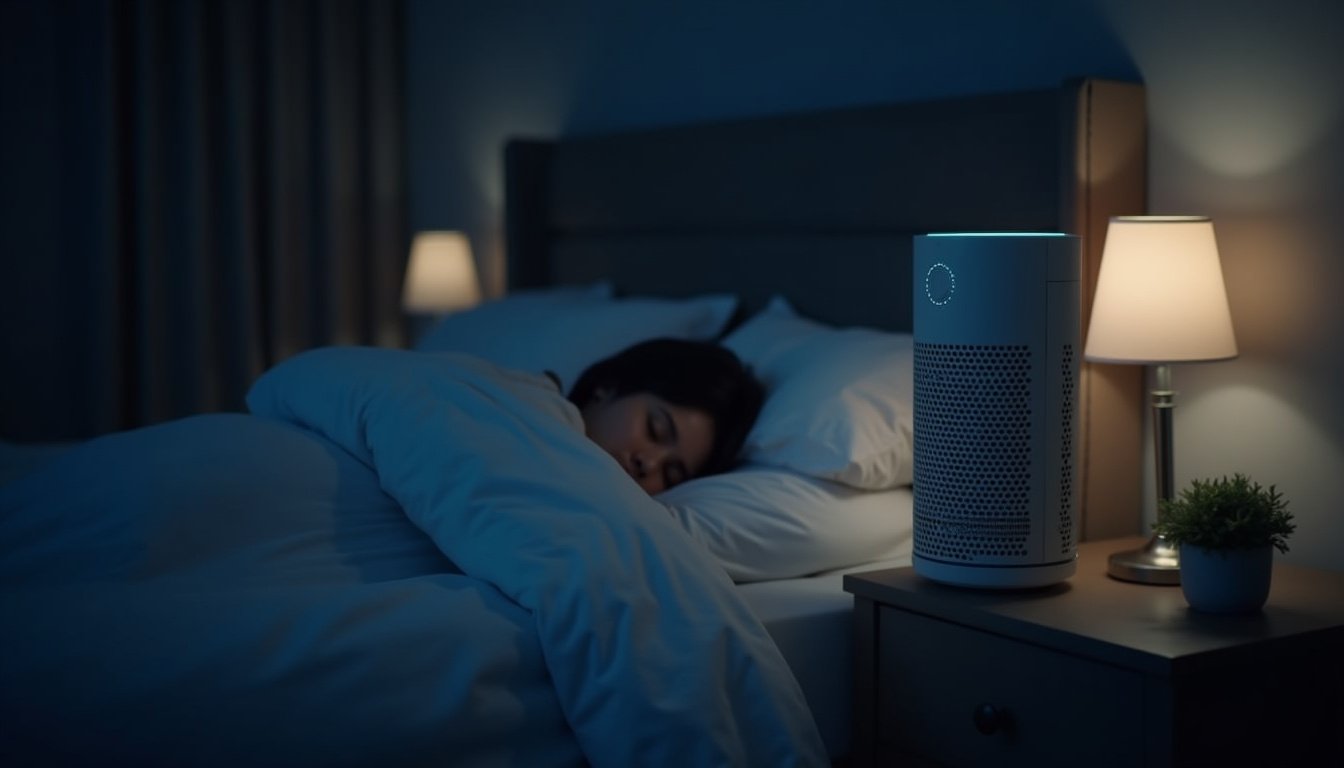
Yes, in most homes a HEPA air purifier should be left on all the time, on a low or medium speed or in auto mode, in the room where it matters. Particles are generated continuously: people shed skin and fibers, pets shed dander, the heating and cooling system stirs up dust, outdoor pollen and pollution leak in, and cooking adds smoke. A purifier switched off for an hour lets the room return to its baseline; one that runs continuously holds the level low. Cleaning a room from scratch takes a sized unit about 30 to 60 minutes, so a unit used only when you notice a problem spends most of its running time catching up. The cost of continuous operation is modest: a mid-size unit on medium draws roughly as much as a couple of LED bulbs, and filters load by the amount of dust they catch, which is the point.
In short: leave it on, use a quiet speed or auto mode, and put it in the room you actually occupy. Running it only when the air seems bad means it is always behind.
The EPA’s guide to air cleaners in the home notes that portable units are most effective when run continuously at the highest setting the occupants will tolerate, and that performance depends on run time as well as CADR. AHAM’s CADR ratings describe the rate of cleaning while running; a unit that is off has a CADR of zero.
This guide is research-based, drawn from EPA and AHAM material, Department of Energy appliance energy formulas and maker specifications. We have not tested the units in the comparison table and quote no prices or ratings, only published features relevant to continuous use.
Leave it on continuously if
- Someone in the home has allergies or asthma triggered by particles
- Pets, carpet, nearby traffic or smoke keep particles arriving
- The unit is quiet enough on low or medium to live with
- It sits in a bedroom, living room or office you actually use
It is fine to switch off when
- The room will be unoccupied for days
- You are airing the house out with windows wide open
- Cleaning or renovation dust is finished and the unit has run a few hours after
- The unit is being cleaned or its filter changed
Key Takeaways
- Particles are produced continuously, so a purifier that is off lets the room return to baseline within an hour or two.
- Continuous running on low or medium holds particle levels low; occasional running is always catching up.
- Electricity cost is small: a few watts on low to around 15 to 25 on medium for most mid-size units.
- Filters load by the dust they capture, not by hours; continuous running removes more dust, which is the goal.
- Auto mode is a good compromise if the sensor is clean and the fan has a minimum speed you accept.
- Noise is the real reason units get switched off; size a step up so the target CADR is met quietly.
- Turn it off when the room is empty for days or when windows are wide open for airing.
Purifiers Built for Continuous Running
These widely reviewed filter-based units publish low-speed noise and power figures that suit all-day operation and offer auto modes with particle sensors. Compare the maker-listed CADR against your room so the unit meets the target on a speed you can leave on.






How This Guide Weighs the Question
We looked at how fast particles return to a room once a purifier stops, how long a sized unit takes to clear a room, what continuous operation costs in electricity and filter life, and when sensors and auto modes help. Guidance comes from the EPA, AHAM and the Department of Energy; product details from maker specifications.
The core trade-off is simple: the only cost of running continuously is a small amount of electricity and the filter wear that comes from doing the job. The cost of not running is the job not being done.
How Fast a Room Gets Dirty Again
A sized purifier running in a closed room drives particle levels down within 30 to 60 minutes and holds them there. Switch it off and the room does not stay clean. Fine particles under 2.5 microns stay airborne for hours and keep arriving from people, pets, cooking and the outdoors; the heating or cooling system redistributes dust each cycle. Monitors show levels climbing back toward the household baseline within one to three hours of shutdown, faster when the room is in use.
That recovery explains why intermittent use disappoints. A unit run for an hour after vacuuming spends that hour clearing what the vacuum stirred up and is then switched off just as it finishes. The room is back to baseline by bedtime. Run continuously, the same unit never has a backlog to clear and the room stays near its clean floor.
| Pattern | Time the room spends near its clean level | Typical result |
|---|---|---|
| One hour after cleaning, then off | About an hour a day | Little noticeable change |
| Evenings only, living room | Three to four hours a day | Mild improvement while present |
| Overnight only, bedroom | Eight hours a day, when it matters most | Clear improvement for sleepers |
| Continuous on low or medium | Most of the day | Steady low particle level; dust builds slower |
| Continuous on auto | Most of the day, with bursts | Steady level with less average noise |
What Running All Day Actually Costs
Electricity is the first worry and the smallest cost. Fan power rises steeply with speed, so the low and medium settings most people run continuously draw a small fraction of the maximum on the box. A typical mid-size unit draws a few watts on low and perhaps 15 to 25 watts on medium. The Department of Energy formula is watts times hours divided by 1,000 for kilowatt-hours, times your rate.
Worked example: a unit drawing 18 watts on medium for 24 hours uses 0.43 kilowatt-hours a day, about 158 kilowatt-hours a year. At a rate of 17 cents per kilowatt-hour, near recent US residential averages reported by the Energy Information Administration, that is roughly 27 dollars a year, comparable to a couple of LED bulbs left on. The same unit on high at 50 watts around the clock would use about 438 kilowatt-hours, nearly three times as much, which is one reason to size the unit so medium is enough.
Filters are the second cost, and the worry here is partly misplaced. A HEPA filter loads according to how much dust it captures, not how many hours it spins. Running continuously captures more dust, which is the purpose, and makers’ 6 to 12 month intervals already assume near-continuous use. Running on medium rather than high and keeping the pre-filter clean do more for filter life than switching the unit off.
Auto Mode: The Practical Middle Ground
Many units include a particle sensor and an auto mode that raises fan speed when the sensor reads high and drops to low when the air is clean. Used well, auto mode is continuous running with lower average noise and power: the fan idles on low most of the day and ramps up when someone vacuums, cooks or makes the bed. The EPA’s suggestion to run at the highest tolerable setting is partly met by letting the unit decide.
- Sensors see particles, not gases; auto mode will not respond to odors or VOCs.
- Sensor lenses collect dust and start reading the room as cleaner than it is; wipe the inlet with a dry swab monthly.
- Some units drop to a near-zero fan speed in auto, which is effectively off; check that the minimum speed still moves air.
- Night-time spikes from rolling over or a pet jumping on the bed can wake light sleepers; a sleep mode that caps the speed helps.
- If auto never leaves low in a room you know is dusty, override to a manual medium for a day and clean the sensor.
Noise: The Reason Purifiers Get Switched Off
Almost no one switches off a purifier to save electricity; they switch it off because it is loud. The speed that delivers a unit’s rated CADR is typically conversation-level, and in a bedroom that is intolerable. The solution is not to run it less but to buy a unit that meets the room’s CADR target on a quiet speed. AHAM’s rule of thumb is a dust CADR of about two-thirds of the floor area in square feet; choose a unit that reaches that figure on medium, which usually means one size larger than the minimum.
| Speed | Typical noise | Share of rated CADR | Suitable for continuous use? |
|---|---|---|---|
| Low or sleep | Near-silent to a whisper | A third to a half | Yes, if the unit is sized a step up |
| Medium | Soft fan, like a quiet room fan | Most of rated CADR | Yes for most people |
| High | Conversation level or louder | Full rated CADR | Only for bursts after cooking or cleaning |
| Auto | Varies | Follows the sensor | Yes, with a sensible minimum speed |
A unit that is one size larger, running on medium, is quieter, cleans faster and loads its filter more slowly than a minimum-size unit straining on high. For continuous running it is the single most useful purchase decision.
When Turning It Off Makes Sense
Continuous does not mean eternal. A few situations justify switching off. Rooms that will be empty for days gain nothing from running; particles that settle while nobody breathes them are harmless until disturbed, and the unit can clear the room in an hour when you return. Airing the house with windows wide open overwhelms any purifier and briefly floods it with outdoor particles, so pause it until the windows close. Cleaning or filter changes obviously require it off.
Cooking is a special case. A purifier near a kitchen will pull in grease aerosols while frying; running the range hood and keeping the purifier a room away is better than switching it off, but if it sits next to the stove, pausing it during heavy frying protects the filter. After cooking, run it on high for an hour to clear what spread.
Room by Room: What Continuous Looks Like
| Room | Recommended pattern | Why |
|---|---|---|
| Bedroom | Continuous on low or medium, door closed, all night and ideally all day | Eight hours of heaviest exposure; keeps the room ready for bedtime |
| Living area | Continuous on auto, high after cooking | Activity and cooking vary; sensor responds |
| Home office | Continuous on medium during work hours, low otherwise | Printer particles and a closed door |
| Nursery | Continuous on sleep or low speed, sized so that suffices | Quiet and steady for an infant |
| Guest room | Off until a day before guests arrive | No occupants, no benefit |
| Basement | Continuous after moisture is controlled | Damp air and spores; dehumidify first |
Across all of these, the common thread is occupancy. Run the unit where and when people breathe the air, which for most homes means nearly always in the bedroom and living area.
Does Continuous Running Wear Out the Unit?
Purifier fans are designed for continuous duty and most run for years without trouble. Running on low or medium is gentler on the motor than repeated bursts on high, and a clean pre-filter keeps the fan from working against restriction. The components that age are the filters, which are consumables, and the sensor lens, which just needs wiping. Switching a unit on and off several times a day does nothing to extend its life and may shorten it slightly through startup surges.
The practical habits that keep a continuously running unit healthy are the ordinary ones: clean the pre-filter every two to four weeks, wipe the sensor monthly, inspect the HEPA stage every couple of months, replace on schedule or evidence, and keep a foot of clearance around the intake and outlet.
Smoke Seasons, Pollen Seasons and Events
Continuous running matters most when the outdoor air is bad. During wildfire smoke, the EPA’s guidance is to close the home, set the HVAC to recirculate and run a HEPA purifier continuously in a clean room, usually a bedroom, where people spend their time. Pollen season is similar on a smaller scale: keep windows closed on high-count days and let the purifier run continuously so what comes in on clothes and through doors is captured.
Both load filters faster than ordinary use. Inspect the HEPA stage every week or two during a smoke event and replace it early if it is gray and matted; a loaded filter cuts airflow exactly when you need it.
How to Set Up Continuous Running in 6 Steps
- Measure the room and choose a unit whose dust CADR meets two-thirds of the floor area on medium, not high.
- Check the published noise figure on low and medium; pick one you can sleep or work beside.
- Place it where people spend time, with a foot of clearance, and close the door in bedrooms.
- Set a fixed low or medium overnight and auto by day, with a sleep mode if the display is bright.
- Clean the pre-filter every two to four weeks and the sensor inlet monthly so auto mode stays honest.
- Turn it off only for empty rooms, open windows, cleaning or filter changes; otherwise leave it on.
Do and Do Not
Do
- Run continuously on low, medium or auto.
- Size a step up for quiet operation.
- Use high only for bursts after cooking or cleaning.
- Keep the pre-filter and sensor clean.
- Inspect filters more often in smoke and pollen seasons.
Do not
- Do not run it only when the air seems bad.
- Do not run on high around the clock in a correctly sized room.
- Do not run a unit with a damp filter, frayed cord or burning smell.
- Do not place it beside the stove.
- Do not expect auto mode to detect odors.
Who Should Skip This
If the room is unoccupied most of the time, a guest room or a formal dining room, skip continuous running there entirely. Move the unit to a room people use, or switch it on a day before the room will be occupied.
If your purifier is too loud to leave on at the speed the room needs, do not try to solve that with a schedule. Replace it with a unit one size larger that meets the CADR target on medium, or a model with a quieter published rating. A purifier that is off is the most expensive kind.
Honest Limits
- Continuous running cleans one room; it does not extend to rooms behind closed doors.
- A loaded or damp filter undermines continuous operation; maintenance is part of the deal.
- Sensors do not detect gases, so auto mode under-runs for odors.
- Filters in smoke, pet and dusty homes load faster regardless of schedule.
- Electricity estimates depend on your rate and the unit’s actual wattage at the speed used.
- No run pattern makes an undersized unit adequate for a large room.
When to See a Professional
See a doctor or allergist if symptoms persist in a room where a correctly sized purifier runs continuously; the trigger may not be airborne or may need treatment beyond filtration. Nothing on this page is medical advice.
Call an electrician for any outlet that is warm, loose or scorched, and contact the maker for any purifier that smells of burning, sparks, grinds or runs hot; stop using it meanwhile. An HVAC professional can advise on a MERV 13 furnace filter to reduce the load on portable units.
Frequently Asked Questions
Should I leave my HEPA air purifier on all the time?
Yes, in rooms people use. Particles are produced continuously, and a room returns to its baseline within one to three hours of switching the unit off. Running on low, medium or auto around the clock holds levels low, costs little in electricity and is how makers and the EPA expect units to be used.
Is it safe to run an air purifier 24 hours a day?
Yes for a healthy unit on a sound outlet with a foot of clearance; purifier fans are built for continuous duty. It is not safe for a unit with a damp filter, frayed cord, grinding fan or burning smell, which should be unplugged, and no purifier should share an extension cord with a heater.
How much electricity does an air purifier use if left on all day?
Little at low and medium speeds. A mid-size unit drawing about 18 watts on medium uses roughly 158 kilowatt-hours a year running continuously, about 27 dollars at 17 cents per kilowatt-hour. High speed draws two to three times more, which is a reason to size the unit so medium suffices.
Does running a purifier all the time wear out the filter faster?
Filters load by the dust they capture, not by hours, so continuous running captures more dust, which is the purpose. Makers’ 6 to 12 month intervals assume near-continuous use. Running on medium instead of high and cleaning the pre-filter regularly do more for filter life than switching off.
Is auto mode as good as running continuously?
Auto mode is continuous running with the fan speed chosen by a sensor, and it works well if the sensor inlet is kept clean and the minimum speed still moves air. Sensors do not detect gases, so for odors set a manual medium. A fixed speed overnight avoids speed changes while sleeping.
Should I turn the purifier off at night?
No. Night is when a bedroom purifier does its most valuable work, during eight hours of breathing near a dust-shedding mattress. Choose a unit that meets the room’s CADR target on a quiet low or medium speed, dim the display and leave it running with the door closed.
Should I turn it off when I open the windows?
Yes, while windows are wide open for airing. Outdoor air overwhelms the unit and floods the filter with particles. Close the windows, then switch it back on. On high-pollen or smoky days, keep windows closed and the purifier running continuously instead.
Does it matter if I run it on high all the time?
It is noisy, uses two to three times the electricity of medium and loads filters faster, for little extra cleaning in a correctly sized room. Use high in bursts after cooking or cleaning, and otherwise run medium or auto. If medium cannot meet the room’s CADR target, the unit is too small.
Can I leave a purifier running in an empty room?
You can, but there is little point for a room empty for days; particles that settle while nobody is there are harmless until disturbed. Move the unit to an occupied room or switch it on a day before the room is used. Occupied rooms are where continuous running pays off.
How long does it take a purifier to clean a room from scratch?
A unit sized by AHAM’s rule, a dust CADR of about two-thirds of the floor area, lowers particle levels substantially within 30 to 60 minutes in a closed room. That recovery time is why intermittent running underperforms: each session starts with a backlog, and the room is dirty again soon after.
Bottom Line
A HEPA air purifier should be left on all the time in the rooms people use. Particles never stop arriving, a room gets dirty again within an hour or two of switching off, and the cost of running continuously is a couple of LED bulbs’ worth of electricity plus filters that are doing exactly what you bought them for.
Make continuous running easy: size the unit so medium meets the CADR target, choose one quiet enough to sleep beside, use auto by day and a fixed speed at night, and keep the pre-filter and sensor clean. Switch it off for empty rooms, open windows and maintenance, and never run a unit that is damp, damaged or smells of burning.
Related reading: Air purifier maintenance cost, Is it worth having an air purifier at home, Best air purifiers for bedrooms vs living rooms.