Last updated:
Disclosure: As an Amazon Associate we earn from qualifying purchases. Some links below are affiliate links, and we may earn a commission at no extra cost to you. Our picks are research-based and do not come from lab tests. We do not show prices because they change, so check the store page for current details.
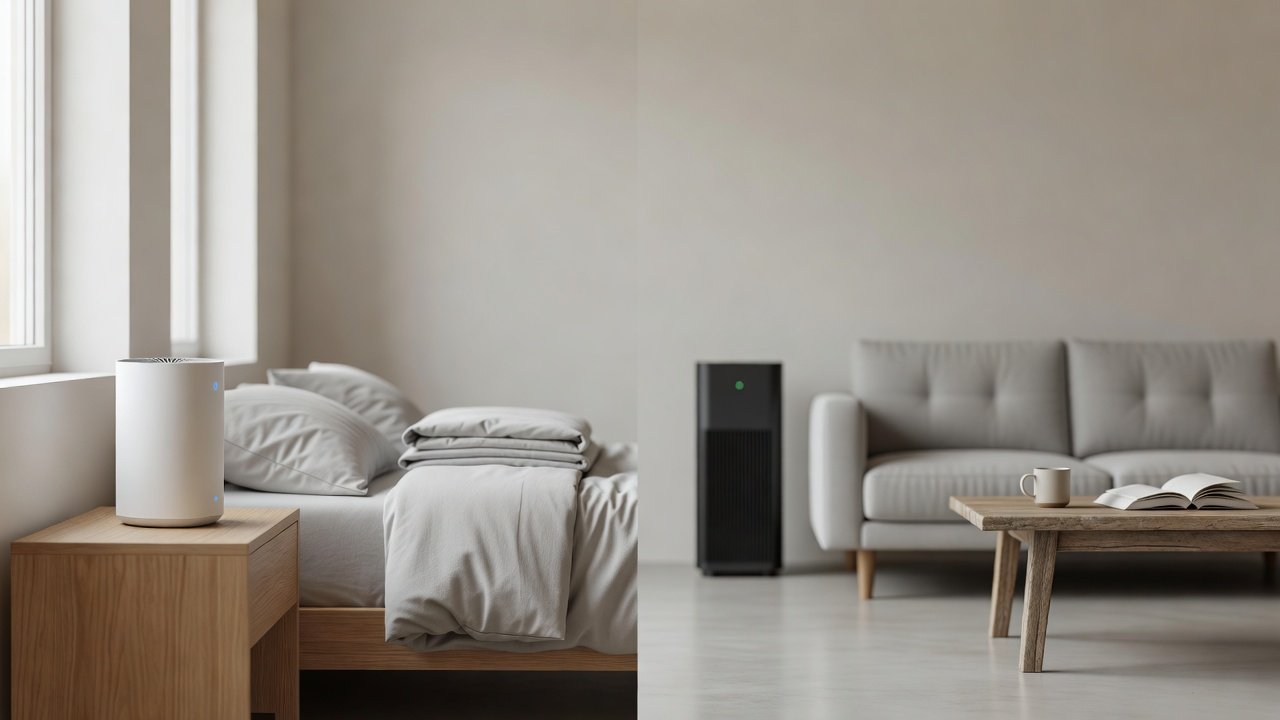
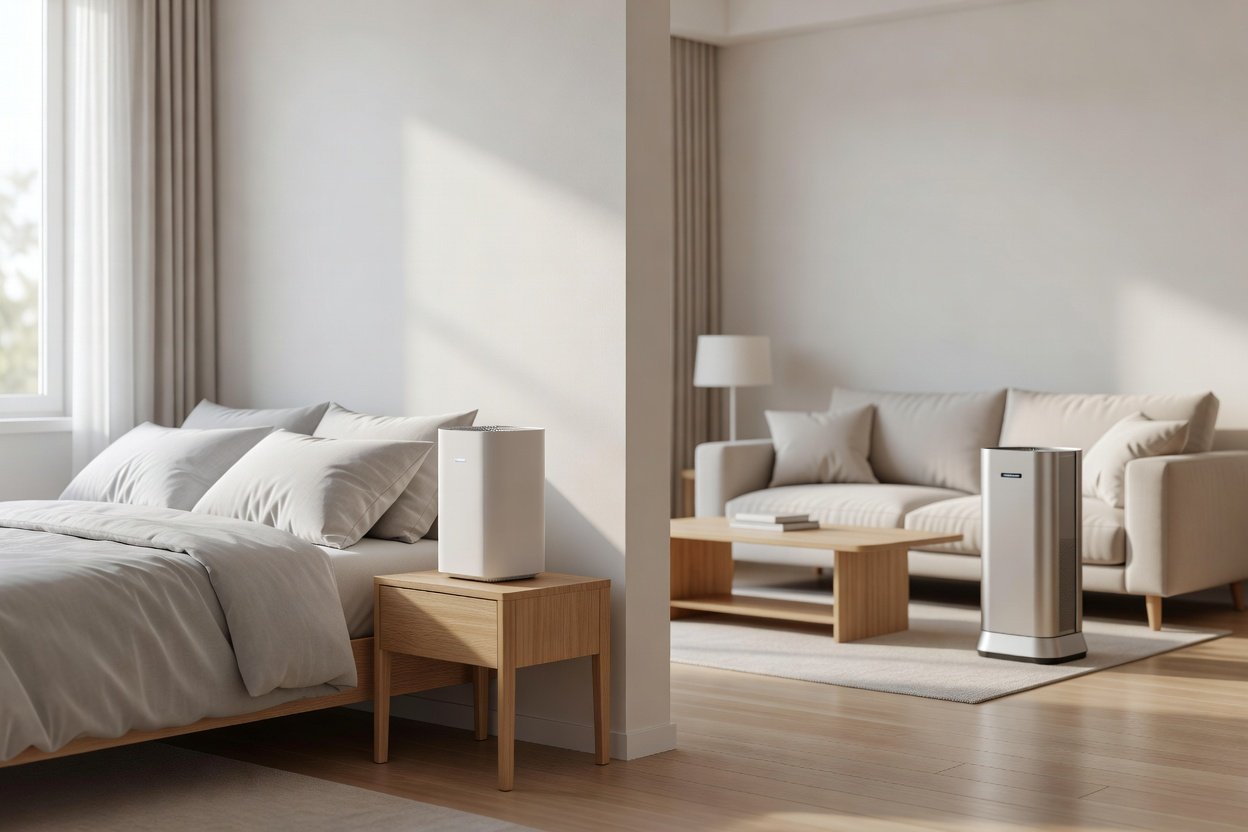
A bedroom and a living room ask very different things of an air purifier. One is small, quiet and used for hours of sleep, while the other is large, busy and open to the rest of the home. Buying the same model for both usually means one room gets too little cleaning or the other gets too much noise. This guide shows how to size and choose for each space, with seven models: three suited to bedrooms and four aimed at living rooms.
For a bedroom, choose a compact, quiet unit with a sleep mode and dimmable lights, sized with AHAM’s two-thirds rule: a tobacco smoke CADR of about two-thirds of the floor area. For a living room, choose a larger unit with a higher CADR, because the space is bigger, more open and used by more people. Filter quality is much the same in both rooms, so look for True HEPA with some activated carbon. The real differences are capacity, noise at low speed and placement. If you can only buy one unit, put it where the most vulnerable person spends the most time, which is often the bedroom at night.
In short: size by floor area, pick for quiet in the bedroom and for capacity in the living room, and trust the certified label over a listing’s coverage claim.
AHAM explains that CADR is the standard measure of how fast an air cleaner works, and that an oversized unit wastes energy and adds noise. The American Lung Association adds that large homes may need several units, and that you should place them where vulnerable people spend the most time and keep doors and windows closed while they run.
These are research-based picks from manufacturer information and widely reviewed listings, not laboratory tests. We do not show prices because they change.
Bedroom: pick for quiet
- A compact unit with a sleep mode and lights you can dim
- A CADR target of about two-thirds of the floor area, which is 100 to 133 for a 150 to 200 square foot room
- Clear space around the unit and the door kept closed
Living room: pick for capacity
- A larger unit with a higher certified CADR
- About 267 for a 400 square foot room under the two-thirds rule
- A second unit if the space is open to the rest of the home

Key Takeaways
- Size every purifier with the two-thirds rule: a tobacco smoke CADR of about two-thirds of the room’s floor area.
- Bedrooms reward quiet low speeds, a sleep mode and lights you can dim.
- Living rooms reward a higher CADR, because the space is bigger and more open.
- A 200 square foot bedroom needs a CADR of about 133, and a 400 square foot living room about 267.
- A listing’s coverage claim is not the same as the certified room size on the AHAM Verifide label.
- If you can buy only one unit, place it where the most vulnerable person spends the most time, as the American Lung Association suggests.
- Avoid ozone-producing devices, and be cautious with ionizer features.
Top Picks for Bedrooms and Living Rooms
Three models suit bedrooms and four suit living rooms. Each button opens the Amazon listing, where you can confirm the exact variant and current details.






Why Bedrooms and Living Rooms Need Different Purifiers
Three things change between the two rooms: size, noise tolerance and the time you spend there. Bedrooms are small, so a modest CADR is enough, and the machine runs while you sleep, so low-speed noise and light matter more than top speed. Living rooms are larger and often open to a kitchen or hallway, so air moves in and out more and the purifier needs more capacity to keep up.
Usage differs too. You may sit in the living room for a few hours in the evening, but you spend about a third of each day in your bedroom. The American Lung Association suggests placing units where vulnerable people spend the most time, such as a living room or office by day and a bedroom at night. If you only have one unit, decide who is most at risk and when they are in each room.
Sizing: The Two-Thirds Rule With Real Numbers
AHAM says to choose a unit whose tobacco smoke CADR is about two-thirds of the room’s floor area. CADR, the clean air delivery rate, is a certified measure of how quickly a unit cleans air of smoke, dust and pollen. Measure length times width in feet, multiply by two-thirds, and use the answer as your target.
| Room | Floor area (square feet) | Target tobacco smoke CADR |
|---|---|---|
| Small bedroom | 120 | about 80 |
| Typical bedroom | 150 | about 100 |
| Large bedroom or home office | 200 | about 133 |
| Living room | 300 | about 200 |
| Large living room | 400 | about 267 |
| Open-plan space | 500 | about 333 |
Targets are rounded. Treat them as a minimum for open-plan spaces, where air moves freely into other rooms. AHAM warns against going far above your target, because an oversized unit wastes energy and adds noise.
Coverage Claims vs Certified Room Size
Shoppers often compare the wrong numbers. Amazon titles and bullets quote coverage figures, such as the area a unit can clean in an hour, that rest on the maker’s own assumptions. The certified label works differently. This table separates them.
| Number | Where you see it | How to use it |
|---|---|---|
| Listing coverage claim | Amazon title or bullets | A rough hint only; do not size by it alone |
| AHAM Verifide label or directory entry | Packaging and the AHAM directory | Certified CADR and suggested room size; use it for sizing |
| Tobacco smoke CADR | The certified numbers on the label | The figure AHAM uses in the two-thirds rule |
| Pollen or dust CADR | The same label | Check these too if pollen or dust is your main issue |
Choosing for the Bedroom
In a bedroom, the quietest useful setting matters more than the strongest one. Look for a sleep mode, a way to dim or switch off the lights, and a unit that meets your CADR target without needing high speed. Maker and listing claims about noise are not the same as measured noise, and we have not measured any of these models, so compare each maker’s stated sound level at the lowest setting.
Leave clear space around the unit so air can flow in and out, and keep the door and windows closed while it runs, as the American Lung Association advises. In a nursery, follow the manual, keep cords out of reach, and avoid ozone-producing devices. If you have health concerns about a baby’s breathing, talk to a pediatrician.
Choosing for the Living Room
A living room needs capacity first. Work out your CADR target, then choose a model whose certified numbers meet it with some headroom. Features that help here are an auto mode that speeds up when the room gets dusty and an air quality indicator so you can see what is happening. Noise matters less when you are awake, so a higher fan speed is easier to accept.
Open-plan spaces are the hard case. If the living room flows into a kitchen and hallway, one unit may struggle, and the American Lung Association notes that large homes may need several. Carbon filters help with some cooking and pet smells but are thin in household units, so ventilate the kitchen as well.
Placement and Running Habits
The American Lung Association links consistent use to modest benefits, so run the unit regularly rather than only when the air looks bad. Close doors and windows while it runs, and follow the manual’s clearance guidance around the intake and outlet.
If a portable unit has to cover both rooms, you can follow the American Lung Association’s pattern: living room by day, bedroom at night. The trade-off is that each room gets cleaned only part of the day.
Filters and Upkeep
Every unit here uses filters that wear out. Follow the manual’s schedule, since the right interval depends on how often you run it and how dirty the air is. Carbon layers fill faster in smoky or smelly homes, and the American Lung Association notes that charcoal filters may need frequent replacement. The Coway Airmega 400 and Winix 5500-2 listings mention washable parts, which cuts some chores but does not remove the need to replace the HEPA filter.
Before you buy, find the replacement filter for the exact model and check where you can buy it. Compare filter prices on the store page, since we do not show prices here.
How to Choose for Your Rooms in 6 Steps
- Measure each room. Multiply length by width in feet.
- Set a target. Multiply each area by two-thirds to get a tobacco smoke CADR target.
- Check the certified label. Look up candidates in the AHAM Verifide directory.
- Pick bedroom features. Look for a sleep mode, dimmable lights and a unit that meets the target at low speed.
- Pick living room capacity. Choose a model whose certified numbers meet the target, and consider two units for open plans.
- Place and run it well. Leave clear space, close doors and windows, and use the unit consistently.
Do and Do Not
Do
- Size each room separately
- Check certified CADR and suggested room size on the AHAM label
- Use the sleep mode in the bedroom
- Replace filters on the manual’s schedule
Do not
- Buy one large unit for a small bedroom just in case
- Size by a listing’s coverage claim alone
- Use an ozone-producing device in a living space
- Block the intake or outlet with furniture or curtains
Honest Limits
An air purifier reduces airborne particles but does not eliminate them, and it does not replace source control or ventilation, as the American Lung Association points out. Carbon helps with some odors but is limited for gases. The picks here come from maker and listing information rather than our own testing, and specifications can differ between variants of one model name. Treat every number as a starting point, and confirm it on the store page and in the manual.
When to See a Professional
If you or a family member has persistent breathing symptoms, allergies or asthma, talk to a doctor or allergist rather than relying on a purifier. For ventilation problems or whole-home air quality, ask a qualified heating and cooling professional. If a unit smells of burning or has a damaged cord, stop using it and contact the maker. This guide is general information, not medical advice.
Frequently Asked Questions
Do I need different air purifiers for the bedroom and the living room?
Usually, if both rooms matter to you. The rooms differ in size and noise needs. One portable unit can serve both if you move it, but each room is then cleaned only part of the day.
What size air purifier do I need for a bedroom?
Multiply the floor area by two-thirds to get a tobacco smoke CADR target. A 150 square foot bedroom needs about 100, and a 200 square foot bedroom about 133.
What size do I need for a living room?
Use the same rule. A 300 square foot room needs about 200, a 400 square foot room about 267 and a 500 square foot space about 333. For open plans, treat the target as a minimum.
Is a bigger air purifier always better?
No. AHAM warns that an oversized unit wastes energy and adds noise. Aim to meet your target with modest headroom rather than buying the largest model.
Which of these picks is quietest for a bedroom?
We have not measured noise. The Levoit Core 300 and 300S listings describe quiet operation for bedrooms, and one listing cites 24 dB on the lowest setting. Compare each maker’s stated lowest-setting noise.
Can one air purifier serve both rooms?
It can if it is portable and you move it, following the American Lung Association’s living room by day, bedroom at night pattern. The trade-off is that neither room is covered all day.
Where should I put an air purifier in a bedroom?
Leave clear space around the intake and outlet, away from curtains and furniture, and keep the door and windows closed while it runs. Follow the manual for exact clearances.
Is the Honeywell HPA300 too big for a bedroom?
It is listed for extra-large rooms, so it likely exceeds what a bedroom needs. Compare its certified numbers with your target, and remember that oversized units can waste energy and add noise.
Do I need a purifier with activated carbon?
Carbon helps with some odors, so it suits living rooms with cooking or pet smells. It is a thin layer in household units, so it will not remove every gas, and it fills faster in smoky homes.
Are air purifiers safe for a baby’s room?
Used as the manual directs, they can be. Avoid ozone-producing devices, keep cords out of reach and leave space around the unit. For health concerns about a baby’s breathing, talk to a pediatrician.
Bottom Line
Treat the two rooms as two sizing problems. For the bedroom, find a compact unit that meets your two-thirds target at a quiet setting, such as the Levoit Core 300 or 300S. For the living room, choose a larger model whose certified numbers meet the target with headroom, such as the Levoit Core 600S or Coway Airmega 400, and consider a second unit for open plans.
Before you buy, confirm the certified CADR and suggested room size on the AHAM Verifide label, and check the replacement filter for your exact model. For related reading, see our Levoit versus Winix comparison and our guide to multiple fan speeds versus single-speed models. Our editorial policy explains how we research. Sources: AHAM Verifide and the American Lung Association.