Last updated:
Disclosure: As an Amazon Associate we earn from qualifying purchases. This does not change what we recommend. See our affiliate disclaimer.
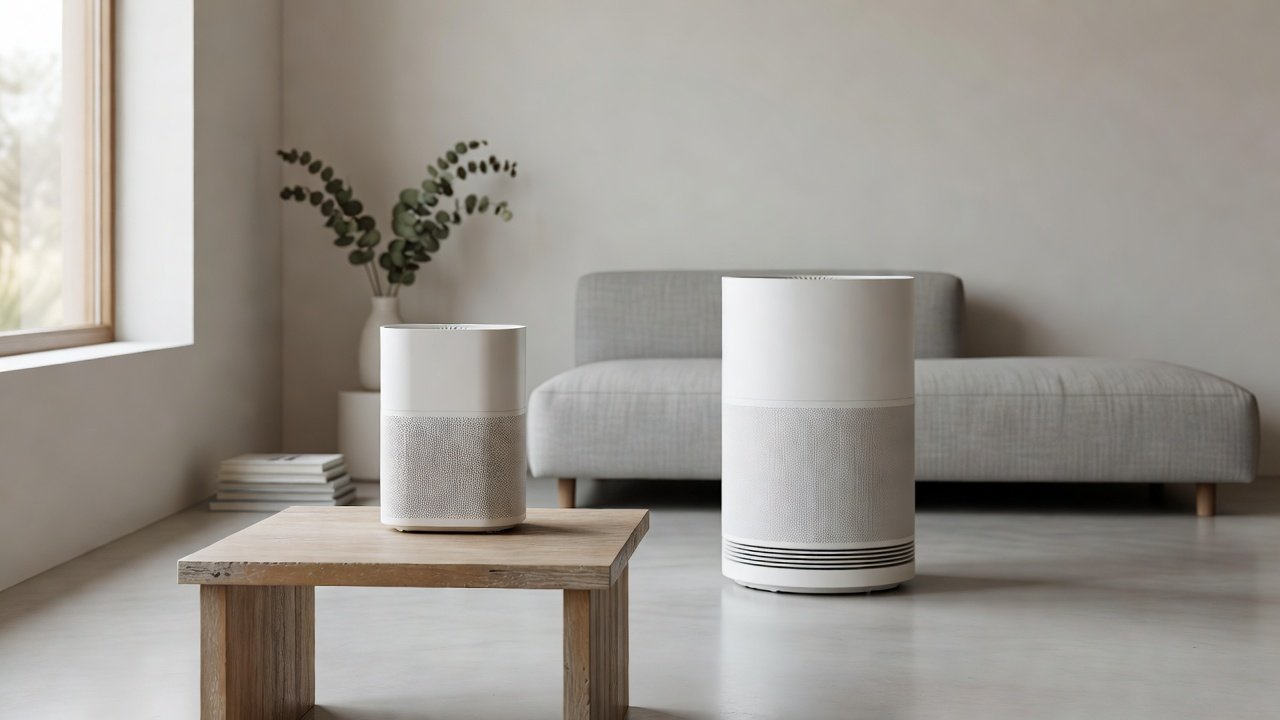
The Levoit Core 300 and Core 400S share a design approach: a cylindrical purifier with a pre-filter, a true HEPA layer and activated carbon. The Core 400S is the larger, smarter step up. It adds an air quality sensor, auto mode and app control, and it has roughly double the airflow. The Core 300 is the smaller, simpler unit meant for bedrooms and offices.
The figures below come from a third-party spec comparison (airpurifierfirst.com), because we could not confirm every number on a current Levoit page. Treat them as reported figures and verify on Levoit’s site, since models are revised and sold in different versions. We have not tested these products ourselves, and we do not list prices.
Core 300 fits
- Bedrooms and offices up to about 200 sq ft
- Buyers who want a smaller, lighter unit
- Those who do not need an app or sensor
Core 400S fits
- Larger bedrooms and living areas
- Buyers who want auto mode and an app
- Those who want a longer filter interval
Key Takeaways
- Reported figures: Core 300 about 141 CFM and 219 sq ft; Core 400S about 260 CFM and 403 sq ft.
- The Core 400S adds a PM2.5 sensor, auto mode and app control; the Core 300 does not.
- Filter intervals reported: 6 to 8 months for the Core 300 and up to 12 months for the Core 400S.
- Figures come from a third-party comparison, so verify on Levoit’s site.
- Compare on smoke CADR and check whether the listed CADR is for smoke or another pollutant.
A Worked Sizing Example
Take a 180 square foot bedroom with eight-foot ceilings. The AHAM rule suggests a smoke CADR near 120. A reported 141 CFM unit would meet that if the figure is a smoke CADR. In a 300 square foot room, the target is about 200, which a 260 CFM unit would meet. In a 400 square foot room, the target is about 267, which sits right at the 400S’s reported figure, leaving no margin for pets or smoke.
If your ceilings are nine feet, raise the target by about 12 percent. If you have pets or smokers, add more margin. In those cases, consider the larger unit even if the room is on the smaller side.
Setup, Maintenance and Tips
Place the unit on a stable surface with several inches of clearance on all sides. The cylindrical design draws air from the sides and releases it upward, so avoid putting items on top. Vacuum the pre-filter periodically if the model has one that can be cleaned, following the manual, and replace the main filter on time. If you use the 400S app, keep the firmware updated and review privacy settings.
Avoid placing either unit in damp locations, and do not run it with the filter removed. Keep cords out of walkways and away from pets.
Who Should Choose Which
Choose the Core 300 if you want a small, light and simple purifier for a modest room and do not need smart features. Choose the Core 400S if you have a larger room, want auto mode and an app, and prefer a longer filter interval. If your room is bigger than about 350 square feet or you need to filter smoke quickly, look at higher-CADR options.
This article provides general information and is not medical advice. If you have a respiratory condition, ask your clinician what steps are right for you.
Version Differences to Watch For
Levoit sells several variants of similar names, such as the Core 300, Core 300S and Core 400S, and models are sometimes updated or sold in different regional versions. The Core 300 in this comparison has no app, and the Core 300S is a separate model with a different feature set. Before buying, match the exact model name and part number, including the letter suffix, against the filter you plan to use. Filters are model-specific, so a filter for one version may not fit another.
Retailer listings sometimes list older stock or bundle different versions under the same title. Read the product description and the photos, and confirm that the version you receive matches what you wanted.
What This Comparison Cannot Tell You
Spec sheets give capacity and features. They do not tell you how the unit sounds in your room, how long the filter actually lasts in your home or how reliable the app is over time. Independent measurements and owner reviews help with those questions, but they vary. If you can, buy from a retailer with a clear return policy and test the unit in your room for the first few weeks.
Remember too that no purifier replaces ventilation or source control. For cooking smoke, use the range hood, and for mold or moisture problems, fix the source. For gas smells, a carbon monoxide alarm or heavy smoke, leave the area and get help.
Air Purifiers to Compare
The table below lists purifiers from our affiliate partner for small and mid-sized rooms. Compare smoke CADR, room size ratings, filter cost and noise, and check Levoit’s pages for current models.
Side-by-Side
The table summarizes the reported figures. Confirm current numbers.
| Factor | Core 300 | Core 400S |
|---|---|---|
| CADR (reported) | 141 CFM | 260 CFM |
| Coverage (reported) | Up to about 219 sq ft | Up to about 403 sq ft |
| Filter interval | 6 to 8 months | Up to 12 months |
| Smart features | None listed | App, sensor, auto mode |
| Weight | About 7.5 lb | About 10.5 lb |
| Noise range (reported) | About 41 to 65 dBA | About 42 to 60 dBA |
Reported Specifications
The comparison lists a CADR of 141 CFM for the Core 300 and 260 CFM for the Core 400S, with room coverage of up to about 219 square feet and 403 square feet respectively. Both are listed with a pre-filter, true HEPA and activated carbon. The Core 300 filter is listed at 6 to 8 months and the Core 400S at up to 12 months.
Noise ranges are listed at roughly 41 to 65 dBA for the Core 300 and 42 to 60 dBA for the Core 400S. The 400S is listed with the VeSync app, a PM2.5 laser sensor and auto mode. The Core 300 is listed without an app, sensor or auto mode. Dimensions are listed at about 8.7 by 8.7 by 14.2 inches and 7.5 pounds for the Core 300, and about 10.8 by 10.8 by 20.5 inches and 10.5 pounds for the Core 400S.
What the Numbers Mean for Your Room
Room coverage claims vary with the assumed air-change rate, so compare on the AHAM basis, where smoke CADR is about two-thirds of floor area at about 4.8 air changes per hour. If the 141 and 260 figures are comparable to smoke CADR, they correspond to roughly 210 and 390 square feet at that rate. If they are for another pollutant, the effective coverage would be lower, so check the model page.
In practice, the Core 300 suits a small to average bedroom, and the Core 400S gives headroom for larger bedrooms, open rooms or heavier loads.
Smart Features: Do You Need Them?
The Core 400S adds a laser dust sensor, an air quality indicator, auto mode and app control. Auto mode raises or lowers the fan according to what the sensor sees, which can mean quieter operation most of the time and stronger cleaning when cooking or when outdoor smoke comes in. The app can schedule the unit and show readings.
If you run a purifier on a steady low setting overnight, the Core 300 may be all you need. If your air changes through the day, the 400S’s sensor and auto mode can be useful. Remember that sensor readings show relative changes and are not laboratory measurements.
Filter Life and Running Costs
The reported filter intervals differ: 6 to 8 months for the Core 300 and up to 12 months for the Core 400S. Over a year, that can mean one or two filters. Multiply the filter price by the number of replacements to compare cost per year. We do not list prices, so check current figures for both models. Heavy-use homes may need to replace sooner than the listed interval.
Power use is also listed, at about 45 watts for the Core 300 and 38 watts for the Core 400S on the comparison. Use the wattage at your working speed to estimate electricity.
Noise and Placement
Both units list a range of noise figures that rise with fan speed. The larger unit can deliver more airflow at a lower speed, which can be quieter in practice for the same room. Place either one a few inches from walls, away from curtains, and aim for a spot where air can circulate through the room.
Which Room Fits Which Unit
A guest room, nursery or home office of around 100 to 200 square feet suits the Core 300. A primary bedroom of 200 to 350 square feet or a living area suits the Core 400S. For open-plan spaces larger than that, consider a higher-CADR unit or two units.
Questions to Ask Before Buying
Is the CADR figure for smoke, dust or pollen? Is the exact variant still sold? What is the replacement filter part number and where can you buy it? Is the app supported on your phone? Verify these on Levoit’s current pages and retailer listings.
How to Choose
- Size by smoke CADR for your room.
- Check whether the CADR on the listing is for smoke or another pollutant.
- Compare filter life and replacement cost.
- Check noise at the speed you will use.
- Avoid ozone-generating modes; the EPA advises against ozone-emitting air cleaners.
Do
- Match the unit’s rated coverage to your room first
- Run it consistently, not only when the air feels bad
- Leave space around the unit for airflow
- Replace filters on the maker’s schedule
Don’t
- Do not buy on looks or price alone
- Do not block the intake or exhaust
- Do not skip filter changes
- Do not expect a purifier to fix every source of pollution
Honest Limits
- This guide uses manufacturer information and public guidance from the EPA and AHAM, not our own lab tests.
- Features and room ratings change between model years, so confirm on the listing before you buy.
- A purifier is not a medical device and does not replace medical advice or treatment.
Who Should Skip This
When to See a Professional
Frequently Asked Questions
What is the main difference between the Core 300 and Core 400S?
The Core 400S is larger, has roughly double the reported airflow and adds a PM2.5 sensor, auto mode and app control.
Which is quieter?
Reported noise ranges are similar, but the larger unit can deliver the same airflow at a lower speed. Compare at the speed you will use.
How often do the filters need replacing?
Reported intervals are 6 to 8 months for the Core 300 and up to 12 months for the Core 400S, depending on use.
Which room size does each fit?
Reported coverage is up to about 219 sq ft for the Core 300 and 403 sq ft for the Core 400S, so verify with the AHAM two-thirds rule.
Are these figures official?
They come from a third-party comparison. Check Levoit’s current product pages.
Bottom Line
The Core 300 is for smaller rooms and simple use, and the Core 400S is for larger rooms with smart features.
Verify current specs and availability, since both lines change.
Related reading: sens,fan,bed
Sources: EPA, Guide to Air Cleaners in the Home; AHAM Verifide.