Last updated:
As an Amazon Associate we earn from qualifying purchases. This does not change what we recommend. See our affiliate disclaimer.
Pull a filter out of a purifier after a few months and it tells a story in color. Most of the time the story is simply that the filter has been doing its job, but a few shades point to something specific: a cooking habit, a damp room, a smoker next door, a pet, or a filter that should have been changed a season ago.
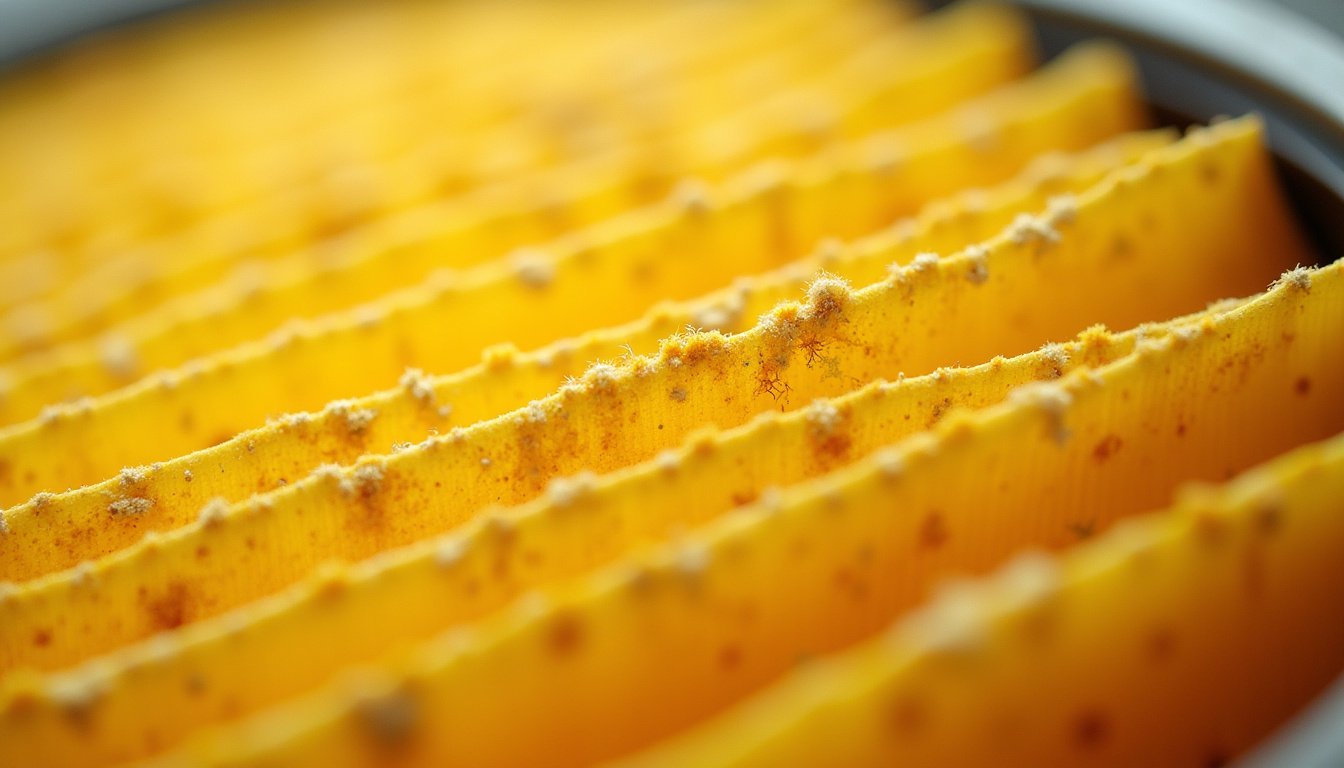
Filter discoloration on an air purifier is mostly normal loading, and the shade indicates what was captured. An even gray across the face is household dust. Dark gray to black is fine particles from smoke, candles, traffic or cooking, or carbon dust shed from a damaged carbon stage. Yellow to amber, often tacky, is grease aerosol from frying or nicotine tar from indoor smoking. Brown is heavier soil, pet dander and outdoor dust. Green or pink patches, or dark spots in a pattern, are the shades to take seriously, because they usually mean mold or bacterial growth on a filter that has been damp. Discoloration concentrated on one edge or in a streak points to air bypassing a poorly seated filter, and gray on the downstream face of a HEPA filter means leakage. None of these colors can be washed out of HEPA media; a loaded or contaminated filter is replaced, and the color is used to decide what to change in the room.
In short: gray is dust, black is smoke, yellow is grease or tar, brown is dirt and dander, and green or pink means damp. Replace the filter in every case, and fix the room for the last two.
The EPA’s guide to air cleaners in the home advises following the maker’s replacement schedule and notes that a loaded filter reduces airflow; its mold guidance warns that damp materials can grow mold within 24 to 48 hours. Maker manuals universally describe visible darkening as a replacement cue and prohibit washing HEPA media.
This guide is research-based, drawn from maker manuals, EPA guidance and the way common indoor pollutants deposit on fiber filters. We have not tested the units in the comparison table and quote no prices or ratings. Color is a clue, not a laboratory analysis.
Normal loading, replace on schedule
- Even gray across the intake face
- Darker gray toward the center where airflow is strongest
- Brown tint in a home with pets, carpet or open windows
- Gradual darkening over the maker’s interval
Investigate the room, replace now
- Yellow or amber tackiness: grease or tobacco tar
- Green, pink, white fuzz or dark spots in a pattern: growth on a damp filter
- Black dust that smears: shedding carbon
- Gray on the clean side or a streak at one edge: air bypassing the filter
Key Takeaways
- Even gray is ordinary dust and the normal look of a filter doing its job.
- Dark gray to black means fine particles from smoke, candles, traffic or cooking, or shed carbon dust.
- Yellow or amber, often sticky, is grease aerosol or nicotine tar; move the unit from the kitchen or the smoking room.
- Brown points to soil, pet dander and outdoor dust; a washable pre-filter and closed windows help.
- Green, pink or spotted patches mean mold or bacteria on a filter that has been damp; replace it and dry the room.
- Color on the clean side or in a streak at one edge means bypass; reseat the filter and check the gasket.
- No discoloration washes out of HEPA media; the filter is replaced and the color guides what to change.
Purifiers With Easy-to-Inspect Filters to Compare
These widely reviewed filter-based units pair true HEPA with carbon and open easily for the quarterly look at the filter face described here. Compare the maker-listed CADR against your room and favor models with a washable pre-filter, which takes the brunt of the discoloration.






How This Guide Reads Filter Color
We matched the common colors seen on purifier filters to the pollutants that produce them, drawing on how particles deposit on fiber media, maker guidance on replacement cues and EPA material on mold and moisture. Product details in the table come from maker specifications.
Two questions organize the reading: where on the filter is the color, and does it smell. Where tells you about airflow and seating; smell separates dust from damp.
The Color Guide
| Color or pattern | Likely source | Normal? | What to do |
|---|---|---|---|
| Even light to medium gray | Household dust: skin, fabric, paper fibers, soil | Yes | Replace on schedule or when airflow drops |
| Dark gray to black, even | Fine particles: smoke, candles, incense, traffic, frying | Yes, but heavy load | Replace sooner; find the source; range hood, no candles |
| Black dust that smears, mainly at edges or outlet | Carbon shedding from a damaged carbon stage | No | Replace the carbon filter; clean the housing |
| Yellow to amber, tacky | Cooking grease aerosol or nicotine tar | No, source issue | Replace; move from kitchen; smoke outdoors; hood on every burner |
| Brown | Soil, pet dander, outdoor dust, pollen | Yes in pet or open-window homes | Replace; washable pre-filter; close windows on dusty days |
| Green, blue-green or pink patches | Mold or bacteria on damp media | No | Replace immediately; find and fix moisture; dry the housing |
| White fuzz or powdery spots | Mold growth or mineral dust from a humidifier | No | Replace; move away from humidifier; use distilled water in humidifiers |
| Dark spots in a scattered pattern | Mold colonies | No | Replace; check humidity, 30 to 50 percent target |
| Color on the downstream, clean side | Air bypassing the filter | No | Reseat; check gasket and fit; replace if heavily marked |
| Streak or dark band at one edge | Gap at that edge | No | Reseat; confirm exact filter; check cover latch |
| Center darker than edges | Normal airflow pattern | Yes | Nothing; replace on schedule |
Gray: The Normal Case
A filter that turns an even gray over its interval is doing exactly what it should. Household dust is a mix of skin flakes, fabric and paper fibers, soil tracked in on shoes and the fine fraction of everything else, and it deposits as a uniform gray film that darkens with time. The center of the face usually darkens first because airflow is strongest there. A white filter frame against a gray face after six months is the picture of a working purifier.
The question gray answers is when, not what. Compare the shade against a new filter and against the maker’s interval, typically 6 to 12 months for HEPA, and watch for the signs that matter more than color: a weaker outlet breeze and a louder fan at the same speed. A gray filter with normal airflow can run to its interval; a gray filter with weak airflow is due.
| Months in use | Typical look in an average bedroom | Typical look in a pet or dusty home |
|---|---|---|
| 1 to 2 | Faint gray haze at the center | Light gray across the face; pre-filter furry |
| 3 to 4 | Even light gray | Medium gray; brown cast on pre-filter |
| 6 | Medium gray; airflow still normal | Dark gray; airflow easing off; consider replacing |
| 9 to 12 | Dark gray; fan slightly louder; replace | Usually replaced already |
Black: Fine Particles or Shed Carbon
Dark gray shading to black means a heavy load of very fine particles, which are what smoke and combustion produce: wildfire smoke, tobacco, candles, incense, a wood stove, a gas range used without a hood, or traffic if windows face a busy road. These particles are small enough to penetrate deep into the media and darken it thoroughly, and they load a filter faster than ordinary dust. A black filter after a smoke season is expected; a black filter in a clean suburban bedroom suggests candles, incense or a cooking habit worth examining.
Black that smears when touched and concentrates at the filter edges, the outlet grille or on the floor is different: it is carbon dust shedding from a damaged, poorly made or roughly handled carbon stage. Replace the carbon filter with a genuine part, wipe the housing and vacuum the dust; it is a filter defect, not an air quality finding.
Yellow and Amber: Grease and Tar
A yellow to amber tint, especially one that feels tacky, is condensed oil. In a kitchen-adjacent room it is cooking grease aerosol from frying, searing and roasting, which travels as a fine mist and settles on the filter face. In a room where someone smokes it is nicotine tar, which has the same sticky amber look and a stale smell. Both coat the fibers, ruin HEPA media and clog carbon far faster than dust does.
Replace the filter and change the room. Move the purifier 10 to 15 feet from the cooktop where the layout allows, run the range hood on every burner, and in a smoking household move smoking outdoors; no purifier makes indoor smoking acceptable and the filters will yellow again within weeks. A washable pre-filter catches some grease and can be rinsed, which extends the HEPA stage in a kitchen-adjacent unit.
Worked example: a tower unit in an open living and kitchen area shows a tacky yellow face after three months on a filter rated for twelve. The owner smells frying on it, moves the unit to the far side of the room, starts using the hood for every meal and adds a monthly rinse of the pre-filter. The next filter reaches eight months before the tint returns.
Brown: Soil, Dander and Outdoor Dust
Brown is the color of heavier, coarser material: soil tracked in on shoes and paws, pet dander and hair, pollen in season, and outdoor dust from open windows on dry windy days or from nearby construction. It often shows first on the pre-filter as a brown felt, and reaches the HEPA face as a brown-gray cast. Pet homes and homes with carpet or a gravel driveway see it most.
It is normal loading for those homes, and the fix is upstream: door mats inside and out, a sealed HEPA vacuum twice a week, washing pet bedding, closing windows on dusty afternoons, and a washable pre-filter cleaned every two weeks so the HEPA stage reaches its interval. A brown filter that also smells of must has been damp as well; see the next section.
Green, Pink, White Fuzz and Spots: Growth
These are the colors to act on. Green, blue-green or pink patches, white fuzzy growth, or dark spots scattered in a pattern rather than an even film mean mold or bacteria are growing on the filter. The media got damp, from a humidifier’s mist, a steamy bathroom doorway, a damp basement, a spill, condensation or wet storage, and the dust it holds fed the growth. A musty, sour or earthy smell usually accompanies the look.
- Unplug and remove the filter; bag it immediately rather than shaking it, since the fan has been distributing spores.
- Replace every filter in the unit that looks or smells affected, including carbon.
- Wipe the housing with a cloth dampened with mild soapy water, then dry completely with the cover open overnight.
- Find the moisture: move the unit several feet from humidifiers and away from bathroom doors and damp floors; set it on a stand in basements.
- Bring the room to the EPA’s 30 to 50 percent relative humidity with ventilation or a dehumidifier, and check with a hygrometer.
- Store spare filters sealed in a dry closet.
White powdery spots without fuzz or smell can also be mineral dust from an ultrasonic humidifier using tap water, which deposits fine white residue on everything nearby. Switch the humidifier to distilled water and move it away from the purifier; the filter is replaced either way.
Where the Color Is: Airflow and Bypass
The pattern of discoloration says as much as the shade. A face that is darkest in the center and lighter at the edges reflects normal airflow through a well-seated filter. A dark band or streak along one edge means air is rushing through a gap there, usually because the filter is slightly undersized, installed backwards, or not pressed against its gasket. Color on the downstream side, the face toward the fan, is the clearest sign of bypass: clean air should never carry dust to that face.
| Pattern | Meaning | Action |
|---|---|---|
| Center darker, edges lighter | Normal airflow | None |
| Dark band along one edge | Gap at that edge; bypass | Reseat; check filter size and orientation; check gasket |
| Downstream face gray | Air bypassing the filter | Reseat; replace poor-fit filter; inspect gasket and cover latch |
| Patchy light areas on the intake face | Pre-filter or grille blocking parts of the filter | Clean pre-filter; check nothing covers the intake |
| One half much darker | Unit against a wall or furniture on one side | Give a foot of clearance all around |
| Dust on fan blades and outlet | Long-standing bypass | Fix the seal; wipe the fan with the unit unplugged |
Using Color to Time Replacement
Color is a replacement cue alongside airflow and the maker’s interval, and it beats a timer-based indicator that cannot see dust. A practical rule: inspect every two to three months; replace when the face is uniformly dark and airflow at the outlet has weakened, when any yellow tackiness appears, immediately for any sign of growth, and at the maker’s interval regardless. Carbon stages do not change color meaningfully; judge them by age and returning odors.
Write the install date on the filter frame so color can be read against time. A filter that is black at three months in a smoke region is normal; the same filter black at three months in a clean bedroom means a source worth finding.
What Not to Do With a Discolored Filter
- Do not wash a HEPA or carbon filter; water damages the fibers, does not remove embedded particles and can start the very growth you are trying to avoid.
- Do not blow it out with compressed air, which drives particles deeper and can tear pleats.
- Do not vacuum a HEPA filter hard; a gentle pass on the intake face of some pre-filters is fine where the manual allows, but it does not restore a HEPA stage.
- Do not shake a moldy filter indoors; bag it.
- Do not spray disinfectant or deodorizer onto a filter; it coats the media and adds VOCs.
- Do not keep running a unit with visible growth on the filter.
The pre-filter is the exception: mesh and foam pre-filters are designed to be rinsed or vacuumed, and a brown or gray pre-filter cleaned every two to four weeks is what keeps the HEPA stage white longer.
How to Read and Act on Filter Color in 6 Steps
- Unplug and remove the filters every two to three months and look at both faces in good light against a white surface.
- Note the color and pattern: even gray, black, yellow, brown, or green, pink and spotted; note where it is darkest.
- Smell the filter: dry and dusty is loading; musty, sour or earthy is damp and growth.
- Smudge-test dark areas to separate fine particle loading from shed carbon.
- Decide: run on, replace on schedule, replace now, or reseat and check the seal if color is at one edge or on the clean side.
- Act on the room: hood and distance for yellow, source hunting for black, pre-filter care and windows for brown, moisture control for growth.
Do and Do Not
Do
- Inspect filters quarterly and date the frame.
- Replace immediately for any sign of growth.
- Move the unit from kitchens and smoking rooms if it yellows.
- Keep humidity at 30 to 50 percent.
- Clean the pre-filter every two to four weeks.
Do not
- Do not wash HEPA or carbon filters.
- Do not run a unit with a moldy filter.
- Do not shake a dirty filter indoors.
- Do not spray anything onto a filter.
- Do not ignore color on the clean side of the filter.
Who Should Skip This
If the filter is an even gray, airflow at the outlet feels normal and the fan sounds as it always has, skip the worry; that is the look of a working filter. Note the date and check again in two months, replacing at the maker’s interval.
If the filter shows green, pink, white fuzz or spotted patches, or smells musty, skip the analysis and replace it now, then address the moisture. Growth on a filter is not a color to interpret at leisure.
Honest Limits
- Color is a practical clue, not an identification of specific pollutants; a lab would be needed for that.
- Lighting and media color vary between brands; compare against a new filter of the same type.
- Carbon stages do not show their condition by color; judge them by age and odor.
- A clean-looking filter can still be loaded internally with fine particles; airflow and fan sound matter too.
- Discoloration tells you what was captured, not what remains in the room’s fabrics and surfaces.
- Nothing here applies to cleaning HEPA media, which cannot be cleaned.
When to See a Professional
Call a mold professional if a filter shows growth and the room itself has visible mold over about 10 square feet, hidden damp or a persistent musty smell after the filter is replaced, following EPA guidance. An HVAC technician should check ducts and the coil if filters blacken quickly from vent dust or the whole house smells of smoke.
See a doctor if anyone has respiratory symptoms after a moldy filter has been running, and stop using and contact the maker for any filter that discolors because of oil or burning from within the unit. Nothing on this page is medical advice.
Frequently Asked Questions
Why is my air purifier filter gray?
Gray is ordinary household dust, skin flakes, fabric and paper fibers and soil, deposited as an even film that darkens over the maker’s interval. It is the normal look of a working filter. Replace it on schedule or when the outlet breeze weakens and the fan gets louder at the same speed.
Why is my air purifier filter black?
Dark gray to black means a heavy load of very fine particles from smoke, candles, incense, a wood stove, cooking without a hood or traffic. It is normal after a smoke season but suggests a source worth finding in a clean bedroom. Black that smears like pencil dust is shed carbon from a damaged filter.
Why is my filter yellow and sticky?
Yellow to amber tackiness is condensed oil: cooking grease aerosol in a kitchen-adjacent room or nicotine tar in a smoking room. It ruins HEPA media and clogs carbon quickly. Replace the filter, move the unit 10 to 15 feet from the cooktop, use the range hood on every burner, and move smoking outdoors.
What does a brown air purifier filter mean?
Brown is coarser material: soil tracked in on shoes and paws, pet dander and hair, pollen and outdoor dust from open windows or nearby construction. It is normal in pet and carpeted homes. Door mats, a sealed HEPA vacuum, closed windows on dusty days and a washable pre-filter cleaned every two weeks help.
Is green or pink on my filter mold?
Very likely. Green, blue-green or pink patches, white fuzz or dark spots in a pattern mean mold or bacteria growing on media that has been damp, usually with a musty smell. Bag and replace every affected filter, dry the housing, move the unit from damp spots, and hold humidity at 30 to 50 percent.
Why is there dust on the clean side of the filter?
Air is bypassing the filter. The downstream face toward the fan should stay white; gray there, or a dark streak at one edge, means the filter is undersized, backwards or not pressed against its gasket, or the cover is not latched. Reseat it, confirm the exact part and inspect the gasket.
Can I wash a discolored HEPA filter?
No. Water damages the fine fibers, does not remove embedded particles and can start mold growth in the media; makers exclude washed filters from warranty. Only mesh or foam pre-filters are rinsed, if the manual allows. A discolored HEPA or carbon filter is replaced.
How dark should a filter get before I replace it?
Use color with airflow and the maker’s interval. An even gray filter with normal airflow can run to its 6 to 12 month interval; a uniformly dark face with a weaker outlet breeze and louder fan is due; any yellow tackiness means replace and fix the source; any sign of growth means replace immediately.
Why is the center of my filter darker than the edges?
Because airflow is strongest at the center of the intake, so more particles deposit there. It is the normal pattern of a well-seated filter. The reverse, a dark band along one edge with a lighter center, suggests a gap at that edge and air bypassing the filter.
Does the carbon filter change color when it is used up?
Not meaningfully. Activated carbon looks the same saturated as new, so judge it by age against the maker’s 3 to 6 month interval and by returning odors. Black dust shedding from it is a defect, not saturation; replace the carbon stage with a genuine part in that case.
Bottom Line
An air purifier filter’s color is a short report on the room. Even gray is dust and the normal look of a filter at work; black is fine smoke and combustion particles or, if it smears, shed carbon; yellow and tacky is grease or tobacco tar; brown is soil, dander and outdoor dust; green, pink, fuzz or spots mean the filter has been damp and something is growing on it. Where the color sits tells you whether air is bypassing the filter.
Read it every two or three months, replace on schedule for the ordinary shades, replace immediately for growth or bypass marks, and let the color point at the fix in the room: a range hood, smoking outdoors, door mats and a washable pre-filter, or a drier space held at 30 to 50 percent humidity. The filter cannot be washed, but it can be understood.
Related reading: How long do HEPA filters last in air purifiers, Air purifier leaking oil or greasy liquid, Air purifier leaking air.