Last updated:
As an Amazon Associate we earn from qualifying purchases. This does not change what we recommend. See our affiliate disclaimer.
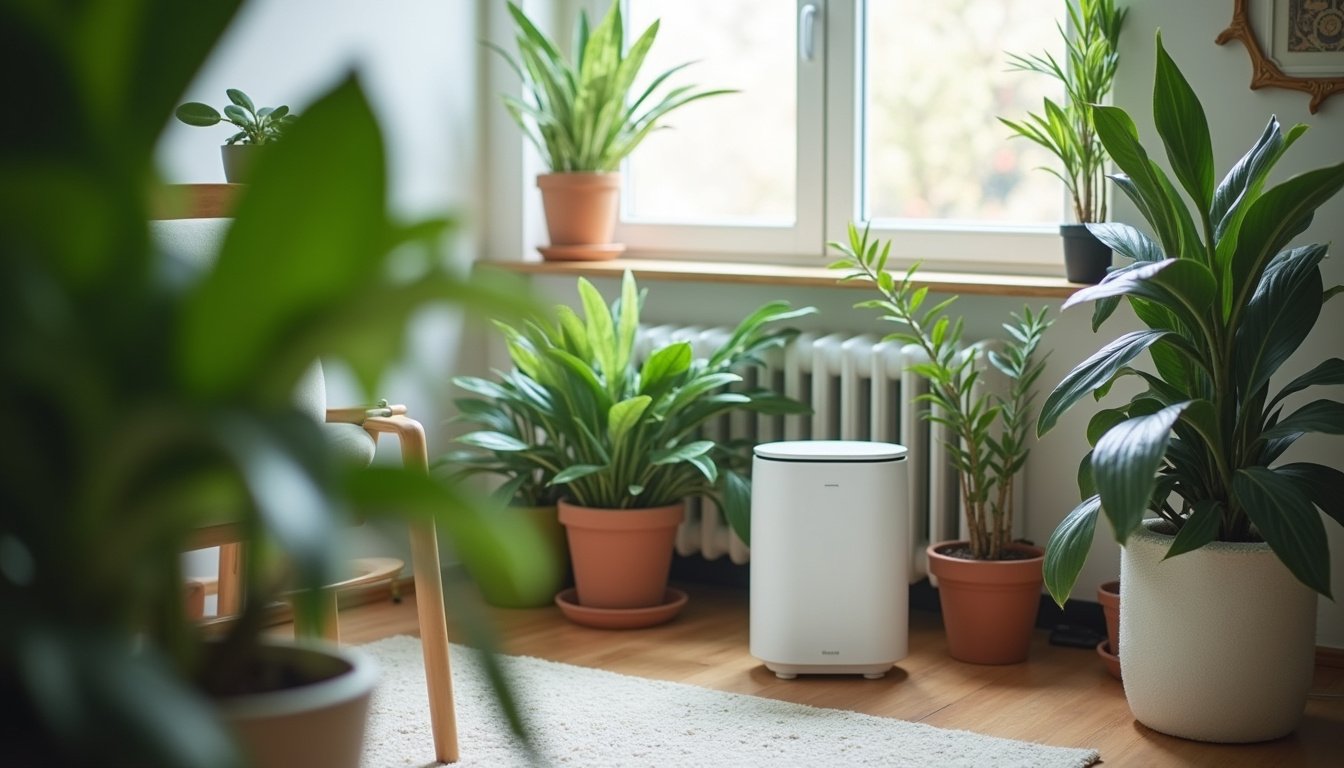
The idea that a few houseplants can clean the air in a home is one of the most durable pieces of indoor air folklore. It has a famous study behind it, a long list of recommended species, and the appeal of a solution that is green, quiet and pretty. The catch is that the study was done in sealed chambers, and homes are not sealed chambers.
Houseplants do remove some pollutants from air, in the sense that a leaf in a small sealed box will slowly lower the concentration of certain gases. In a real home, with its constant exchange of air with the outdoors and its steady production of new pollutants, the effect of any realistic number of plants is too small to measure. Research reviewing dozens of chamber studies concluded that it would take somewhere between ten and a thousand plants per square meter of floor to match the pollutant removal of a building’s ordinary ventilation. Plants also do nothing for particles, the dust, pollen, dander, smoke and spores that most people are trying to reduce. A filter-based air purifier with true HEPA media removes those particles at a rate measured by CADR, and one with a real carbon stage removes a meaningful share of odor and gas. Plants remain worth having for every other reason; air cleaning is not one of them.
In short: keep the plants because you like them, and buy a HEPA purifier because you want cleaner air. Expecting the plants to do the purifier’s job is where the folklore fails.
The EPA’s guide to air cleaners in the home does not list houseplants among effective air cleaning methods and notes that source control, ventilation and filtration are the approaches that work. The widely cited 1989 NASA study tested plants in small sealed chambers; a 2019 review in the Journal of Exposure Science and Environmental Epidemiology by Cummings and Waring quantified why those results do not translate to homes.
This article is research-based, drawing on the NASA chamber work, the 2019 review and EPA guidance, plus maker specifications for the purifiers in the comparison table, which we have not tested and for which we quote no prices or ratings.
Houseplants are a good idea if
- You want greenery, humidity in dry rooms and a pleasant space
- You enjoy caring for them
- You understand they will not change pollutant levels measurably
- You keep them free of mold and overwatering
Choose a HEPA purifier instead if
- Dust, pollen, pet dander, smoke or spores are the problem
- Someone has allergies or asthma triggered by particles
- You want a measurable, repeatable effect
- You want odor or VOC reduction, which needs carbon, not leaves
Key Takeaways
- The famous NASA plant study used small sealed chambers; homes exchange air constantly and the effect disappears.
- A 2019 review estimated it would take ten to a thousand plants per square meter to match normal ventilation.
- Plants do nothing for particles, which are what most indoor air complaints are about.
- A true HEPA purifier removes particles at a measurable rate, CADR, and a carbon stage removes some gases.
- Houseplants can add humidity and, if overwatered, mold; neither is purification.
- Plant-based gadgets with fans and pots are mostly ordinary filters or marketing; judge them by CADR.
- Keep plants for enjoyment; keep expectations for air quality with ventilation, source control and filtration.
Filter-Based Purifiers That Do What Plants Cannot
These widely reviewed units combine true HEPA with activated carbon and cover bedrooms through large living rooms. Compare the maker-listed CADR and room size against your space; a CADR figure is exactly the kind of measurable performance that no houseplant can offer.






How We Evaluated the Plant Claim
We read the original NASA chamber study and the 2019 review that reanalyzed chamber data in terms of clean air delivery rate, compared those figures with the air exchange of a typical home, and checked EPA guidance on what reduces indoor pollutants. For purifiers in the table we used maker specifications only.
The useful idea is to put plants and purifiers on the same scale. CADR, the volume of clean air a device delivers per minute, applies to anything that removes pollutants. Expressed that way, the comparison answers itself.
Where the Idea Came From
In 1989 NASA researchers studying life support for sealed space habitats placed common houseplants in small sealed chambers, injected gases such as formaldehyde, benzene and trichloroethylene, and measured how concentrations fell over 24 hours. Many plants, and the microbes in their potting soil, reduced the gases substantially. The study was careful and its conclusions were about sealed environments, where there is no other way for pollutants to leave.
Popular retellings dropped the sealed chamber part and kept the species list. Spider plants, peace lilies, snake plants and others became air purifying plants in articles, labels and nursery displays. The research itself never claimed a few pots would clean a living room, and later work explained why they cannot.
| Setting | Air exchange with outside | What happens to a pollutant | Effect of a few plants |
|---|---|---|---|
| Sealed test chamber, under 1 cubic meter | None | Only removal path is the plant and soil | Large and measurable |
| Closed bedroom, 30 cubic meters | Slow leakage; opens several times a day | Dilution and ventilation dominate | Too small to detect |
| Typical home | Roughly a third to a full air change per hour from leaks and doors | Ventilation removes pollutants many times faster than leaves | Negligible |
| Office or school | Mechanical ventilation | Even faster removal | Negligible |
What Later Research Found
In 2019, researchers at Drexel University reviewed a dozen published chamber studies and converted their results into clean air delivery rates, the same measure used for purifiers. The typical plant delivered a CADR for volatile organic compounds in the range of a few hundredths of a cubic meter per hour, while even a leaky home’s natural air exchange delivers tens to hundreds of cubic meters per hour. Their estimate was that matching ordinary ventilation would require between 10 and 1,000 plants per square meter of floor area, depending on the plant and the pollutant.
Worked example: a 12 by 15 foot bedroom is about 17 square meters. At the optimistic end of that range, matching the room’s own air exchange would take around 170 plants; at the pessimistic end, 17,000. A single potted purifier, as some products are marketed, cannot change that arithmetic.
Plants and Particles: No Effect
Most people who want cleaner indoor air are thinking about particles: dust on shelves, pollen in spring, pet dander, wildfire smoke, mold spores. Plants do not capture particles in any meaningful way. Leaves collect a little dust, which is why they need wiping, but that is settling, not filtration, and the dust is still in the room until the leaf is cleaned. The chamber studies measured gases only; even their optimistic results say nothing about particles.
A true HEPA filter captures 99.97 percent of particles at 0.3 microns under test conditions and is rated by AHAM for dust, pollen and smoke removal. A mid-size unit sized by the two-thirds rule, dust CADR of about two-thirds of the floor area in square feet, turns over a bedroom’s air several times an hour. There is no plant equivalent.
What Houseplants Genuinely Offer
None of this is a case against plants. They raise humidity slightly through transpiration, which can be welcome in dry winter rooms. They absorb some carbon dioxide and release oxygen in daylight, in amounts that are real but tiny next to a single open window. Many people find caring for plants and looking at greenery restful, and studies on attention and mood support that. Those are good reasons to keep them.
- Modest humidity increase in dry rooms, useful in winter but watch for condensation.
- Visual and psychological benefits that are well documented.
- A hobby that encourages opening windows and tending the space.
- Marginal CO2 uptake in daylight, with the reverse at night.
- Dust collection on leaves, which at least shows where dust is landing.
Keep them, enjoy them and water them carefully. Just do not count them as part of the air quality plan.
| Hoped-for benefit | What plants deliver | What actually delivers it |
|---|---|---|
| Fewer dust and pollen particles | Nothing measurable | True HEPA purifier sized by CADR |
| Lower VOCs from furniture or paint | Negligible in a ventilated room | Ventilation, airing items out, carbon stage |
| Better humidity in dry rooms | A slight increase | Humidifier with a hygrometer |
| Fresher-feeling, calmer space | Yes, well supported | Plants, light and tidiness |
| Lower CO2 | Marginal by day, reversed at night | Opening a window |
Plant-Based Air Purifier Products
A category of products pairs a plant with a fan, a pot and sometimes a filter, marketed as biological or living air purifiers. Some pull air through the potting soil on the theory that soil microbes degrade gases faster than leaves alone; a few include an ordinary filter. Evaluate them like any purifier: ask for a CADR figure for particles and a stated carbon amount for gases. If neither is published, assume the fan is doing little and the plant nothing measurable.
| Product type | What it actually does | How to judge it |
|---|---|---|
| Potted plant marketed as air purifying | Decor and slight humidity | Enjoy; expect no air quality change |
| Plant pot with a fan drawing air through soil | Moves a little air past microbes; small effect on some gases | Ask for CADR; likely tiny |
| Plant wall or green wall with fan | Larger version of the above; humidity and decor | Still no particle removal; check for mold |
| Plant pot with built-in HEPA or carbon filter | An ordinary small purifier with a plant on top | Judge by the filter’s CADR and carbon, not the plant |
| Fan plus true HEPA filter, no plant | Measurable particle removal | Size by the two-thirds CADR rule |
What to Use Instead
The EPA’s order of operations for indoor air is to reduce sources, ventilate and then filter, and each step does more than any number of plants.
- Source control: a vented range hood used on every burner, low-emission furniture and finishes, airing out new items before they come inside, no smoking indoors, sealed storage for solvents.
- Ventilation: open windows when outdoor air is good, run bathroom and kitchen exhaust fans, and consider the HVAC fan’s circulate setting with a pleated MERV 11 to 13 filter where the system allows.
- Particle filtration: a true HEPA purifier sized by CADR for the bedroom and main living area, run continuously.
- Gas and odor control: a purifier with a substantial activated carbon stage, by the pound, where cooking, pet or VOC odors are an issue.
- Moisture control: hold indoor humidity between 30 and 50 percent, as the EPA recommends, which limits mold and dust mites and, incidentally, keeps plant soil from growing mold.
Worked example: a renter moves into an apartment with new carpet and a lingering chemical smell, and buys six plants. After a month the smell is slightly less, because new materials off-gas less over time, not because of the plants. Opening windows for an hour a day would have cleared more in a week than the plants in a year, and a carbon-equipped purifier running continuously would have handled the rest.
Plants and Purifiers in the Same Room
There is no conflict between the two. A purifier near plants captures the dust that would otherwise settle on leaves and any mold spores from damp soil, which is a small service to the plants and the people. Keep the purifier’s intake clear of foliage and a foot from the pots so leaves do not block airflow, and keep plant misting away from the unit so the filter stays dry.
If a room is dry enough that plants struggle, note that a purifier does not change humidity either way; a small humidifier does, and both can run together with the hygrometer kept in the 30 to 50 percent band.
How to Read Air Purifying Plant Claims
Claims about air purifying plants rarely come with numbers, and when they do the numbers are chamber results. A few questions sort them out: Was the test in a sealed chamber or a real room? Was the pollutant a gas or particles? How many plants per square meter were used? Is a clean air delivery rate given, and how does it compare with ventilation? Honest answers lead back to the same place: plants are pleasant, and purification comes from somewhere else.
How to Clean Indoor Air Properly in 6 Steps
- Identify the problem: particles, odors or gases, or moisture. Plants address none of them measurably.
- Reduce sources: range hood, low-emission products, airing out new items, no indoor smoking.
- Ventilate when outdoor air is good and run exhaust fans in kitchens and bathrooms.
- Add a true HEPA purifier sized by the two-thirds CADR rule to the bedroom and main living area, run continuously.
- Add a carbon stage by weight if odors or VOCs are an issue, or a dehumidifier if humidity is above 50 percent.
- Keep the plants for enjoyment, water them carefully and wipe their leaves.
Do and Do Not
Do
- Keep houseplants for their real benefits.
- Judge any air cleaning claim by CADR.
- Fix sources and ventilate first.
- Use true HEPA for particles and carbon for odors.
- Keep soil surfaces dry and humidity at 30 to 50 percent.
Do not
- Do not rely on plants to clean air.
- Do not buy plant gadgets without a published CADR.
- Do not overwater pots in a sensitive household.
- Do not expect leaves to capture dust, pollen or smoke.
- Do not skip a purifier because a room is full of greenery.
Who Should Skip This
If you have no air quality complaint and simply like plants, skip the purifier question entirely and enjoy the greenery. Nothing here argues against houseplants; it argues against expecting them to filter.
If your problem is a specific pollutant, carbon monoxide, radon, gas smells or heavy VOCs from a renovation, skip both plants and purifiers as the first step. CO alarms, a radon test, the gas utility and ventilation address those, and no plant or portable device is a substitute.
Honest Limits
- Chamber studies are real science; the error is applying them to homes, not the studies themselves.
- Research on plant gadgets is limited and varies by product.
- Plants may offer small, hard-to-measure benefits for gases in very tightly sealed rooms; this does not extend to particles.
- A purifier cleans only the room it is in while running; it is a complement to ventilation, not a replacement.
- Carbon stages saturate and need replacement; plants do not, but they also do not do the job.
- No health claims are made for plants or purifiers; both are environmental measures.
When to See a Professional
See a doctor or allergist if indoor air seems to trigger symptoms; identifying the trigger decides which measure, filtration, moisture control or source removal, is worth pursuing. Nothing on this page is medical advice.
Call an HVAC professional before fitting a dense MERV 13 filter to an older system, a mold professional for growth over about 10 square feet including in plant soil or on walls behind planters, and for carbon monoxide or gas concerns use alarms, the utility and a licensed technician, not plants or purifiers.
Frequently Asked Questions
Do houseplants actually purify indoor air?
Not measurably in a home. Plants lowered certain gases in small sealed test chambers, but homes exchange air constantly, and a 2019 review estimated it would take 10 to 1,000 plants per square meter to match ordinary ventilation. Plants do nothing for particles such as dust, pollen and smoke.
What did the NASA plant study really show?
That common houseplants and their soil microbes reduced gases such as formaldehyde and benzene in small sealed chambers over 24 hours, for life support research in space habitats. It did not test real rooms or particles, and its authors did not claim a few pots would clean a home.
How many plants would I need to clean a room?
Far more than any room can hold. The 2019 Drexel review estimated 10 to 1,000 plants per square meter of floor to match normal air exchange for gases. A 12 by 15 foot bedroom is about 17 square meters, so hundreds to thousands of plants, and still nothing for particles.
Which plants are best for air purification?
None make a measurable difference in a home, so choose plants for light, care and appearance instead. Species lists from chamber studies, such as spider plants and peace lilies, describe performance in sealed boxes. For cleaner air use source control, ventilation and a true HEPA purifier.
Do plants remove dust or pollen from the air?
No. Leaves collect a little settling dust, which is why they need wiping, but that is not filtration and the dust stays in the room until cleaned. Dust, pollen, dander, smoke and spores are particles, and only a filter such as true HEPA removes them at a measurable rate.
Can houseplants make indoor air worse?
Sometimes. Overwatered soil grows mold and releases spores, damp pots raise humidity in small rooms, some fertilizers and pesticides add VOCs, and flowering plants release pollen. Keep soil surfaces dry, avoid flowering species indoors if anyone is allergic, and wipe leaves regularly.
Are plant-based air purifier gadgets worth buying?
Judge them like any purifier: ask for a CADR figure for particles and a stated carbon amount for gases. Pots with fans drawing air through soil have a small effect on some gases and none on particles. A pot with a built-in HEPA filter is just a small purifier with a plant on top.
What should I use instead of plants to clean the air?
Follow the EPA’s order: reduce sources, ventilate, then filter. A true HEPA purifier sized by the two-thirds CADR rule removes particles; a substantial carbon stage reduces odors and some VOCs; a vented range hood and open windows handle much of the rest.
Do plants help with odors or VOCs from new furniture?
Only trivially. New materials off-gas less over time on their own, and ventilation clears VOCs far faster than leaves. For lingering smells, air items out before bringing them in, open windows daily and run a purifier with a real activated carbon stage.
Is it fine to keep plants and a purifier in the same room?
Yes, and they coexist well. The purifier captures dust that would settle on leaves and any spores from damp soil. Keep foliage a foot from the intake, keep misting away from the unit so the filter stays dry, and hold humidity at 30 to 50 percent for both plants and people.
Bottom Line
Plants do not purify indoor air in any way you could notice, and the research that seemed to say otherwise was about sealed chambers rather than rooms with doors and windows. They do nothing for particles at all, and the number needed to affect gases in a real home runs into the hundreds per room.
That is no reason to give them up. Keep plants for greenery, a little humidity and the pleasure of tending them, and get cleaner air the way the EPA describes: reduce sources, ventilate, and run a true HEPA purifier sized by CADR, with real carbon if odors matter. The plants will look better in cleaner air too.
Related reading: What are the different types of air purifiers, What do air purifiers clean, Is it worth having an air purifier at home.
Sources
- NASA Technical Reports: Interior Landscape Plants for Indoor Air Pollution Abatement (1989)
- Cummings and Waring, Journal of Exposure Science and Environmental Epidemiology (2019): Potted plants do not improve indoor air quality
- EPA: Guide to Air Cleaners in the Home
- AHAM Verifide: Clean Air Delivery Rate