Last updated:
As an Amazon Associate we earn from qualifying purchases. This does not change what we recommend. See our affiliate disclaimer.
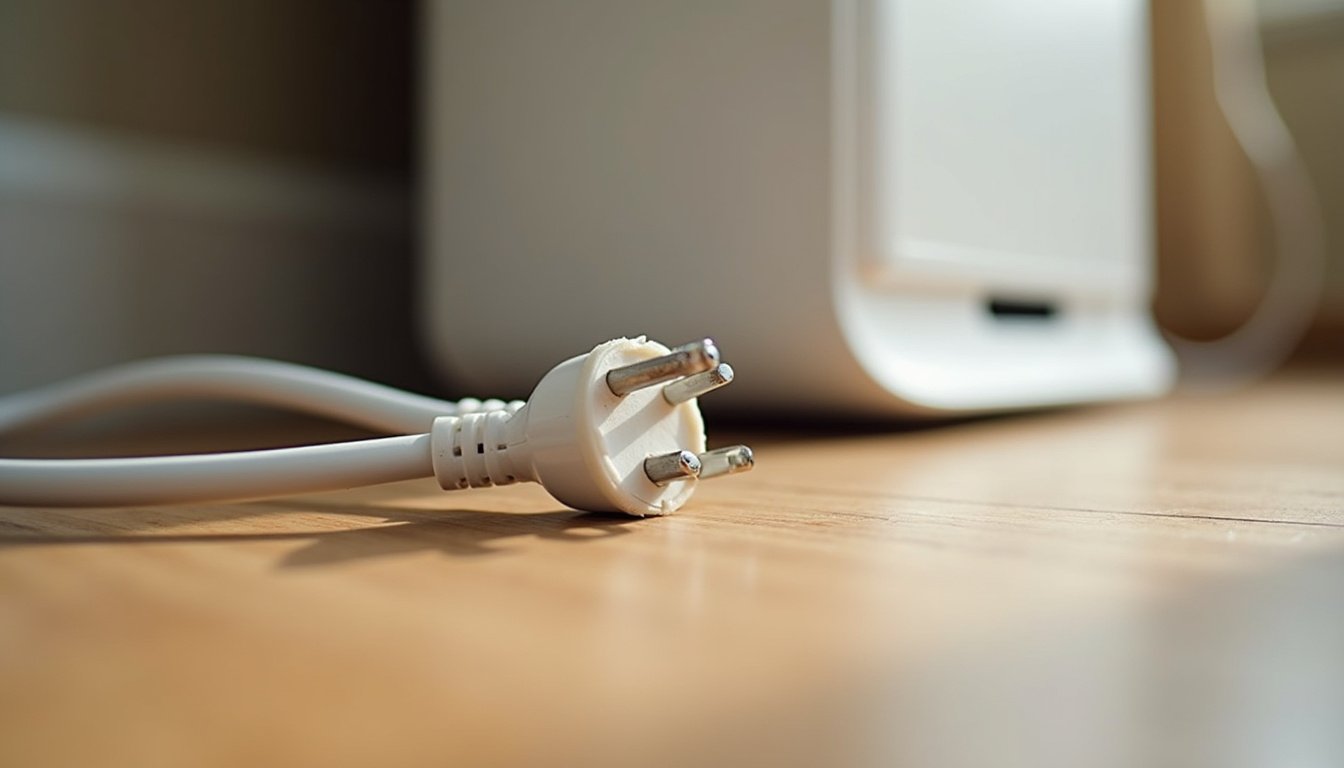
A purifier runs for years in one spot, its cord trapped behind a dresser, pinched under a chair leg or chewed by a puppy, and one day the unit flickers, cuts out when the cord is nudged or will not start. The cord is the most abused part of the appliance and the one carrying mains voltage, so fixing it is as much about safety as repair.
The safe way to fix an air purifier power cord is to replace it, not repair it. A cord that is cut, frayed, crushed, kinked, discolored, warm, or that works only at a certain angle has damaged insulation or broken conductors, and tape, heat-shrink or a splice does not restore the insulation rating or strain relief that keep mains voltage where it belongs. Safety bodies advise against using any appliance with a damaged cord and against splicing. What the fix looks like depends on the cord type. Many purifiers use a detachable cord or an external adapter that unplugs from the unit; those are replaced by ordering the maker’s part or a matching rated cord, a five-minute job. Units with a cord hard-wired into the housing need the maker or a qualified repairer, since the case must be opened and the internal connection and strain relief replaced; on most consumer units that is a warranty call or a replacement decision. The owner’s useful work is diagnosis, knowing whether the cord is the fault, and prevention, keeping the next cord out of harm’s way.
In short: inspect, do not splice. A detachable cord or adapter is swapped for the maker’s part; a hard-wired cord goes back to the maker. A damaged cord is unplugged and retired, not taped.
The CPSC and ESFI advise against using appliances with damaged cords and against repairing cords with tape or splices, since the insulation and strain relief cannot be restored. Maker manuals direct owners to replace detachable cords and adapters with the specified part and to contact the maker for hard-wired cord damage.
This guide is research-based, drawn from consumer electrical safety guidance and maker manuals. We have not tested the units in the comparison table and quote no prices or ratings.
Replace the cord or adapter when
- Insulation is cut, cracked, frayed or crushed anywhere along it
- The plug or adapter is discolored, melted, hot or has bent pins
- The unit flickers or cuts out when the cord is moved
- A pet has chewed it, even if no copper shows
Do not
- Tape, heat-shrink or splice a damaged cord
- Use a cord of lower rating or different polarity
- Open a sealed unit to replace a hard-wired cord yourself
- Keep using a cord that is warm at the plug
Key Takeaways
- A damaged power cord is replaced, never taped or spliced; the insulation and strain relief cannot be restored.
- Detachable cords and external adapters are swapped for the maker’s part or a matching rated cord in minutes.
- Hard-wired cords need the maker or a qualified repairer; opening a sealed unit voids the warranty and exposes mains wiring.
- Diagnose first: a unit that flickers when the cord moves, or a plug that is warm, points to the cord.
- Match voltage, current, polarity and connector exactly when buying a replacement adapter.
- A chewed cord is damaged even when no copper shows; the insulation is compromised.
- Route the next cord away from furniture legs, door swings, heat and pets.
Purifiers With Detachable Cords or Standard Adapters
These widely reviewed units take a detachable power cord or a standard external adapter, so a damaged cord is a part to order rather than a reason to retire the appliance. Check the maker’s parts listing for the exact cord or adapter specification.






How This Guide Approaches the Question
We looked at how cords fail, how to tell a cord fault from other no-power causes, what consumer safety guidance says about cord repair, and how each cord type is replaced. Product details in the table come from maker specifications.
The single most useful rule is that a cord is a consumable with a safety function, and when it is damaged the job is to swap it, not to save it.
How Purifier Cords Fail
Purifier cords live hard lives. They are routed behind furniture and crushed by it, pinched in door swings, run under rugs where they are trodden on, pulled from the wall by the cord rather than the plug, chewed by pets and bent sharply at the plug or where they enter the unit. Repeated flexing breaks the fine copper strands inside while the outer jacket looks fine, which is why a cord that works at some angles and not others is a classic sign. Crushing and chewing cut the insulation, which can expose conductors or let the two conductors touch and short.
| Damage | Cause | Sign | Risk |
|---|---|---|---|
| Internal strand breakage | Repeated bending at plug or unit entry | Works only at certain angles; flickers when moved | Arcing, heat |
| Crushed section | Furniture leg, door, rug traffic | Flat spot; stiff section; intermittent power | Short, heat |
| Cut or chewed jacket | Pets, sharp edges, vacuum | Exposed inner insulation or copper | Shock, short |
| Overheated plug | Loose outlet, loose plug, overload | Discolored or warm plug; scorch marks | Fire |
| Kinked cord | Tight wrapping for storage | Permanent bend; cracking jacket | Strand breakage |
| Adapter failure | Age, heat, surge | No LED; unit dead; adapter cold | Unit will not start |
Is It the Cord? Diagnosis Before Replacement
A dead purifier is not always a dead cord. Rule out the outlet with a lamp, bypass any power strip or smart plug, and check the filter cover interlock and child lock, which cause most no-power calls. Then look at the cord: unplug it, run your fingers slowly along its full length feeling for flat spots, bumps, stiff sections or cuts, and look closely at the plug pins and at the point where the cord enters the unit or the adapter. Plug back in and, with the unit running, gently flex the cord near the plug and near the unit; a flicker or cut-out on flexing is a cord fault. Feel the plug and adapter after fifteen minutes of running; warmth beyond slightly warm is a fault.
On units with an external adapter, the adapter has its own cord on both sides, and either can fail. A dead adapter with an indicator LED that does not light, when the outlet works, is a dead adapter. A cold adapter with the unit dead and no LED points the same way.
Why Tape and Splices Are Not a Fix
Electrical tape over a cut looks like a repair and is not one. The cord’s jacket is rated insulation designed to hold mains voltage safely for years through bending, heat and abrasion; tape is not, it loosens with heat and time, and a splice inside tape has no strain relief, so the next pull puts tension on bare wire joints. Heat-shrink alone does not restore a double-insulated cord’s rating either. Splicing two cords with connectors creates a joint that can loosen, arc and heat, hidden under furniture. Consumer safety bodies are consistent: a damaged cord is replaced. The exception that people cite, a cord-repair kit on a heavy extension cord, is a different product with a different construction and still not recommended for appliance cords.
| Attempted fix | Why it fails |
|---|---|
| Electrical tape over a cut | Not rated insulation; loosens with heat; no strain relief |
| Heat-shrink over damage | Covers but does not restore insulation; strands still broken |
| Splicing with wire nuts or crimps | Joint can loosen and arc; hidden under furniture |
| Cutting out the bad section and rejoining | Shorter cord under more tension; same joint problems |
| Replacing only the plug on a damaged cord | Fixes the plug, leaves the cord damage |
| Using a lower-rated or wrong-polarity adapter | Overheating or damage to the unit’s electronics |
Replacing a Detachable Cord
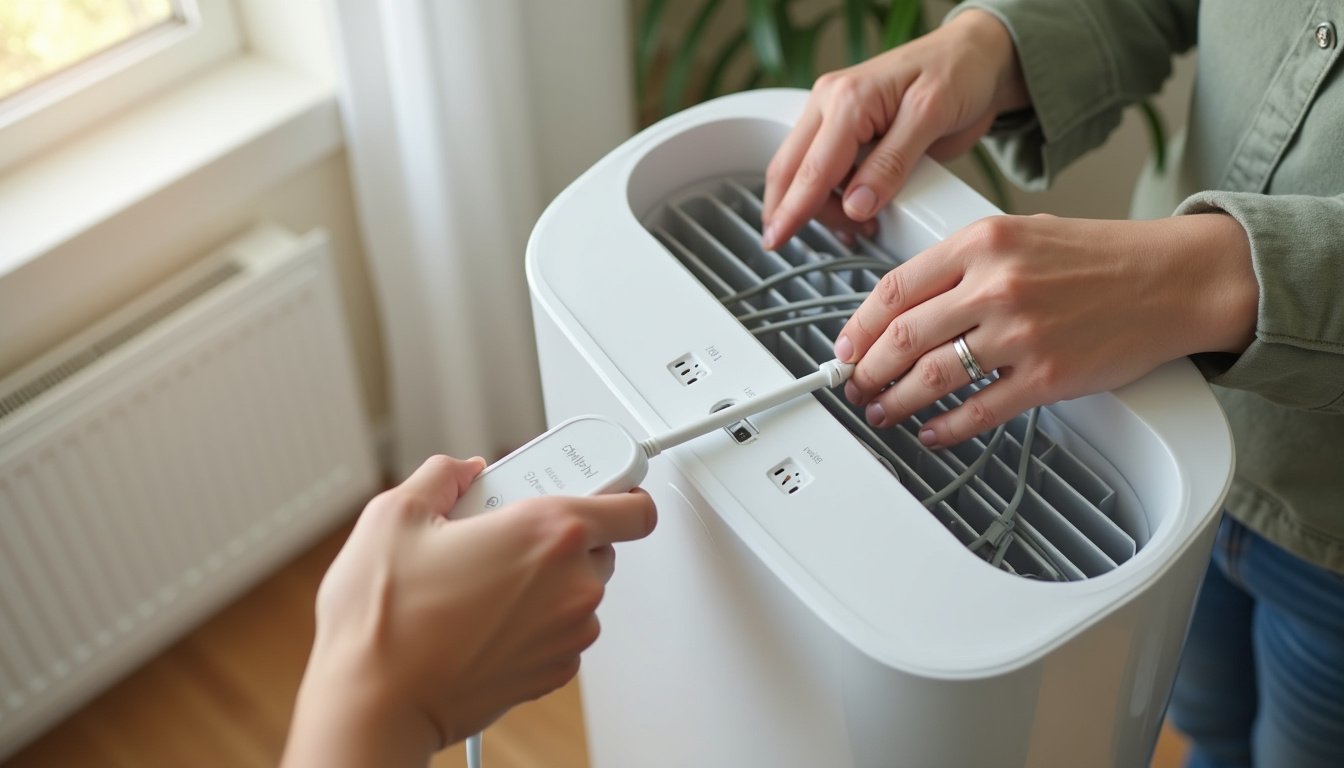
Many purifiers use a standard detachable cord that plugs into a socket on the unit, often a two-pin figure-8 connector or a three-pin cloverleaf, or a barrel plug from an external adapter. Replacement is a matter of matching the connector and the rating. The maker’s parts listing is the safest source; failing that, a cord with the same connector type, rated at or above the unit’s voltage and current, from a reputable supplier with a safety certification mark. Unplug the old cord from the wall first, then from the unit, fit the new one at the unit, then at the wall.
- Unplug the old cord from the wall outlet, then from the unit.
- Note the connector type at the unit end and the voltage and current on the unit’s rating label.
- Order the maker’s part, or a certified cord with the same connector rated at or above the label figures.
- Fit the new cord at the unit end until it seats fully.
- Route the cord clear of furniture, doors, heat and pets.
- Plug into the wall and confirm the unit starts and runs without flicker.
- Dispose of the old cord; do not keep it as a spare.
Replacing an External Power Adapter
Adapters must match on four points: output voltage, output current at or above the original, polarity of the barrel plug, and the plug’s size. The original adapter’s label lists all four, and the maker’s part number is the safe choice. A universal adapter set to the wrong voltage or polarity can destroy the unit’s electronics in seconds, and one with too little current overheats. Buy by the maker’s part number where possible; where not, match every figure on the label and buy from a supplier with a recognised safety mark.
Hard-Wired Cords: The Maker’s Job
Where the cord disappears into the purifier’s housing with a molded grommet, it is hard-wired to the internal power supply and replacing it means opening the case, disconnecting it from the board or terminal block, fitting a new cord with the correct strain relief grommet and closing the case to its original condition. On a sealed consumer appliance that is not an owner repair: it voids the warranty, exposes mains wiring, and the correct cord and grommet are rarely sold to the public. Contact the maker with the model and serial number and a description or photo of the damage. Under warranty, cord damage from normal use is often covered; out of warranty, the maker may offer a repair, or the decision becomes whether a repair is worth it against a new unit.
| Cord type | How to identify | Who replaces it |
|---|---|---|
| Detachable figure-8 or cloverleaf | Cord unplugs from a socket on the unit | Owner, with the maker’s part or a certified match |
| External adapter with barrel plug | Brick in the cord; small plug into the unit | Owner, with the maker’s adapter or an exact match |
| Hard-wired with grommet | Cord molded into the housing | Maker or qualified appliance repairer |
| Hard-wired with internal plug | Cord enters housing; not visible outside | Maker or qualified appliance repairer |
Worked example: a purifier’s hard-wired cord has a crushed section under a sofa leg and the unit cuts out when nudged. The owner photographs the damage, finds the unit is eighteen months into a two-year warranty, and contacts the maker, who sends a replacement unit on receipt of the old one. The alternative, cutting the cord and splicing, would have voided that and left a hidden joint under the sofa.
Protecting the Next Cord
Route the cord along a wall rather than across a walkway, and never under a rug, where it is trodden on and heat cannot escape. Keep it clear of furniture legs and door swings. Leave slack at the plug and at the unit entry so the cord is not bent sharply; a cord that comes straight down from the plug and curves gently is under less strain than one yanked sideways. Pull by the plug, never the cord. Keep it away from radiators and heaters, which embrittle the jacket, and from pets, using cord covers or a different placement if chewing is a habit. When storing or moving the unit, coil the cord loosely rather than wrapping it tightly around the housing.
How to Deal With a Damaged Purifier Cord in 6 Steps
- Unplug the unit and rule out the outlet, power strip, filter cover interlock and child lock as causes.
- Inspect the full cord, plug and adapter for cuts, crushing, chewing, stiffness, discoloration or heat; flex it gently while running to catch intermittent breaks.
- If damage is found, retire the cord: do not plug it in again, and do not tape or splice it.
- Identify the cord type: detachable, external adapter or hard-wired, from the connector at the unit.
- Replace a detachable cord or adapter with the maker’s part or an exact certified match on connector, voltage, current and polarity.
- For a hard-wired cord, contact the maker with the model, serial number and a photo; do not open the case.
Do and Do Not
Do
- Inspect the whole cord with the plug out of the wall.
- Replace damaged cords and adapters outright.
- Match the maker’s part number or every rating figure.
- Route cords along walls with gentle curves.
- Pull by the plug.
Do not
- Do not tape, heat-shrink or splice a cord.
- Do not use a warm or discolored plug.
- Do not run cords under rugs or across walkways.
- Do not use a universal adapter without matching voltage, current and polarity.
- Do not open a sealed unit to replace a hard-wired cord.
Who Should Skip This
If the cord is detachable and the maker sells the part, skip any thought of repair; the swap takes five minutes and restores the appliance to its certified condition.
If the unit is out of warranty, hard-wired, and the maker quotes a repair close to the cost of a new unit, skip the repair; a replacement unit comes with a new cord, new filters and a new warranty.
Honest Limits
- Cord and adapter specifications vary by model; the rating label and maker’s parts list are authoritative.
- Local electrical regulations may restrict appliance cord work to qualified persons.
- We cannot assess cord damage remotely; when in doubt, treat it as damaged.
- Third-party cords and adapters vary in quality; a recognised safety mark is the minimum.
- Nothing here covers house wiring, outlets or breakers, which are an electrician’s domain.
- Nothing here is a substitute for the maker’s instructions or electrical safety guidance.
When to See a Professional
Contact the maker for any hard-wired cord damage, for the correct replacement cord or adapter part number, and for warranty claims; opening the appliance yourself voids coverage and exposes mains wiring.
Call an electrician if the outlet is loose, scorched or warm, if the breaker trips, or if a plug has overheated, since the fault may be in the outlet or wiring rather than the cord.
Frequently Asked Questions
Can I repair an air purifier power cord with electrical tape?
No. Tape is not rated insulation, loosens with heat and time, and restores neither the cord’s insulation rating nor its strain relief, so a taped cut can arc and overheat hidden behind furniture. Consumer safety bodies advise replacing any damaged appliance cord. Retire the cord and fit the maker’s replacement or an exact certified match.
How do I know if the power cord is the problem?
Rule out the outlet with a lamp, bypass power strips, and check the filter cover and child lock first. Then unplug and run your fingers along the cord for flat, stiff or cut sections, inspect the plug and unit entry, and gently flex the cord with the unit running; a flicker means a cord fault.
Can I replace the cord myself?
If it is detachable or an external adapter, yes: unplug, note the connector type and rating label, order the maker’s part or an exact certified match, fit it and route it safely. If the cord is molded into the housing, no; that needs the maker or a repairer, and opening the case voids the warranty.
Where do I get a replacement cord or adapter?
The maker’s parts listing is the safe source, by model number. Failing that, a certified cord with the same connector rated at or above the unit’s voltage and current, or an adapter matching output voltage, current, polarity and plug size exactly, from a supplier with a recognised safety mark. Photograph the rating labels before ordering.
Can I use any universal adapter?
Only if it matches the original on output voltage, output current at or above the original, barrel polarity and plug size, all printed on the old adapter’s label. The wrong voltage or polarity can destroy the unit’s electronics, and too little current makes the adapter overheat. The maker’s own adapter removes the guesswork.
My dog chewed the cord but no copper shows. Is it still safe?
No. Teeth puncture and crush insulation in ways that are not visible, and the conductors inside may be damaged or close to touching. Treat a chewed cord as damaged: unplug it, retire it and replace it. Then move the unit or use cord covers so the new cord is out of reach.
The plug gets warm when the purifier runs. Is that normal?
Slightly warm after a long run can be normal; noticeably warm, hot, or discolored is not. Heat at the plug points to a loose fit in the outlet, a loose or damaged plug, or an overloaded circuit, and it is a fire precursor.
Does cord damage void my warranty?
Damage from normal use, such as a cord that fails at the plug from ordinary bending, is often covered; damage from crushing, chewing or misuse may not be, and any owner attempt to repair or splice the cord usually voids coverage outright.
What should I do with the old cord?
Dispose of it rather than keeping it as a spare, since a damaged cord that looks usable is a hazard waiting for the next person. Cut the plug off so it cannot be reused, and put it in household waste or an electrical recycling point where your area has one. Adapters go to electrical recycling.
How do I stop the new cord being damaged?
Route it along a wall, never under a rug or across a walkway, clear of furniture legs, door swings and heaters, with gentle curves at the plug and the unit so it is not bent sharply.
Bottom Line
Fixing an air purifier power cord means replacing it. A cut, crushed, chewed, stiff or warm cord has lost the insulation and strain relief that keep mains voltage contained, and tape, heat-shrink and splices do not give them back. Diagnose first, since outlets, strips, cover interlocks and child locks cause most dead units; then inspect the cord with the plug out and flex it while running to catch hidden breaks.
A detachable cord or adapter is a five-minute swap for the maker’s part or an exact certified match; a hard-wired cord is the maker’s job, and opening the case to do it yourself ends the warranty and exposes live wiring. Retire the old cord, route the new one along the wall with gentle curves, and check it at every filter change.
Related reading: Air purifier not turning on, Air purifier causing power outage, Air purifier replacement parts.