Last updated:
As an Amazon Associate we earn from qualifying purchases. This does not change what we recommend. See our affiliate disclaimer.
Cigarette smoke is the hardest common test an air purifier faces. It arrives as a cloud of extremely fine particles mixed with hundreds of gases, it keeps coming as long as someone is smoking, and the smell soaks into fabric, paint and dust so that a room keeps releasing it long after the last cigarette. Buyers who pick a purifier for smoke by filter grade alone are usually disappointed within a week.
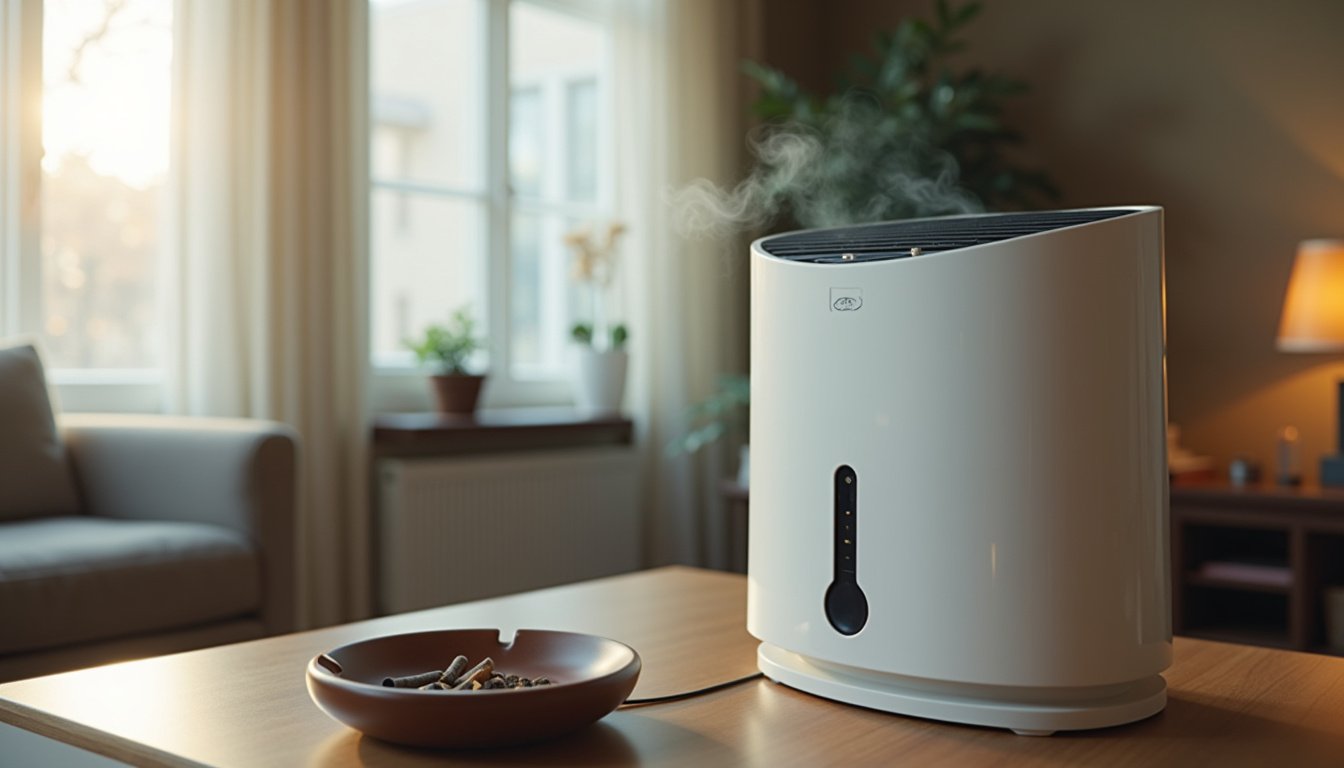
The best type of air purifier for cigarette smoke is a filter-based unit that does two jobs at once: a true HEPA stage for the particles and a substantial activated carbon stage for the gases and odor. Smoke particles are mostly between 0.1 and 1 micron, right in the range a HEPA filter rated for 99.97 percent of 0.3 micron particles handles well. The smell, tar vapors and irritant gases are not particles and pass straight through HEPA; only a thick bed of activated carbon, measured in pounds rather than a thin coated pad, adsorbs a meaningful share of them. The unit should be sized above the usual CADR rule because smoke is a continuous source, and it needs to run on a high speed while smoking happens and continuously afterward. No purifier of any kind makes indoor smoking safe or removes the residue in fabrics.
In short: true HEPA plus a heavy carbon bed, oversized for the room, run hard and constantly. And the only full fix is smoking outdoors.
The EPA’s guide to air cleaners notes that portable units with HEPA filters can reduce smoke particles and that gas-phase removal requires sorbent media such as activated carbon, with effectiveness depending on the amount. AHAM’s smoke CADR is the rating designed for this exact particle type, and the EPA, CDC and American Lung Association all state that no ventilation or filtration system eliminates the risks of secondhand smoke.
This guide is research-based, drawn from EPA, CDC and ALA material, AHAM’s CADR program and maker specifications. We have not tested the units in the comparison table and quote no prices or ratings, only published features relevant to smoke.
A purifier will help noticeably if
- Smoking happens in one room you can close off
- You choose true HEPA plus a heavy carbon bed
- You size the unit well above the room’s basic CADR target
- You run it on high while smoking and continuously after
Expect disappointment if
- You rely on a HEPA-only unit or a thin carbon pad
- Several people smoke throughout the home
- You expect it to remove the smell from curtains and carpet
- You hope it makes secondhand smoke exposure safe for others
Key Takeaways
- Smoke is particles plus gases; you need true HEPA for the first and a heavy activated carbon bed for the second.
- Use the smoke CADR rating and size above the usual two-thirds rule, since smoking is a continuous source.
- Thin carbon-coated pads saturate within weeks in a smoking room; look for carbon measured in pounds.
- Run on high during smoking and continuously afterward; smoke keeps off-gassing from surfaces for days.
- Thirdhand smoke residue in fabrics, carpet and paint is not removed by any purifier.
- Avoid ozone generators and ionizers; the EPA advises against ozone, and smokers’ lungs do not need another irritant.
- Smoking outdoors is the only measure that removes the problem rather than reducing it.
HEPA and Carbon Purifiers to Compare for Smoke
These widely reviewed units pair true HEPA with activated carbon and include large-room models suited to a smoking area. Compare the maker-listed smoke CADR and carbon stage against your room, and favor units with a thick carbon bed over a coated pad.






How We Approached Smoke
We separated cigarette smoke into its particle and gas components, matched each to the filter technology that addresses it, and applied AHAM’s smoke CADR and EPA guidance on sorbent media to sizing. Product details in the table come from maker specifications.
We also kept the health framing honest. Public health agencies agree that there is no safe level of secondhand smoke and that filtration reduces but does not eliminate exposure. This guide is about making a smoking room less unpleasant and reducing what drifts to the rest of the home, not about protecting anyone from the smoke itself.
What Cigarette Smoke Is Made Of
Cigarette smoke is an aerosol: billions of tiny liquid and solid particles suspended in a mix of gases. The particle fraction, visible as the gray haze, is mostly 0.1 to 1 micron in size, small enough to stay airborne for hours and to penetrate deep into lungs. The gas fraction includes carbon monoxide, formaldehyde, benzene, ammonia and many others, along with the semi-volatile tar compounds that carry the smell and later condense on surfaces.
Each fraction needs a different tool. Particles are what HEPA filters capture and what AHAM’s smoke CADR measures. Gases pass through HEPA entirely and need adsorption on activated carbon, and some, such as carbon monoxide, are not captured by carbon either. The tar compounds settle onto walls, fabric and dust and re-emit for weeks, which is why a smoking room smells even when nobody is smoking.
| Component | Form | Typical size | What removes it from the air |
|---|---|---|---|
| Smoke haze | Particles | 0.1 to 1 micron | True HEPA, sized by smoke CADR |
| Odor and tar vapors | Semi-volatile gases | Molecular | Thick activated carbon bed; source removal |
| Formaldehyde, benzene, other VOCs | Gases | Molecular | Carbon partially; ventilation; treated media for formaldehyde |
| Carbon monoxide | Gas | Molecular | Nothing in a purifier; ventilation |
| Residue on surfaces | Condensed film | n/a | Washing, repainting, replacing soft materials |
True HEPA for the Particles
A true HEPA filter is rated to capture 99.97 percent of 0.3 micron particles under test conditions, and smoke particles cluster right around that size. On each pass essentially all of them are caught. The limiting factor is how much smoky air the fan can pull through the filter per hour, which is the smoke CADR. A fresh cigarette can add particles faster than a small unit removes them, so capacity decides whether the haze clears in minutes or hangs for an hour.
HEPA-type and HEPA-like media let more fine particles through and are a poor choice here. Look for true HEPA or H13 and a gasketed housing so smoky air cannot slip around the filter. Expect the HEPA stage to load faster than in a non-smoking home; smoke particles are sticky and numerous, and a 12 month filter may be gray in six.
Activated Carbon for the Smell
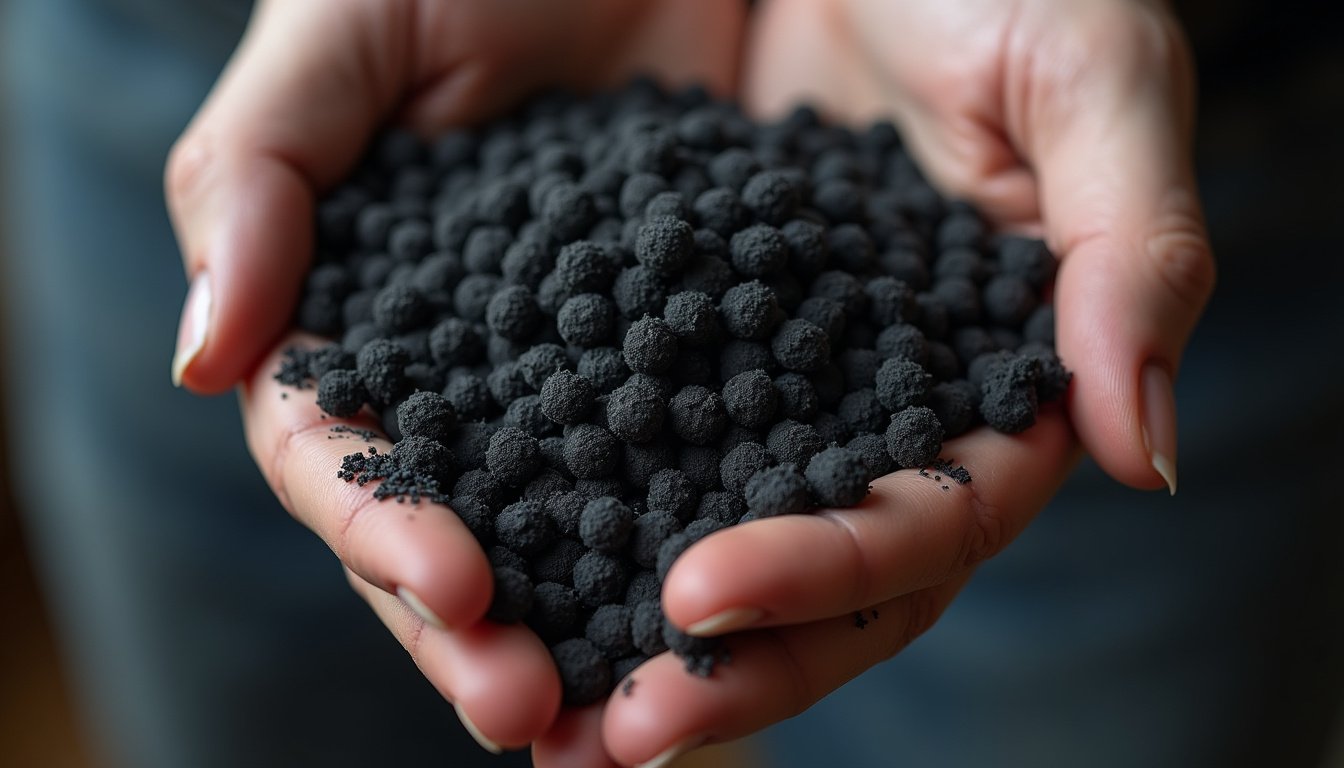
Activated carbon is charcoal treated to have an enormous internal surface riddled with pores. Gas molecules stick to that surface, a process called adsorption, which is how carbon removes odor compounds and a share of smoke VOCs. The catch is capacity: each gram of carbon holds a limited amount, and cigarette smoke delivers a heavy, continuous load. A thin fabric pad dusted with carbon is saturated in a few weeks in a smoking room and then does nothing for smell.
Units built for smoke and odor carry a pound or more of granular or pelletized carbon in a thick bed, sometimes several pounds in large units. Makers that take odor seriously state the carbon weight on the spec sheet. Some add treated media to improve capture of formaldehyde, which plain carbon holds poorly. Replace carbon on the maker’s schedule or sooner when the smell returns; in a smoking room that may be every two to three months.
| Carbon stage | What it does in a smoking room | How long it lasts |
|---|---|---|
| Coated fabric pad, a few ounces | Mild odor reduction for days to weeks | Saturates in weeks; replaced with the HEPA cartridge |
| Carbon sheet or honeycomb, under a pound | Noticeable reduction of light smoke odor | One to three months |
| Granular or pelletized bed, one to several pounds | Strong reduction of smoke odor and some VOCs | Three to six months, sooner with heavy smoking |
| Carbon plus treated media | Adds formaldehyde capture | Similar to the bed it is part of |
Sizing for a Continuous Source
The standard AHAM rule, a CADR of about two-thirds of the floor area in square feet, assumes an ordinary particle load. Smoking is a continuous, heavy source while it happens, so size above the rule using the smoke CADR figure specifically. A unit rated for a room twice the size is not overkill in a smoking room; it is what lets the haze clear quickly and the unit run on a lower, quieter speed between cigarettes.
Worked example: a den measures 14 by 16 feet, 224 square feet. The basic target is a smoke CADR of about 150. For a room where someone smokes several times a day, look for a smoke CADR of 250 to 300 or more, which is what a unit rated for a 400 to 450 square foot room typically delivers. Run it on high while smoking and for half an hour after, then continuously on medium or auto. Close the door so the unit is not trying to clean the hallway and the rest of the house.
Placement and How to Run It
Place the unit in the smoking room, within a few feet of where the smoking happens, with a foot of clearance around intake and outlet. Smoke rises and spreads, so a unit that draws air from the upper part of the room or sits on a low table rather than the floor often catches the plume sooner. Keep the door closed and, if the room has a window, open it slightly while smoking so the smoke has an exit rather than relying on the purifier alone.
- Run on high during smoking and for 30 minutes afterward, then continuously on medium or auto; smoke keeps off-gassing from surfaces for days.
- Keep the unit running at night; residue re-emits odor compounds continuously.
- Set auto mode cautiously: particle sensors see the haze and ramp up, but they cannot sense the gases, so they drop to low while the smell remains. A manual medium floor works better.
- Wipe the sensor inlet weekly; tar film fools sensors quickly.
- Clean the pre-filter every two weeks and inspect the HEPA stage monthly; expect shorter life than the maker’s figure.
Thirdhand Smoke: What No Purifier Reaches
Thirdhand smoke is the residue that condenses on surfaces: the yellow film on windows, the smell in curtains and upholstery, the tar in carpet and dust. It re-emits odor compounds for weeks or months and can react with indoor air to form new compounds. A purifier captures what re-emits into the air while it runs; it does not touch the reservoir in the materials themselves.
Reducing that reservoir is cleaning work. Wash curtains, bedding and washable fabrics in hot water. Shampoo or replace carpet and upholstery in a heavily smoked room. Wash walls and ceilings with a detergent solution and repaint with a sealing primer if the smell persists. Replace HVAC filters, since the system spreads smoke residue. Once the reservoir is reduced, the purifier’s carbon lasts longer and the room smells better faster.
Ventilation and the HVAC System
A purifier recirculates and cleans; ventilation replaces smoky air with outdoor air. A slightly open window with a small exhaust fan in the smoking room moves gases outdoors, including the carbon monoxide that no purifier removes. In cold weather this costs heat, but it is the only way to lower the gas fraction significantly while smoking is happening.
Forced-air heating and cooling can carry smoke particles and odor to every room. Close the supply and return registers in a smoking room if the system allows, or at least run the system less while smoking. Upgrading the HVAC filter to a pleated MERV 11 to 13 where the system supports it, as the EPA suggests, captures some particles for the rest of the house, though it does little for odor. Have the ducts and coil inspected if the whole home smells of smoke; residue in the system keeps re-emitting.
Technologies to Avoid for Smoke
Ozone generators are marketed heavily for smoke odor, and they do break down some odor compounds. They also fill the room with ozone, a lung irritant that the EPA advises against in occupied spaces, and they can create new irritant by-products from smoke residue. Ionizers make particles stick to walls and furniture, adding to the residue problem, and some produce ozone. UV lamps do nothing for smoke particles or gases. Scented filters and fragrance cartridges mask odor without removing anything.
| Technology | Claim for smoke | Reality | Verdict |
|---|---|---|---|
| True HEPA plus heavy carbon | Removes particles and odor | Well supported; capacity dependent | Use |
| HEPA only | Removes smoke | Clears haze; odor remains | Insufficient alone |
| Ozone generator | Destroys smoke smell | Ozone is an irritant; EPA advises against; by-products | Avoid |
| Ionizer | Removes particles | Particles stick to surfaces; possible ozone | Avoid |
| UV lamp | Purifies | No effect on smoke particles or gases | Irrelevant |
| Fragrance or scented filter | Freshens air | Masks odor only | Avoid |
Smoke From a Neighbor or a Previous Tenant
Many people shop for a smoke purifier because of someone else’s smoke: a neighbor’s balcony, a shared wall in an apartment, or a rental that reeks from a previous tenant. The same HEPA plus heavy carbon unit helps, and because the source is intermittent and lower than active indoor smoking, standard sizing by smoke CADR often suffices. Seal the pathways too: weatherstrip doors, caulk gaps around pipes and outlets on shared walls, and close windows on the smoky side when the neighbor is out there.
For a previously smoked-in rental, the residue is the problem and cleaning, repainting with a sealing primer and replacing carpet or soft furnishings do the heavy lifting. A purifier with real carbon speeds the remaining odor decline and is worth running continuously for the first weeks.
How to Choose a Smoke Purifier in 7 Steps
- Decide where smoking will happen and confine it to one room with a door; if it can move outdoors, that is the real fix.
- Measure the room and find the smoke CADR target: two-thirds of the floor area as a floor, then raise it well above for an active smoking room.
- Choose true HEPA or H13 with a gasketed housing.
- Choose a carbon stage measured in pounds, granular or pelletized, not a coated pad.
- Reject ozone generators, ionizers and fragrance features.
- Plan for frequent filter changes: inspect HEPA monthly, replace carbon when the smell returns.
- Pair the unit with a slightly open window, a closed door and cleaning of the residue in fabrics and on walls.
Do and Do Not
Do
- Use the smoke CADR figure and oversize the unit.
- Run on high during smoking and continuously afterward.
- Replace carbon as soon as odor returns.
- Wash fabrics and walls to shrink the residue reservoir.
- Keep CO alarms in a home where smoking happens indoors.
Do not
- Do not rely on HEPA alone or a thin carbon pad.
- Do not use ozone generators for smoke odor.
- Do not leave the smoking room door open.
- Do not trust auto mode to detect the smell.
- Do not expect any purifier to make secondhand smoke safe.
Who Should Skip This
If smoking can happen outdoors, skip the smoke-rated purifier and buy for the home’s other needs instead. Moving smoking outside removes the particles, the gases and the residue from the home entirely, which no purifier approaches, and a standard HEPA unit then handles the ordinary dust and dander.
If children, pregnant people or anyone with a lung condition shares the home, skip the idea that a purifier makes indoor smoking acceptable. Public health agencies are unanimous that it does not. The purifier can reduce odor and haze; it cannot provide safety.
Honest Limits
- No purifier removes carbon monoxide or all smoke gases; ventilation is the only route for those.
- Carbon has finite capacity and saturates quickly under a smoking load.
- Thirdhand residue in fabrics, carpet and paint is untouched by any purifier.
- A purifier cleans one room; smoke that leaves the room is beyond it.
- Filters load faster in smoking rooms, raising running costs.
- Reduced particles and odor do not equal reduced health risk from secondhand smoke.
When to See a Professional
See a doctor for any respiratory symptoms in a home where smoking occurs, and for support in quitting, which is the only measure that removes the problem; quitlines and physicians can help. A purifier addresses comfort and odor, not health risk. Nothing on this page is medical advice.
Call an HVAC professional if the whole home smells of smoke, since residue in ducts and on the coil re-emits continuously, and a professional cleaner or painter for heavy residue on walls and ceilings. Keep working carbon monoxide alarms on every level of any home where smoking happens indoors.
Frequently Asked Questions
What type of air purifier works best for cigarette smoke?
A filter-based unit with true HEPA for the particles and a heavy activated carbon bed, measured in pounds, for the gases and odor. Size it well above the room’s basic smoke CADR target because smoking is a continuous source, and run it on high while smoking and continuously afterward.
Does a HEPA filter remove cigarette smoke?
It removes the smoke particles, which cluster around the 0.3 micron size HEPA is rated for, so the visible haze clears. It does nothing for the smell and gases, which pass straight through. For odor you need a substantial activated carbon stage alongside the HEPA filter.
How much carbon does a purifier need for smoke?
More than a coated pad. Thin carbon-coated fabric saturates within weeks in a smoking room. Look for a granular or pelletized carbon bed of a pound or more, with the weight stated on the spec sheet, and plan to replace it every two to three months when smoking is frequent.
What size purifier do I need for a smoking room?
Start from AHAM’s rule, a smoke CADR of about two-thirds of the floor area in square feet, then raise it substantially. A 224 square foot den has a basic target of about 150; for active smoking look for 250 to 300 or more and run it on high while smoking.
Will an air purifier get rid of the cigarette smell in my house?
It reduces the smell in the air while running, if it has real carbon, but the odor also comes from residue in fabrics, carpet, walls and dust that re-emits for weeks. Washing fabrics, cleaning walls, repainting with a sealing primer and replacing soft materials remove that reservoir.
Can an air purifier make smoking indoors safe for my family?
No. The EPA, CDC and American Lung Association state that no filtration or ventilation system eliminates the risks of secondhand smoke. A purifier lowers particles and odor in one room; it does not make the air safe. Smoking outdoors is the only effective measure.
Are ozone generators good for smoke odor?
No. They do break down some odor compounds, but they fill the room with ozone, a lung irritant the EPA advises against in occupied spaces, and can create new irritants from smoke residue. Use true HEPA with a heavy carbon bed and clean the residue instead.
How often will I replace filters in a smoking room?
Far more often than the maker’s standard figures. Smoke particles are sticky and numerous, so a HEPA stage rated for 12 months may be gray in six; carbon saturates in two to three months with frequent smoking. Inspect the HEPA monthly and replace carbon as soon as odor returns.
Should I run the purifier on auto mode for smoke?
Not alone. Particle sensors see the haze and ramp up, but they cannot detect the gases and odor, so auto mode drops to low while the smell remains. Run on high during smoking and for 30 minutes after, then hold a manual medium speed continuously.
What helps with cigarette smoke from a neighbor?
The same HEPA plus heavy carbon purifier, sized by the normal smoke CADR rule since the source is intermittent, plus sealing the pathways: weatherstrip doors, caulk gaps around pipes and outlets on shared walls, and close windows on the smoky side when the neighbor is smoking.
Bottom Line
The best type of air purifier for cigarette smoke is the one that treats smoke as two problems: a true HEPA stage sized generously by smoke CADR for the particles, and a thick activated carbon bed for the gases and odor. Oversize it, run it hard while smoking and continuously after, replace the carbon as soon as the smell returns, and keep the smoking room door closed.
Then be honest about the limits. No purifier removes carbon monoxide, reaches the residue in curtains and carpet, or makes secondhand smoke safe for anyone else in the home. Cleaning the residue, ventilating and, above all, moving smoking outdoors do what filtration cannot.
Related reading: What type of air purifier is best for odors, What do air purifiers clean, Can one air purifier clean an entire house.